Starting a brand today feels more accessible than ever. Manufacturing partners are easier to find, digital marketing levels the playing field, and consumers are increasingly open to discovering new names. Yet, when founders take their first serious step into selling online, they face a crucial decision that shapes everything that follows: should they sell directly to consumers through their own website, or begin on established marketplaces?
This is not just a distribution choice. It is a decision about control, margins, customer relationships, scalability, and long-term brand value. Many early-stage founders underestimate how deeply this choice affects their operations and growth trajectory. Some rush toward marketplaces for quick visibility, while others invest heavily in building their own D2C channel without fully understanding the responsibilities that come with it.
For Indian MSMEs and emerging brands, the answer is rarely absolute. The right path depends on business goals, category dynamics, resources, and the kind of brand experience you want to build. Understanding the trade-offs clearly can help founders avoid costly pivots later.
Understanding the Two Paths: D2C and Marketplace
Before comparing, it’s important to understand what each route truly represents.
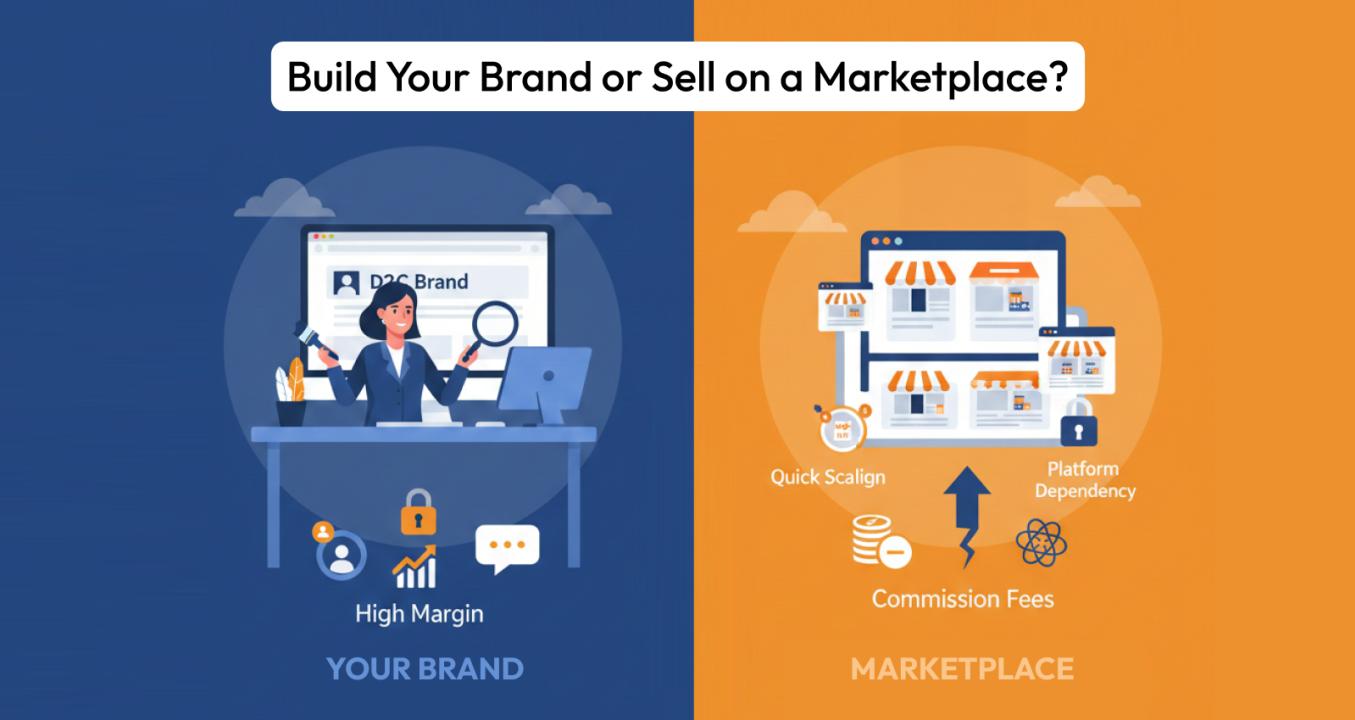
A D2C (Direct-to-Consumer) model means selling through your own ecommerce website. You control the storefront, customer data, pricing, branding, and communication. Every interaction happens within an ecosystem you own.
A marketplace model means selling through platforms like Amazon, Flipkart, Meesho, or similar aggregators. These platforms already have traffic, logistics networks, and payment systems in place. In exchange, they control customer access, pricing rules, and visibility.
At a glance, marketplaces feel easier. D2C feels more demanding. But the long-term implications go far beyond ease of entry.
Why Marketplaces Feel Attractive to New Brands
For first-time founders, marketplaces often appear to be the fastest route to sales. The infrastructure already exists, and customers are actively browsing.
Instant Access to Demand
Marketplaces remove the need to build traffic from scratch. Your products appear alongside established brands, and discovery is driven by platform algorithms rather than your marketing efforts.
Simplified Logistics and Payments
From warehousing to last-mile delivery, marketplaces handle much of the operational complexity. Payments, COD, refunds, and even customer support are often managed centrally.
Lower Initial Setup Effort
Listing products is faster than building a full-fledged ecommerce website. For brands testing product-market fit, this can be a practical starting point.
However, this convenience comes with hidden constraints that many founders only discover over time.
The Limitations of Marketplace-First Growth
While marketplaces can accelerate early sales, they also introduce dependencies that can limit long-term growth.
Limited Brand Control
On marketplaces, your brand lives inside someone else’s ecosystem. Product pages look similar across sellers, branding opportunities are minimal, and customer loyalty often belongs to the platform—not you.
Margin Pressure
Marketplace commissions, logistics fees, advertising costs, and discount pressures eat into margins. As competition increases, maintaining profitability becomes challenging.
Restricted Customer Relationships
Customer data is usually owned by the marketplace. You cannot freely remarket, personalize experiences, or build long-term relationships beyond the transaction.
Algorithm Dependency
Sales visibility depends heavily on platform algorithms. A small policy change or competitor price war can impact sales overnight.
For many founders, marketplaces become a growth channel—but not a foundation.
Why D2C Appeals to Brand Builders
D2C is often chosen by founders who want to build something lasting—not just sell products, but create a brand with identity and customer loyalty.
Complete Ownership of the Brand Experience
From website design and storytelling to packaging inserts and post-purchase communication, D2C allows brands to control every touchpoint.
Direct Customer Relationships
Owning customer data enables personalized marketing, repeat purchases, loyalty programs, and community building. Over time, this reduces dependence on paid acquisition.
Better Margin Potential
Without marketplace commissions, brands retain more control over pricing and profitability, even after factoring in marketing costs.
Long-Term Asset Creation
A strong D2C channel becomes a valuable business asset. Customer databases, brand equity, and operational systems compound over time.
That said, D2C is not effortless—and ignoring its challenges can slow growth.
The Operational Reality of Going D2C
Many founders romanticize D2C without fully preparing for what it demands.
Traffic and Marketing Responsibility
Unlike marketplaces, D2C requires you to generate your own traffic through SEO, ads, social media, influencers, or partnerships. This takes time and consistent investment.
Logistics and Customer Support
Shipping, returns, refunds, and customer queries are your responsibility. Without the right systems, operations can quickly become overwhelming.
Technology Decisions Matter
Your ecommerce platform becomes the backbone of your business—managing inventory, payments, taxes, and customer experience. Choosing the wrong setup can limit scalability.
This is where founders begin evaluating what they believe is the Best Ecommerce Platform, often without fully understanding their future needs.
D2C vs Marketplace: What Should You Choose at the Start?
The answer lies not in choosing one over the other blindly, but in aligning the route with your brand stage and goals.
When Marketplaces Make Sense
Marketplaces are often suitable if:
- You are testing product demand
- You want faster initial sales
- You have limited marketing budget
- Your category is highly search-driven
- You want to understand pricing sensitivity
They can act as a learning ground rather than a permanent home.
When D2C Makes Sense
D2C is better suited if:
- You want to build a recognizable brand
- You plan to invest in customer retention
- You want pricing and margin control
- You aim for long-term scalability
- You want flexibility to expand into B2B or wholesale later
Many successful brands eventually realize that owning the customer relationship is non-negotiable.
The Hybrid Path: A Practical Reality for Many Brands
In practice, many Indian brands don’t choose one route exclusively. They start on marketplaces to generate early revenue and credibility, while gradually building their D2C channel in parallel.
This hybrid approach allows brands to:
- Use marketplaces for discovery and volume
- Use D2C for brand building and retention
- Balance short-term cash flow with long-term equity
Over time, as the D2C channel strengthens, dependence on marketplaces can be reduced strategically.
Thinking Beyond D2C: Future Expansion and Wholesale
Many D2C brands eventually explore B2B, bulk orders, or distribution partnerships. At that stage, having systems that support both retail and wholesale becomes important.
Brands planning such expansion often look for infrastructure that can handle multiple buyer types, pricing models, and order workflows—something typically associated with the Best B2B Wholesale Ecommerce Platform capabilities.
Planning for this early avoids re-platforming later.
Choosing the Right Technology Foundation
Whether you start with D2C, marketplaces, or both, your technology choices should support flexibility. Your platform should not lock you into a single sales model or restrict how you scale.
For Indian MSMEs, platforms that combine D2C storefronts with scalable backend systems—such as Shopaccino—are often considered practical because they support brand-owned channels while remaining adaptable to future growth paths, without forcing a marketplace-first dependency.
Conclusion: Choose the Route That Matches Your Brand Vision
D2C and marketplaces are not opposing forces—they are tools. The mistake many founders make is treating one as universally superior without considering their own goals, resources, and long-term vision.
Marketplaces can offer speed and reach. D2C offers ownership and resilience. The smartest brands understand when to use each—and how to transition over time.
When starting a brand, the right question is not “Which is better?” but “Which aligns with what I want to build?” With clarity on that front, the route forward becomes far easier to navigate.