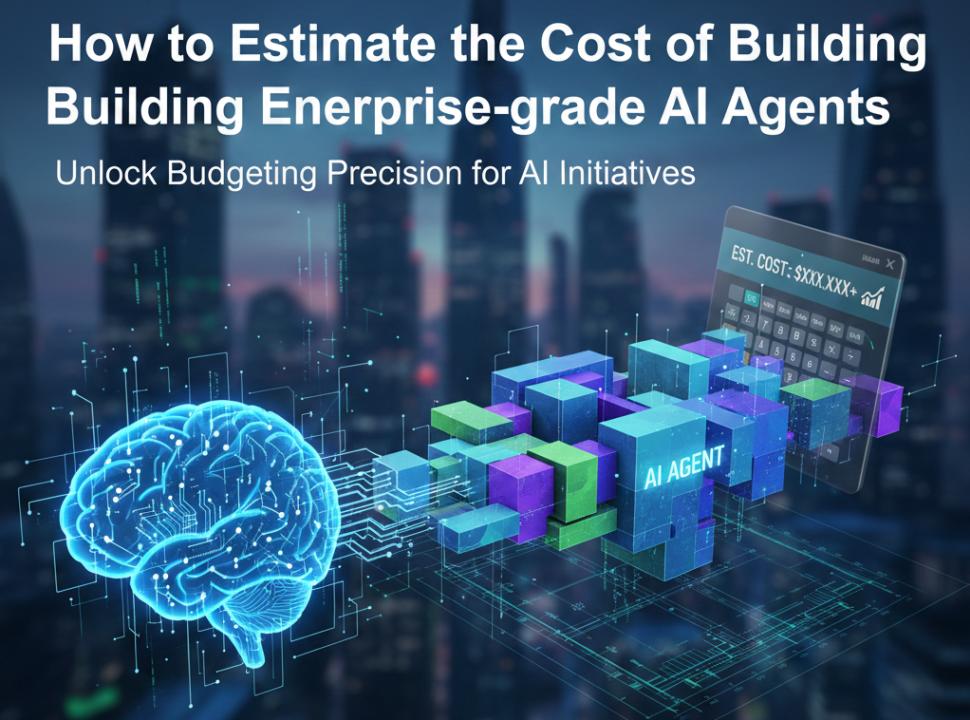
Enterprise leaders are no longer asking whether AI agents are useful. The real question is how much it costs to build them properly and what drives that cost. Budgeting for enterprise-grade AI agents is not comparable to pricing a simple chatbot or an internal automation script. These systems operate across business-critical workflows, integrate with sensitive data, and must meet strict expectations around reliability, security, and long-term scalability.
This article explains how enterprises and well-funded startups can realistically estimate the cost of AI Agent Development Services without guesswork. It focuses on practical cost drivers, trade-offs, and ROI considerations that matter at the board and CTO level.
Why cost estimation for AI agents is complex at the enterprise level
Enterprise AI agents are not standalone tools. They act as autonomous or semi-autonomous systems that reason, interact, and execute tasks across multiple platforms. Whether the goal is automating support operations, optimizing internal decision-making, or building advanced Conversational AI Agents, the architecture and scope expand quickly.
Costs increase because enterprises typically require:
- High accuracy and predictable behavior at scale
- Secure integration with internal systems such as CRMs, ERPs, and data warehouses
- Governance controls, auditability, and human-in-the-loop safeguards
- Ongoing optimization rather than a one-time deployment
According to industry research, enterprises that underestimate AI system complexity often face cost overruns of 30 to 50 percent during post-launch optimization phases.
Core factors that influence AI agent development cost
1. Scope and functional complexity
The first cost driver is what the agent is expected to do. A narrow agent handling a single workflow costs significantly less than a multi-agent system coordinating across departments.
Lower-complexity examples include internal task routing or basic knowledge retrieval. Higher-complexity use cases include autonomous workflow orchestration, cross-system decision-making, or real-time customer interaction with escalation logic.
More complex agents require additional planning, testing, and fallback mechanisms, which directly affect development time and cost.
2. Model strategy and AI architecture
Decisions around model usage have a major budget impact. Enterprises typically choose between proprietary large language models, fine-tuned open-source models, or hybrid approaches.
Key cost considerations include:
- Licensing or API usage fees for commercial models
- Infrastructure costs for hosting and scaling models
- Engineering effort required for fine-tuning or prompt optimization
Generative AI Agents that rely on advanced reasoning or long-context understanding usually require higher compute budgets and more extensive evaluation cycles. These costs are often recurring rather than one-time.
3. Data readiness and integration effort
AI agents are only as effective as the data they can access. In enterprise environments, data is often fragmented across systems with inconsistent formats and access controls.
Costs rise when teams must:
- Clean and normalize large datasets
- Build secure data pipelines
- Implement role-based access and logging
For many organizations, data preparation alone can account for 20 to 30 percent of the total AI agent budget.
4. Security, compliance, and governance requirements
Enterprise-grade agents must comply with internal security standards and external regulations. This includes data encryption, access monitoring, model behavior auditing, and compliance with regional data laws.
Implementing these safeguards adds engineering overhead but reduces long-term operational risk. Skipping governance early often results in costly rework later, especially in regulated industries such as finance, healthcare, or logistics.
5. Deployment scale and performance expectations
An AI agent used by a small internal team has different cost implications than one supporting thousands of users globally. Scalability affects:
- Cloud infrastructure and compute usage
- Load testing and performance tuning
- Monitoring and incident response systems
Enterprises should budget for peak usage scenarios, not average usage. This approach avoids performance degradation during critical business periods.
Typical cost ranges for enterprise AI agents
While exact numbers vary, most enterprise projects fall into broad ranges based on scope:
- Pilot or proof-of-concept: Lower six figures, focused on validating feasibility
- Production-grade single agent: Mid six figures, including integrations and governance
- Multi-agent enterprise system: High six figures to seven figures, depending on scale and complexity
Working with an experienced AI Agent Development Company helps enterprises align these investments with measurable business outcomes rather than experimental spending.
Build in-house or partner with specialists?
Many organizations debate whether to build internally or Hire Skilled AI Agent Developers through a specialized partner. In-house teams offer long-term control but require significant upfront investment in hiring, training, and infrastructure.
External partners bring:
- Established frameworks and deployment patterns
- Faster time to production
- Experience navigating enterprise risk and compliance
For most enterprises, a hybrid model works best. Internal teams define strategy and governance, while external experts execute complex implementation. This approach is often supported by targeted Generative AI Consulting during early planning phases.
Cost optimization strategies without cutting corners
Reducing cost does not mean reducing quality. Enterprises can manage budgets effectively by:
- Starting with a clearly scoped MVP tied to a business KPI
- Reusing existing data pipelines and infrastructure where possible
- Designing modular agent architectures that evolve over time
- Investing early in monitoring and evaluation to avoid costly failures
A phased rollout allows teams to validate ROI before committing to full-scale deployment. This is especially important when agents influence revenue, customer experience, or operational risk.
Estimating ROI alongside cost
Cost estimation should always be paired with value estimation. Enterprise AI agents typically deliver ROI through reduced operational workload, faster decision cycles, and improved consistency.
According to global enterprise AI surveys, organizations that link AI investment to operational metrics report faster payback periods and higher executive confidence.
When evaluating proposals for AI Agent Development Services, decision-makers should request clear assumptions around both cost and expected business impact.
Final thoughts for enterprise decision-makers
Estimating the cost of building enterprise-grade AI agents requires more than a line-item budget. It demands a clear understanding of scope, risk, and long-term ownership. Enterprises that treat AI agents as strategic systems rather than experimental tools are better positioned to control costs and extract lasting value.
Partnering with a proven development team and grounding decisions in realistic architecture planning can significantly reduce uncertainty. For organizations evaluating next steps, reviewing structured AI Agent Development Services offerings can provide clarity on timelines, investment levels, and delivery models.
When cost estimation is done right, AI agents become a predictable investment rather than an open-ended expense.