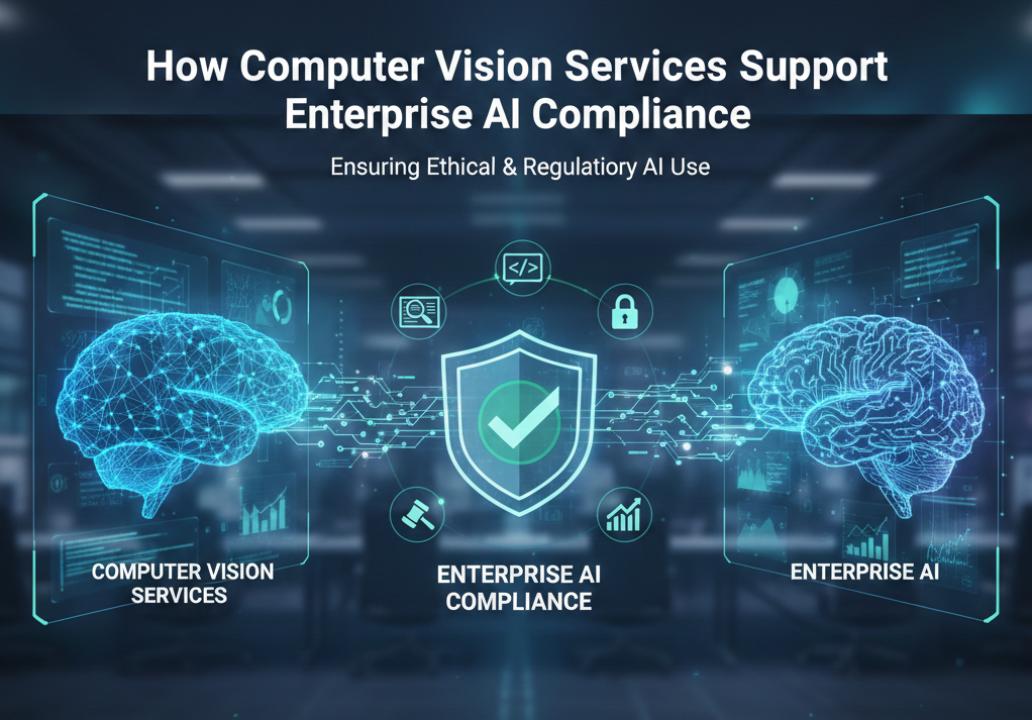
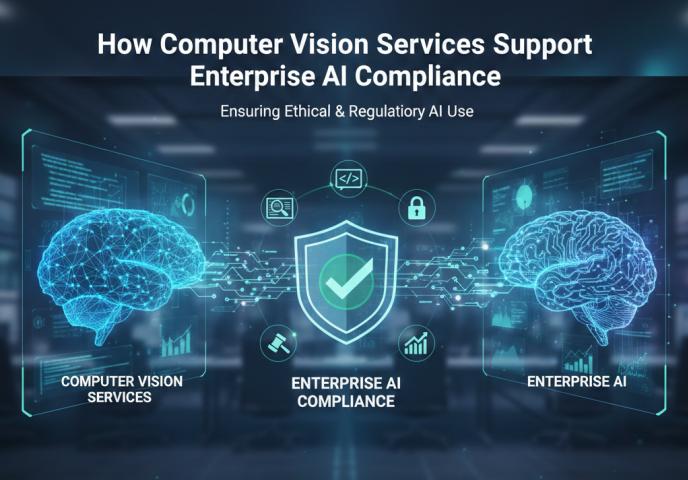
Artificial intelligence now sits at the core of enterprise transformation. From automated manufacturing floors to intelligent security systems and digital identity verification, AI-driven visual systems are becoming standard infrastructure. With this expansion comes a growing responsibility. Enterprises must prove that their AI systems follow data privacy laws, ethical AI principles, safety regulations, and operational governance frameworks.
Compliance is no longer handled through documentation alone. Regulators, auditors, and stakeholders expect continuous visibility into how AI systems behave. This is where Computer Vision Services create strategic value. By converting visual environments into structured data, AI computer vision enables enterprises to monitor operations, enforce rules, generate audit records, and reduce regulatory risk in real time.
For global enterprises and well-funded startups scaling AI adoption, computer vision solutions have become essential compliance infrastructure rather than optional innovation projects.
Why AI Compliance Has Become a Board-Level Priority
AI compliance requirements are expanding across every major market. Regulations now govern:
- Personal data protection and retention
- Automated decision accountability
- Workplace safety enforcement
- Biometric and facial recognition usage
- Ethical AI transparency requirements
Frameworks such as GDPR, sector-specific data protection laws, and upcoming AI governance regulations demand proof of responsible AI operations. Visual data introduces additional complexity since cameras, sensors, and video streams often capture sensitive or identifiable information.
Manual compliance monitoring cannot scale with modern AI deployments. Enterprises need systems that continuously observe, verify, and document real-world activity. Computer vision software fills this gap by providing objective, time-stamped visual evidence that policies are followed consistently across locations and teams.
The Role of Computer Vision Services in AI Governance
Modern Computer Vision Services extend far beyond image recognition. They deliver governance-ready intelligence from visual data streams.
A capable Computer Vision Company builds compliance features directly into system design, including:
- Secure visual data pipelines with encrypted storage
- Role-based access control for sensitive footage
- Automated data anonymization and masking
- Configurable data retention schedules
- Full logging of AI inference decisions
These features allow enterprises to prove how visual data is processed, who accessed it, and how decisions were generated. This level of traceability is critical when responding to regulatory inquiries or internal audits.
AI computer vision platforms also generate structured audit trails. Each detection event, alert, or automated decision is recorded with contextual evidence. When compliance teams need verification, they retrieve objective system logs instead of relying on manual reports.
Reducing Compliance Risk Through Automated Visual Oversight
Human-driven compliance enforcement is inconsistent by nature. Different teams interpret rules differently, and manual reporting often leaves gaps. Computer vision development services replace subjective judgment with consistent visual verification.
Common enterprise applications include:
Workplace safety monitoring
Visual AI verifies protective equipment usage, restricted-zone access, and safety procedure adherence. Violations trigger instant alerts and recorded evidence.
Quality and process inspection
Machine vision solutions detect defects, packaging errors, and labeling mistakes that could violate manufacturing or shipping regulations.
Facility and infrastructure monitoring
Visual systems ensure operational standards are maintained across factories, warehouses, energy plants, and logistics hubs.
Security and access compliance
Identity verification and intrusion detection tools support regulated access control policies with verifiable records.
Each use case replaces periodic manual checks with continuous enforcement. The result is fewer compliance breaches, faster incident response, and reduced exposure to penalties.
Privacy Protection in Visual AI Systems
Data privacy remains one of the most sensitive aspects of visual AI adoption. Enterprises must ensure that video and image data does not violate privacy laws or internal governance policies.
Leading computer vision consulting services implement privacy-by-design principles such as:
- Automatic face and identity masking
- Region-based anonymization in video feeds
- On-device processing to reduce data transmission risks
- Strict retention and deletion policies
- Encryption across storage and transfer layers
These practices allow enterprises to use visual intelligence without compromising personal data protection obligations. Compliance teams gain assurance that privacy safeguards are enforced at the system level, not left to manual processes.
Supporting Ethical and Explainable AI Requirements
Regulators increasingly demand transparency in how AI systems make decisions. This is especially important in applications such as security screening, identity verification, retail behavior analysis, and workforce monitoring.
Computer vision software now includes explainability layers that:
- Record why a visual detection occurred
- Store confidence scores for AI inferences
- Enable review of training datasets
- Support bias testing and model validation
Through computer vision development services, enterprises can demonstrate that their visual AI systems are fair, testable, and auditable. This strengthens trust with regulators, customers, and internal stakeholders.
Continuous Compliance Audits Through Real-Time Monitoring
Traditional compliance audits happen periodically. Visual AI enables continuous oversight.
Computer vision solutions observe environments in real time and generate automated compliance reports. Deviations from approved procedures trigger alerts with supporting visual evidence. This approach allows organizations to:
- Detect violations as they occur
- Reduce incident escalation time
- Maintain always-ready audit records
- Lower audit preparation costs
Regulatory expectations are shifting toward continuous risk management. Enterprises that deploy AI computer vision monitoring align naturally with these emerging standards.
Industry-Specific Compliance Applications
Different industries face distinct regulatory requirements. Computer vision adapts effectively across sectors.
Healthcare
Visual AI monitors hygiene compliance, patient safety procedures, and facility sanitation while maintaining patient privacy controls.
Manufacturing
Vision systems enforce equipment safety protocols, product quality standards, and worker compliance.
Logistics and transportation
Visual tracking verifies cargo handling rules, driver behavior standards, and hazardous material labeling.
Retail and finance
Identity verification and fraud detection tools support KYC and AML compliance with full auditability.
Across every industry, computer vision solutions replace fragmented manual oversight with consistent, data-backed governance.
Selecting the Right Computer Vision Partner
Not all vendors understand enterprise compliance needs. A qualified Computer Vision Company should provide:
- End-to-end computer vision consulting services
- Governance and data policy alignment
- Secure infrastructure and access controls
- Integration with enterprise IAM and audit systems
- Ongoing compliance monitoring support
The right partner helps organizations accelerate deployment while maintaining full control over compliance risk.
Business ROI Beyond Regulatory Alignment
Compliance investment often delivers broader operational returns.
Enterprises adopting computer vision solutions report:
- Lower manual inspection costs
- Reduced workplace incidents
- Faster audit cycles
- Fewer regulatory violations
- Improved operational transparency
Industry benchmarks highlight measurable reductions in compliance incidents after visual AI adoption.
Compliance becomes a strategic advantage rather than a cost obligation.
Preparing for Future AI Regulations
Global AI governance frameworks continue to expand. The EU AI Act, national data sovereignty laws, and sector-specific AI rules will increase compliance complexity. Enterprises implementing governance-ready computer vision software today will adapt faster as regulations evolve.
Future-proof visual AI platforms offer:
- Policy-driven configuration updates
- Modular privacy controls
- Transparent decision logging
- Scalable infrastructure for new compliance rules
This protects long-term AI investments while maintaining regulatory readiness.
Final Perspective
Enterprise AI success now depends on trust, accountability, and transparency. Computer Vision Services provide the tools to achieve all three. From privacy enforcement and ethical AI validation to continuous compliance monitoring and audit readiness, AI computer vision strengthens governance across large-scale operations.
Enterprises and ambitious startups that invest in professional computer vision consulting services and robust computer vision development services will operate with stronger regulatory confidence, lower risk exposure, and higher stakeholder trust.
In a business environment where compliance defines credibility, visual AI has become an essential foundation for responsible enterprise intelligence.