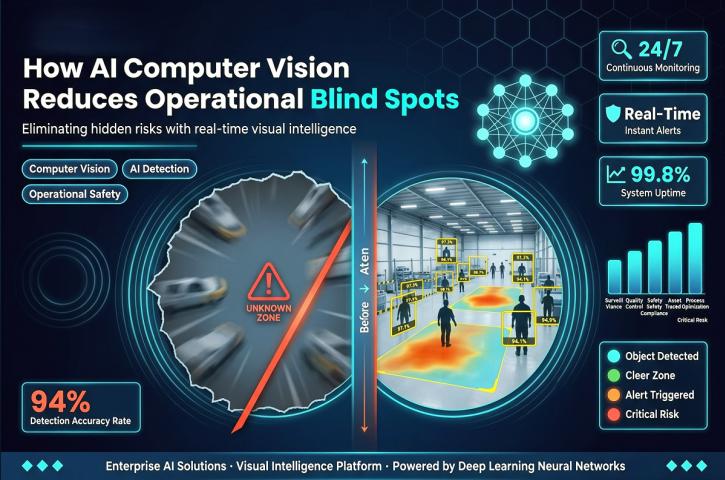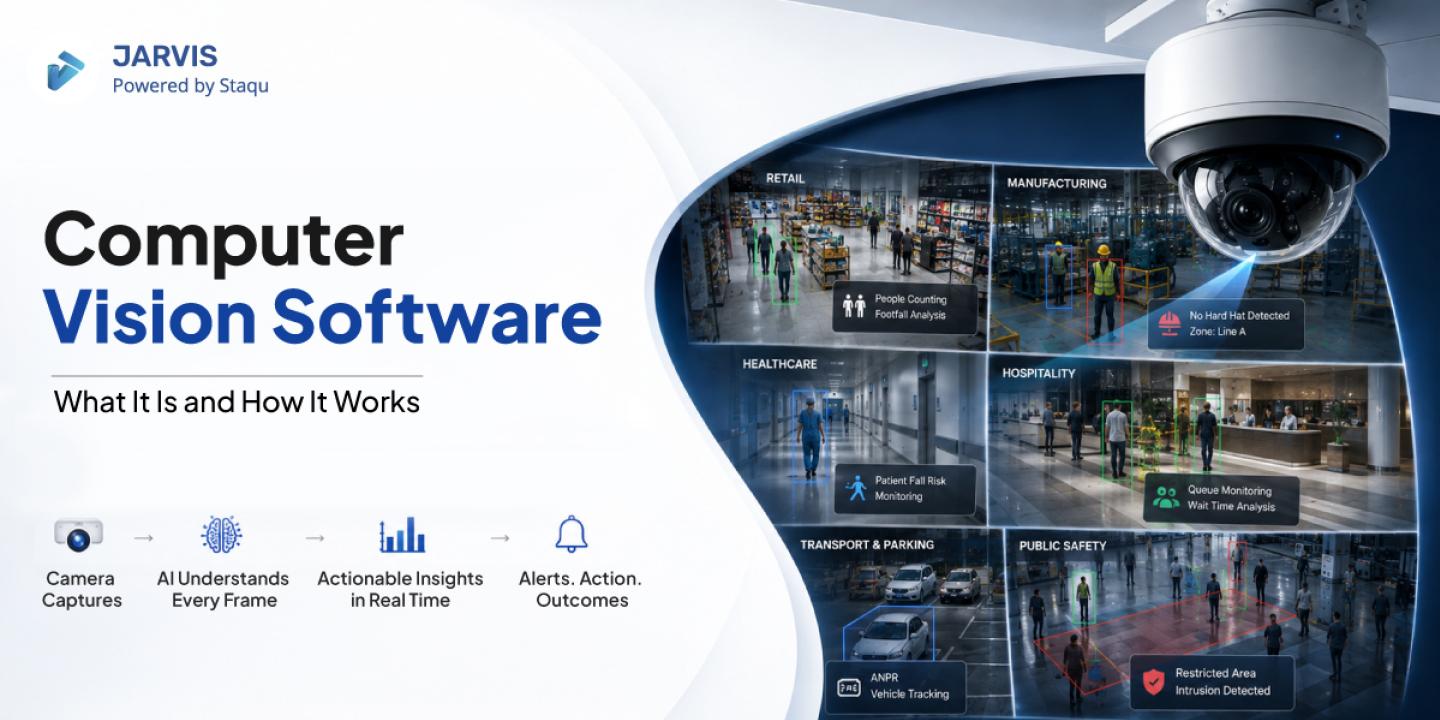
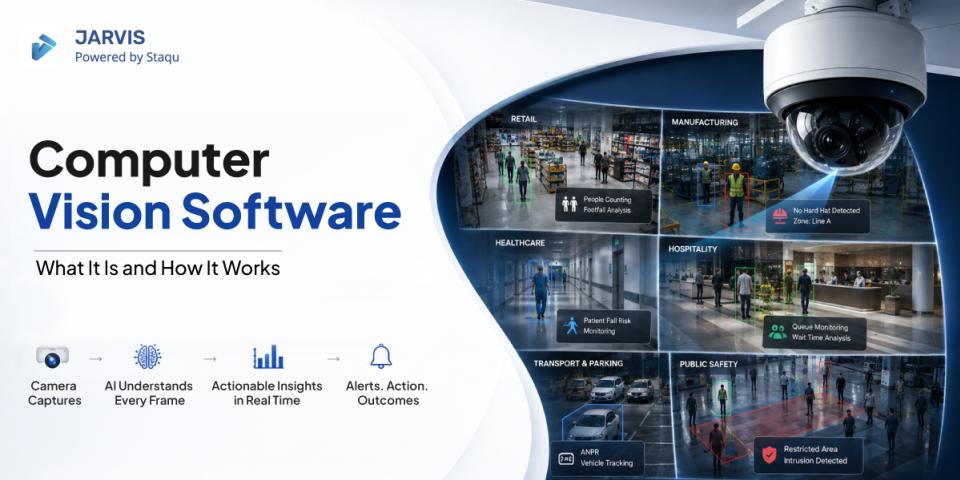
A camera pointed at a busy hospital corridor captures thousands of frames per minute. Each frame contains information, how many people are in the corridor, whether a patient is moving in a way that suggests fall risk, whether an unauthorised person has entered a restricted zone, whether a piece of equipment has been left in a walkway.
Without an analytical layer, all of that information sits in compressed video files on a storage server until someone needs it for post-incident review.
Computer vision software is the field of artificial intelligence that enables machines to extract understanding and insight from visual information captured by cameras. It is the difference between a camera that records and a camera that sees, classifying what is in each frame, tracking objects and people across frames, and delivering specific, actionable information to the relevant person in real time.
The global computer vision market is projected to grow to $59.8 billion by 2033, with the highest adoption in manufacturing, healthcare, retail, agriculture, and security, each with distinct speed, accuracy, and compliance requirements.
Understanding what computer vision software actually does, how it analyses video data, and what distinguishes enterprise-grade platforms from point solutions is what this blog covers, across the informational, commercial, and practical dimensions that anyone evaluating this technology needs to understand.
JARVIS by Staqu is a computer vision software platform deployed across enterprise security, government, retail, manufacturing, healthcare, and hospitality environments across India, the UK, the Middle East, South Africa, and the US.
The platform processes over 400,000 image frames per second, covers more than 50 use cases, and generates over 100 analytics data points simultaneously from existing camera infrastructure.
INC42 covered Staqu as part of its reporting on India’s AI and CCTV surveillance sector. Mint covered Staqu’s retail deployments in a feature on how Indian retail brands including Titan and Raymond are using AI to understand consumer behaviour in physical stores.
What Is Computer Vision Software?
Computer vision is the field of research and category of applications concerned with teaching machines to see. It involves using AI algorithms to process visual information from cameras and extract understanding and insight from it.
In practical terms, computer vision software takes a video or image feed as input and produces structured information as output. Instead of raw footage, the output is data: how many people are in a zone, whether a specific person matches a facial recognition database, whether a vehicle’s number plate is registered or flagged, whether smoke is developing in a monitored area, whether a worker in a manufacturing plant is wearing required PPE.
The software does this by running trained machine learning models on each frame of the video feed. Those models have been trained on large datasets of labelled images, pictures of faces, vehicles, objects, behaviours and have learned to recognise the visual patterns associated with each category. When the model encounters a frame, it applies what it has learned to classify what it sees.
What makes computer vision software practically useful in enterprise environments is not just the classification capability. It is the real-time delivery of alerts when specific classifications occur, a flagged individual entering a premises, a production line deviation, a patient moving in a way that suggests fall risk, while the situation is still developing and a response is still possible.
How Computer Vision Analyses Video Data?
The process from camera feed to actionable output moves through four stages.
Capture:
The camera generates a continuous stream of image frames, typically 15 to 30 frames per second for standard IP cameras. Each frame is a snapshot of the monitored environment at a specific moment.
Pre-processing:
The raw frame is prepared for analysis. This may include noise reduction, contrast adjustment, resolution normalisation, and region-of-interest cropping, focusing the analytical processing on the parts of the frame most relevant to the detection task.
Inference:
The pre-processed frame is passed through the trained model. Core techniques include object detection, object tracking, image recognition, image segmentation, pose estimation, optical character recognition, and pattern recognition, most powered by convolutional neural networks. The model produces a classification output: what objects are present, where they are in the frame, what they are doing, and whether any conditions match defined alert criteria.
Alert generation:
When the inference output matches a defined condition, a person present in a restricted zone, a vehicle with a flagged registration, smoke in a monitored area, an alert fires to the relevant operator or system. The alert includes the camera feed, the specific detection, the confidence score, and a timestamp.
Processing visual data directly on the device where it is captured, using edge AI, reduces bandwidth costs and enables faster action. Computer vision use cases ranging from security systems to factory monitoring benefit from this ability to process data in near real-time.
The distinction between cloud processing and edge processing matters for enterprise deployments with data governance requirements. Edge-based processing keeps video data local, generating only metadata, detection events, timestamps, confidence scores, rather than transmitting raw footage to a remote server.
For healthcare environments with patient privacy obligations, government facilities with data sovereignty requirements, and financial institutions with regulatory constraints, edge deployment is often the architecturally correct choice.
Core Techniques: What the Software Is Actually Doing
Understanding the specific techniques that computer vision software uses helps clarify what any given platform can and cannot do.
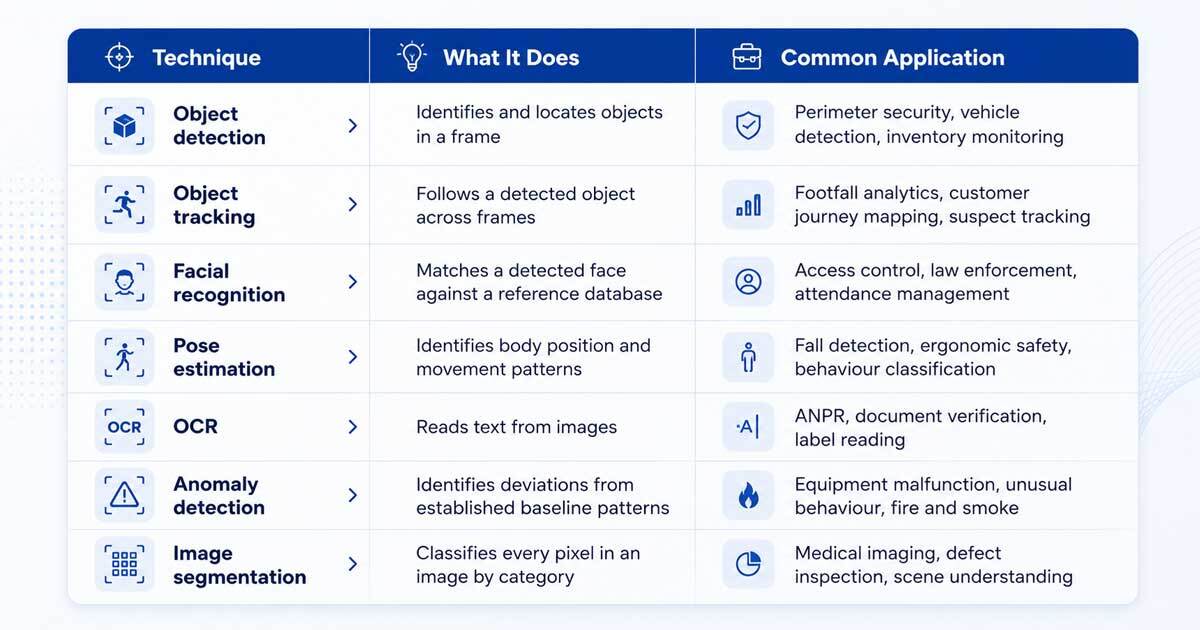
Each of these techniques has specific accuracy characteristics, computational requirements, and optimal deployment conditions. Enterprise computer vision software typically combines multiple techniques simultaneously, running facial recognition, object tracking, and anomaly detection from the same camera feed rather than requiring separate systems for each function.
Discover how enterprise computer vision software transforms existing CCTV into actionable insights. Book a Demo.
Real-World Applications Across Industries
Healthcare:
In healthcare, computer vision software assists in diagnostic automation, patient monitoring, and safety compliance. In clinical environments, specific applications include patient fall detection from ward cameras, OPD queue monitoring, clinical protocol compliance verification, and restricted zone access monitoring. The operational value is continuous monitoring of patient environments that staffing ratios alone cannot sustain.
Manufacturing:
Computer vision on the production floor monitors PPE compliance continuously, detects fire and smoke development earlier than sensor-based systems, tracks vehicle movements at facility gates through ANPR, monitors conveyor belt throughput and product positioning, and flags perimeter intrusions. The same camera network that handles security monitoring simultaneously generates production analytics.
Retail:
Retailers use computer vision to track inventory, monitor customer behaviour, prevent theft, and improve store layout decisions. Footfall counting at over 99 percent accuracy, zone-level heatmaps showing where customers go and how long they stay, conversion rate tracking by hour and zone, queue monitoring at checkout, and loss prevention through POS comparison and facial recognition alerting.
Enterprise security:
Security systems use computer vision to identify threats in real time, scan crowds for signs of potential problems, and monitor facilities for intruders. Abandoned object detection, suspicious activity classification, blacklisted person identification through facial recognition, and perimeter intrusion detection, all operating continuously from existing cameras.
Government and public safety:
The most demanding computer vision deployments globally are in law enforcement and public infrastructure. Crowd density monitoring at large public events, facial recognition against criminal databases, ANPR for vehicle intelligence at city scale, and multi-source intelligence platforms that integrate video with audio, text, and document analysis.
What to Look for in Enterprise Computer Vision Software?
For organisations evaluating computer vision software for enterprise deployment, the criteria that separate platforms delivering genuine operational value from those that underperform in real-world conditions:
- Accuracy on diverse, real-world datasets:
Benchmark accuracy in controlled conditions does not predict operational performance in variable lighting, crowded scenes, or challenging camera angles. Request evidence of performance in deployment environments similar to your own. - Camera agnosticism:
Enterprise-grade computer vision software should connect to existing IP cameras regardless of manufacturer, age, or resolution. Any platform requiring hardware replacement significantly increases total cost of ownership and extends the deployment timeline. - Edge and cloud deployment flexibility:
Different deployment contexts have different data governance requirements. A platform that supports both edge and cloud processing and hybrid configurations, adapts to the specific constraints of each deployment rather than imposing a single architecture. - Multi-use-case coverage from a single platform:
The operational cost of managing separate systems for facial recognition, footfall analytics, fire detection, and ANPR compounds across a large enterprise estate. Platforms covering multiple use cases from the same camera network on the same dashboard deliver better total cost of ownership and simpler operational management. - Real-time alert latency:
The commercial value of computer vision software is in the intervention window it creates. A system that detects a fall risk and delivers the alert to the ward nurse in under one second creates a genuinely different clinical outcome from one that delivers the same alert in thirty seconds. - Integration with existing security infrastructure:
Computer vision software that operates in isolation from existing security management platforms requires manual correlation of alerts from multiple systems. Platforms that integrate with existing VMS, access control, and incident management systems deliver more operationally coherent security intelligence.
JARVIS by Staqu: Computer Vision in Live Enterprise Deployments
JARVIS by Staqu delivers computer vision software across more than 50 use cases from a single camera-agnostic platform covering retail, manufacturing, healthcare, hospitality, government, and public safety environments.
The platform processes over 400,000 image frames per second with sub-second alert latency. It supports cloud, edge, and on-premise deployment. It connects to any existing IP camera without hardware replacement. And it has been deployed at government scale, across eleven Indian state police forces, all 71 UP Prisons, and major public events including IPL matches at M. Chinnaswamy Stadium in Bengaluru, in environments where the operational requirements are considerably more demanding than standard commercial deployments.
Mint covered Staqu’s retail computer vision deployments in a feature on AI adoption in Indian retail, specifically highlighting deployments across fashion and life>
For enterprise security teams, facility managers, and technology decision-makers evaluating computer vision software companies, the most relevant credibility signal is not the feature list. It is the deployment record in environments that match the operational demands of the organisation doing the evaluation.
More from JARVIS by Staqu Technologies
Best Video Analytics Software That Helps Businesses Understand Shopper Behaviour
Why Every Retail Store Needs Retail Store Analytics Software?
Frequently Asked Questions
Q1. What is computer vision software and how does it work?
Computer vision software uses AI algorithms to process visual information from cameras, classifying objects, tracking movement, recognising faces, reading text, and detecting anomalies in real time. It transforms raw camera footage into structured data and actionable alerts. The core techniques include object detection, object tracking, facial recognition, pose estimation, and anomaly detection, typically powered by convolutional neural networks trained on large labelled image datasets.
Q2. What are the real-world applications of computer vision software in enterprise security?
Enterprise security applications include real-time perimeter intrusion detection, facial recognition for access control and blacklisted person identification, abandoned object detection, suspicious activity classification, ANPR for vehicle management, crowd density monitoring, and fire and smoke detection, all from existing cameras. JARVIS by Staqu delivers these across enterprise environments in India, the US, the Middle East, the UK, and South Africa from a single integrated platform.
Q3. Which companies provide real-time computer vision solutions for enterprise security?
Leading platforms include JARVIS by Staqu for multi-sector enterprise and government deployments, Milestone Systems for open-platform VMS integration, BriefCam for forensic video search and post-event investigation, Genetec for unified security management, and Avigilon for tightly integrated physical security ecosystems. The right choice depends on the specific use cases required, existing camera infrastructure, data governance constraints, and the deployment environments involved.
Q4. What is the difference between edge and cloud computer vision software?
Edge computer vision processes video data locally on the camera or a connected edge device, generating only metadata without transmitting raw footage. Cloud computer vision sends footage or frames to remote servers for processing. Edge deployment is preferable for data-sensitive environments healthcare, government, financial services, where raw footage cannot leave the premises. Cloud deployment suits centralised analytics across multiple sites where connectivity is reliable and data governance permits remote processing.
Q5. Is JARVIS computer vision software available outside India, in the US, Middle East, UK and South Africa?
Yes. JARVIS by Staqu is deployed across enterprise, government, and public infrastructure environments in the US, the Middle East, the UK, and South Africa alongside its extensive India deployment base. The platform supports cloud, edge, and on-premise configurations and connects to existing camera infrastructure without hardware replacement across all five markets.
Enterprise intelligence starts with understanding what your cameras already see. Book a 15-Minute Demo.