A clear, fact-checked guide to avoid expensive mistakes
Solar energy is a smart investment—but misinformation causes many homeowners to lose money, underperform on savings, or regret system choices. This article breaks down the most common solar myths, explains why they are wrong, and shows the real financial impact of believing them.
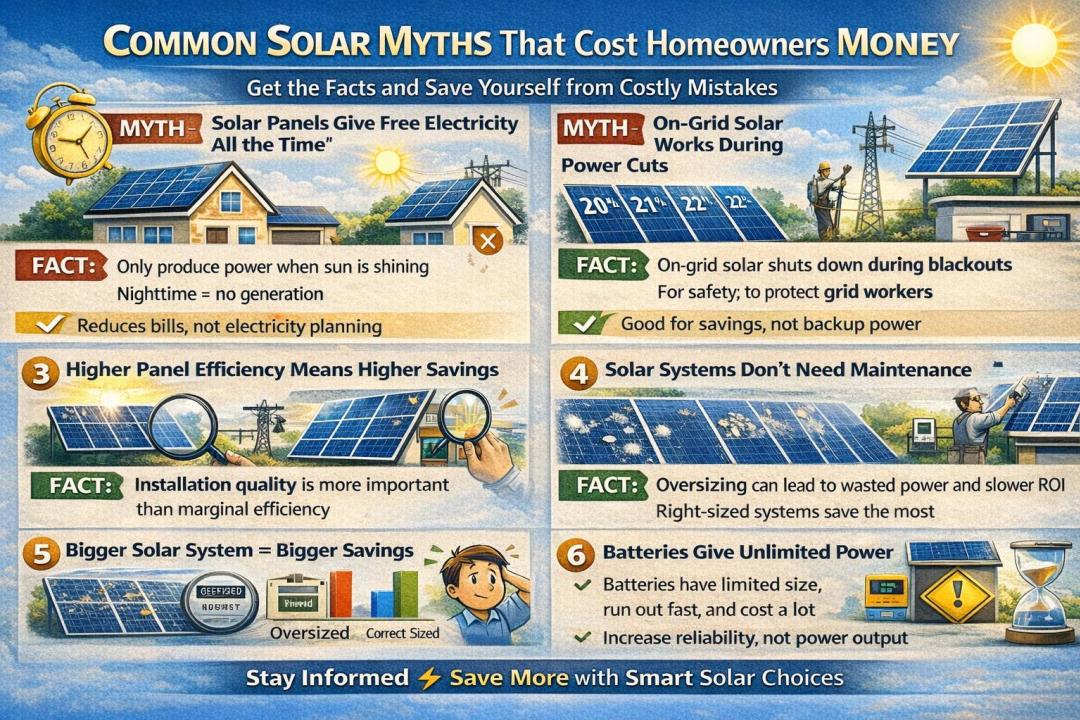
Myth 1: “Solar Panels Give Free Electricity All the Time”
Why people believe this
Marketing phrases like “free power forever” oversimplify how solar works.
Reality:
Solar panels generate electricity only when sunlight is available
Output varies by time of day, season, weather, dust, and heat
Nights = zero generation
Cost of believing this myth
Oversized expectations
Poor appliance planning
Disappointment when bills don’t drop as imagined
Truth: Solar reduces bills—it does not eliminate electricity planning.
Myth 2: “On-Grid Solar Works During Power Cuts”
This is one of the most expensive misunderstandings.
Reality
On-grid solar systems automatically shut down during power outages
This is a mandatory safety feature (anti-islanding protection)
Even if:
The sun is shining
Panels are producing power
👉 Your system will still turn off.
Cost of believing this myth
Installing on-grid solar expecting backup
Spending lakhs and still having no power during outages
Truth: On-grid solar is for savings, not backup.
Myth 3: “Higher Panel Efficiency Means Higher Savings”
Why it sounds logical
Efficiency numbers (20%, 21%, 22%) look scientific and convincing.
Reality
Panel efficiency matters far less than:
Roof direction and tilt
Zero shading
Installation quality
Inverter performance
Panel cleanliness
A 20% panel installed properly often outperforms a 22% panel installed poorly.
Cost of believing this myth
Paying premium prices for minimal real-world gain
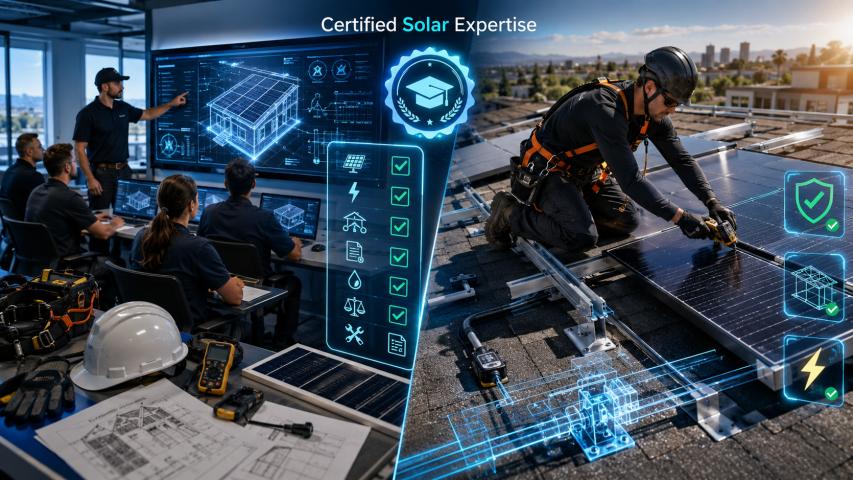
Ignoring design and installer quality
Truth: Installation quality beats brand and efficiency hype.
Myth 4: “Solar Systems Don’t Need Maintenance”
Reality
Solar is low maintenance, not no maintenance.
What actually happens:
Dust reduces output by 10–25%
Bird droppings create hotspots
Loose connections reduce efficiency over time
Cost of believing this myth
Silent loss of generation
Reduced long-term ROI
Panel damage due to hotspots
Truth: Simple cleaning and annual checks protect your investment.
Myth 5: “Bigger Solar System = Bigger Savings”
Reality
Savings depend on how you use electricity, not just system size.
Oversized systems can:
Export unused power at low value
Face net-metering limits
Increase payback period
Undersized systems can:
Miss subsidy optimization
Limit future expansion
Cost of believing this myth
Slower return on investment
Wasted capital
Truth: Right-sized systems save more than oversized ones.
Myth 6: “Batteries Give Unlimited Power”
Reality
Batteries: Store limited energy
Store limited energy
Drain quickly with heavy loads
Degrade over time
Are expensive to replace
A battery does not increase solar generation—it only stores excess energy.
Cost of believing this myth
Overconfidence during outages
Unexpected battery replacement cost
Overspending on unnecessary capacity
Truth: Batteries increase reliability, not power production.
Myth 7: “Solar Panels Last Forever Without Performance Loss”
Reality:
Panels degrade slowly (≈0.5% per year on average)
After 20–25 years, output is lower but still usable
Inverters fail much earlier (8–12 years)
Cost of believing this myth
No budget planning for inverter replacement
Misjudged long-term ROI
Truth: Solar is long-term infrastructure, not a one-time gadget.
Myth 8: “Net Metering Will Always Remain the Same”
Reality
Net metering is a policy decision, not a permanent guarantee.
Rules can change by state or utility
Export limits may be introduced
Compensation rates may reduce
Cost of believing this myth
Designing systems dependent only on exports
ROI uncertainty
Truth: Self-consumption is safer than policy dependence.
Final Takeaway: Knowledge Saves More Money Than Discounts
Most solar losses don’t happen because of bad technology—they happen because of wrong assumptions.
Remember:
Solar rewards planning, not impulse buying
Engineering matters more than marketing
Understanding prevents expensive regret
A well-informed homeowner always gets better results than one chasing offers.