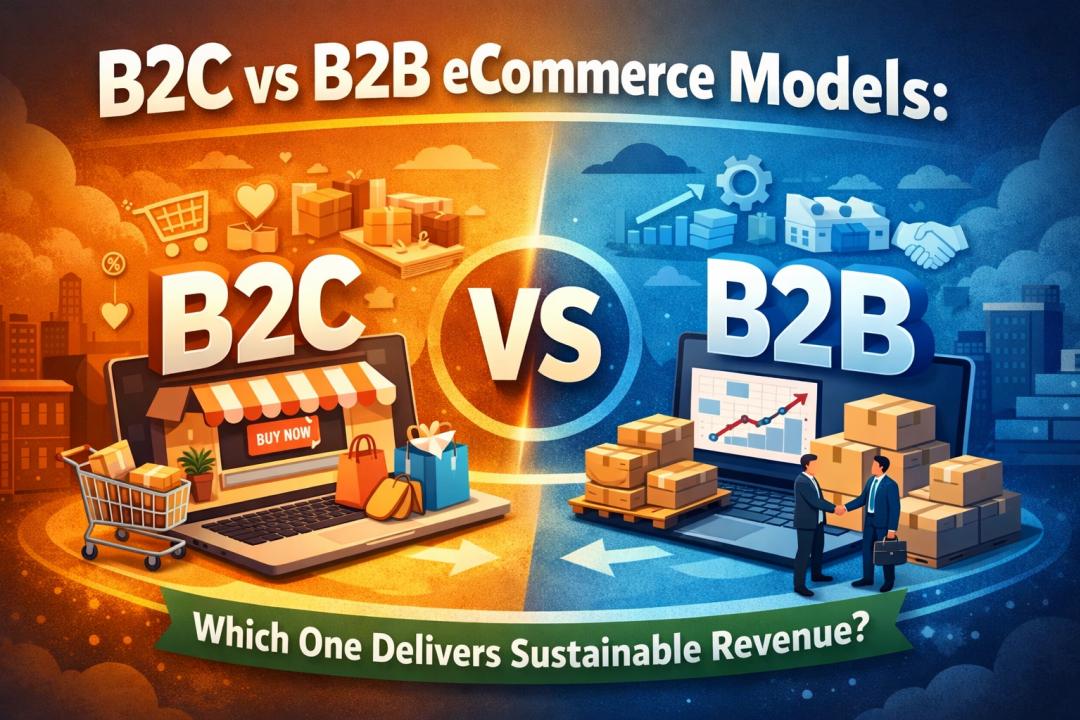
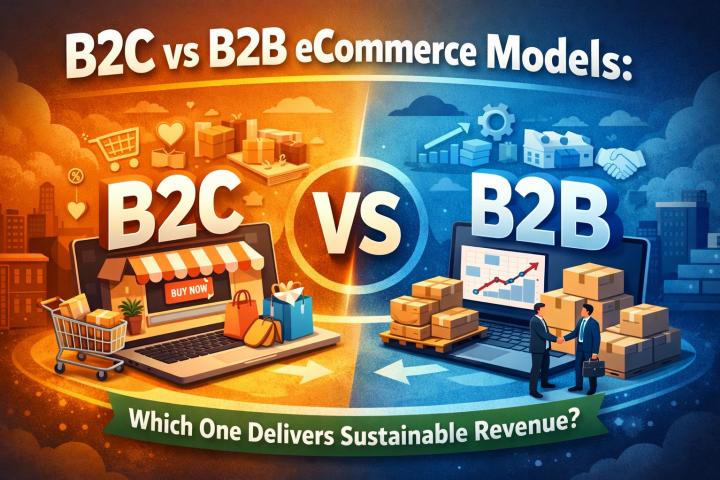
Choosing between B2C and B2B as an eCommerce business model is a strategic decision that directly affects revenue stability and growth potential. Each approach serves different buyer behaviors and market dynamics.
As competition increases, businesses must evaluate which eCommerce business model can support consistent revenue, scalability, and long-term customer value. The wrong choice can lead to unpredictable cash flow and rising costs.
This guide compares B2C and B2B eCommerce models, examines revenue sustainability, and explains how technology and the development of eCommerce marketplaces influence long-term success.
Understanding B2C and B2B as an eCommerce Business Model
Every eCommerce business model is built around how buyers purchase, how sellers deliver value, and how revenue is generated over time.
What Defines the B2C eCommerce Business Model?
The B2C eCommerce business model focuses on selling directly to individual consumers through online stores or digital marketplaces. Transactions are frequent, smaller in value, and driven by convenience and brand appeal.
Success in this model depends on traffic acquisition, conversion optimization, and customer retention strategies.
What Defines the B2B eCommerce Business Model?
The B2B eCommerce business model supports transactions between companies, often involving bulk purchases and negotiated pricing. Orders are less frequent but significantly higher in value.
Revenue sustainability relies on repeat buyers, long-term contracts, and operational efficiency rather than impulse purchases.
Revenue Behavior in the B2C eCommerce Business Model
B2C revenue growth can be rapid, but sustaining it requires constant optimization and engagement.
High Volume Sales With Revenue Volatility
The B2C eCommerce business model benefits from high transaction volume, which can generate steady daily sales. However, revenue is often influenced by seasonality, trends, and ad performance.
Without strong retention, revenue can fluctuate significantly.
Customer Acquisition and Retention Challenges
B2C brands face rising customer acquisition costs due to intense competition. Sustainable revenue depends on increasing lifetime value through loyalty programs and personalized experiences.
Marketing efficiency plays a central role in long-term profitability.
Marketplaces and B2C Expansion
Many brands extend their B2C eCommerce business model through eCommerce marketplace development. Marketplaces help reach new audiences but often reduce pricing control.
Balancing marketplace presence with owned channels is key to protecting margins.
Revenue Behavior in the B2B eCommerce Business Model
The B2B approach prioritizes consistency and predictability over rapid transaction volume.
Higher Order Value and Repeat Purchases
The B2B eCommerce business model generates revenue through bulk orders and recurring procurement cycles. This leads to stronger cash flow visibility and reduced dependency on constant lead generation.
Long-term buyer relationships improve revenue stability.
Long Sales Cycles With Strong Retention
Although B2B sales cycles are longer, customer retention rates are significantly higher. Switching platforms or suppliers often involves operational risk for buyers.
This loyalty makes B2B revenue more resilient during market downturns.
B2B Marketplaces and Digital Growth
Modern B2B companies increasingly rely on eCommerce marketplace development to scale efficiently. Marketplaces enable multi-seller ecosystems, streamlined purchasing, and automated workflows.
They strengthen the B2B eCommerce business model by reducing friction and increasing repeat transactions.
B2C vs B2B: Which eCommerce Business Model Is More Sustainable?
Sustainability depends on how predictable, scalable, and resilient revenue streams are over time within a well-structured business model for ecommerce industry.
Revenue Predictability
B2B eCommerce offers more predictable revenue through contracts and repeat orders. B2C revenue fluctuates based on consumer demand, promotions, and competition.
Predictability supports better financial planning and resource allocation.
Customer Lifetime Value Comparison
The B2B eCommerce business model typically delivers higher lifetime value per customer. B2C businesses must rely on upselling, cross-selling, and loyalty incentives to achieve similar results.
Retention strategies differ significantly between the two models.
Scalability and Operational Complexity
B2C scales faster with marketing investment, while B2B scalability depends on infrastructure and automation. Both models require robust platforms to support growth.
Flexible eCommerce marketplace development helps businesses scale without operational strain.
Technology as a Revenue Enabler Across Models
Technology choices shape how effectively an eCommerce business model sustains revenue.
Automation and Personalization
B2C platforms focus on personalization tools like recommendations and remarketing. These features improve conversion rates and repeat purchases.
B2B platforms prioritize automation for pricing, bulk ordering, and account-level customization.
System Integrations and Efficiency
B2B eCommerce relies heavily on ERP, CRM, and inventory integrations. These systems reduce manual processes and protect margins.
B2C platforms focus more on performance optimization and seamless checkout experiences.
Marketplace-Driven Revenue Streams
Advanced eCommerce marketplace development supports both B2C and B2B models. Marketplaces unlock additional revenue through commissions, subscriptions, and seller services.
They also enable faster market expansion with lower risk.
Choosing the Right eCommerce Business Model for Long-Term Growth
The best eCommerce business model aligns with your product type, audience, and operational strengths.
When B2C Is the Right Choice
B2C works best for consumer-focused brands, fast-moving products, and trend-driven markets. Revenue sustainability depends on strong branding and retention strategies.
Continuous marketing investment is required to maintain momentum.
When B2B Is the Smarter Option
B2B suits businesses offering specialized products, wholesale pricing, or long-term supply agreements. The model delivers stability through recurring revenue and loyal buyers.
Digital transformation strengthens sustainability in this segment.
Hybrid eCommerce Models
Many companies adopt hybrid strategies that combine B2C and B2B. This approach diversifies revenue streams and reduces dependency on a single market.
Hybrid models often rely on scalable eCommerce marketplace development to support multiple buyer journeys.
Conclusion
Both B2C and B2B can be sustainable eCommerce business models, but they generate revenue in very different ways. Understanding these differences is essential for long-term planning.
B2C emphasizes volume and engagement, while B2B focuses on predictability and retention. Each model has unique strengths when supported by the right strategy.
Technology and eCommerce marketplace development play a crucial role in strengthening revenue sustainability across both models, as consistently noted by leading digital commerce trends publications. The right platform enables efficiency, scalability, and growth.
Evaluate your audience, resources, and goals carefully, then refine your eCommerce business model to support consistent, long-term revenue.