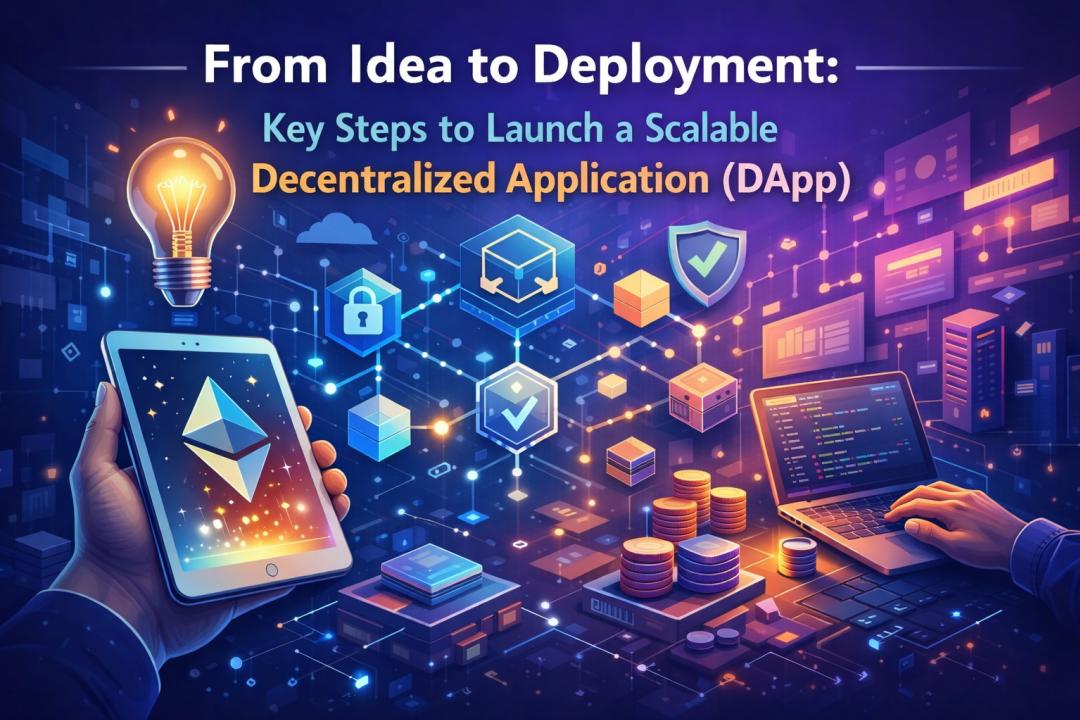
Decentralized applications, commonly known as DApps, are rapidly transforming how digital services operate. Unlike traditional applications that rely on centralized servers, DApps run on blockchain networks, enabling transparency, security, and user ownership of data. From decentralized finance platforms to NFT marketplaces and tokenized asset platforms, DApps are powering a new generation of digital innovation.
However, building a successful DApp involves much more than writing smart contracts. Developers and organizations must carefully plan architecture, infrastructure, and scalability from the very beginning.
This article explores the essential steps involved in taking a decentralized application from initial idea to full deployment.
Understanding the DApp Concept
A decentralized application operates using blockchain technology rather than centralized servers. The backend logic of a DApp typically runs on smart contracts, while the frontend interface interacts with the blockchain through APIs and wallet integrations.
Unlike traditional apps, DApps offer several advantages:
- Trustless interactions through
- smart contracts
- Enhanced transparency and immutability
- Reduced dependency on intermediarie
- Improved data security
Because of these benefits, industries such as finance, gaming, supply chain, and digital identity are increasingly adopting decentralized application development.
Step 1: Define the Use Case and Business Model
Every successful DApp starts with a clearly defined use case. Blockchain should not be implemented simply for the sake of innovation. Instead, it should solve a real problem that benefits from decentralization.
Popular DApp use cases include:
- Decentralized finance (DeFi) platforms
- Tokenized asset marketplaces
- NFT trading platforms
- Gaming ecosystems with digital ownership
- Supply chain verification systems
At this stage, teams should also determine their revenue model. Some platforms generate income through transaction fees, while others rely on token economies or subscription models.
Step 2: Select the Right Blockchain Platform
Choosing the appropriate blockchain network is critical for scalability and performance. Each blockchain offers different benefits depending on transaction speed, cost, and ecosystem support.
Common blockchain platforms for DApp development include:
- Ethereum
- Polygon
- Solana
- Avalanche
- Aptos
Ethereum remains the most widely used ecosystem due to its large developer community and established infrastructure. However, newer networks often provide higher throughput and lower transaction fees.
Selecting the right platform depends on factors such as:
- Transaction volume expectations
- Smart contract capabilities
- Security requirements
- Developer ecosystem support
Step 3: Design the Architecture
DApp architecture typically consists of three primary layers:
Frontend Layer
The user interface interacts with wallets and blockchain APIs. Frameworks such as React or Next.js are commonly used to build responsive interfaces.
Smart Contract Layer
This layer handles the core business logic of the application. Smart contracts automate transactions and enforce rules without requiring intermediaries.
Blockchain Infrastructure Layer
The infrastructure includes nodes, data indexing systems, decentralized storage, and APIs that connect the application to the blockchain network.
A well-designed architecture ensures scalability and reliability as the application grows.
Step 4: Develop and Audit Smart Contracts
Smart contracts are the foundation of any decentralized application. These programs execute predefined actions automatically when specific conditions are met.
Because smart contracts control digital assets and transactions, security is critical. A single vulnerability can result in significant financial losses.
Best practices include:
- Writing modular and well-documented contracts
- Conducting internal code reviews
- Running automated testing
- Performing third-party security audits
Languages such as Solidity and Rust are commonly used for smart contract development.
Step 5: Implement Wallet Integration
Users interact with decentralized applications through blockchain wallets. Wallet integration allows users to sign transactions and connect securely to the application.
Popular wallets include:
- MetaMask
- Trust Wallet
- Coinbase Wallet
- Phantom Wallet
Wallet integration enables features such as authentication, transaction approvals, and token management.
Step 6: Integrate Decentralized Storage
Traditional cloud storage contradicts the decentralized philosophy of blockchain applications. Instead, decentralized storage solutions are often used.
Popular decentralized storage technologies include:
- IPFS
- Arweave
- Filecoin
These systems store data across distributed networks, improving security and preventing single points of failure.
Step 7: Build Scalable Infrastructure
Scalability is one of the biggest challenges in blockchain applications. As user demand increases, infrastructure must be able to handle higher transaction volumes.
Developers often use the following techniques:
- Layer-2 scaling solutions
- Sidechains
- Off-chain computation
- Data indexing services
These approaches help maintain performance while reducing transaction costs.
Step 8: Test the Application
Before launching a decentralized application on the main network, developers should deploy it to test networks.
Testnets allow teams to simulate real-world scenarios without risking actual funds.
Testing phases typically include:
- Unit testing
- Integration testing
- Security testing
- Load testing
Extensive testing ensures the application operates reliably under different conditions.
Step 9: Deploy the DApp
Once testing is complete, the DApp can be deployed to the mainnet. Deployment involves publishing smart contracts to the blockchain and connecting the frontend interface to the live environment.
At this stage, monitoring tools are essential to track performance, detect anomalies, and manage updates.
Step 10: Maintain and Scale the Platform
Launching a decentralized application is only the beginning. Continuous maintenance is required to keep the platform secure and functional.
Key post-launch activities include:
- Updating smart contracts
- Monitoring network activity
- Improving user experience
- Scaling infrastructure
Long-term support ensures the DApp remains competitive in the rapidly evolving blockchain ecosystem.
The Future of Decentralized Applications
Decentralized applications are reshaping industries by providing trustless systems that operate without centralized control. As blockchain technology matures, DApps are expected to become more scalable, user-friendly, and widely adopted.
Organizations exploring decentralized solutions should focus on strong architecture, security practices, and scalable infrastructure.
With the right development approach, a DApp can evolve from a simple concept into a powerful platform serving thousands—or even millions—of users worldwide.