Market Overview:
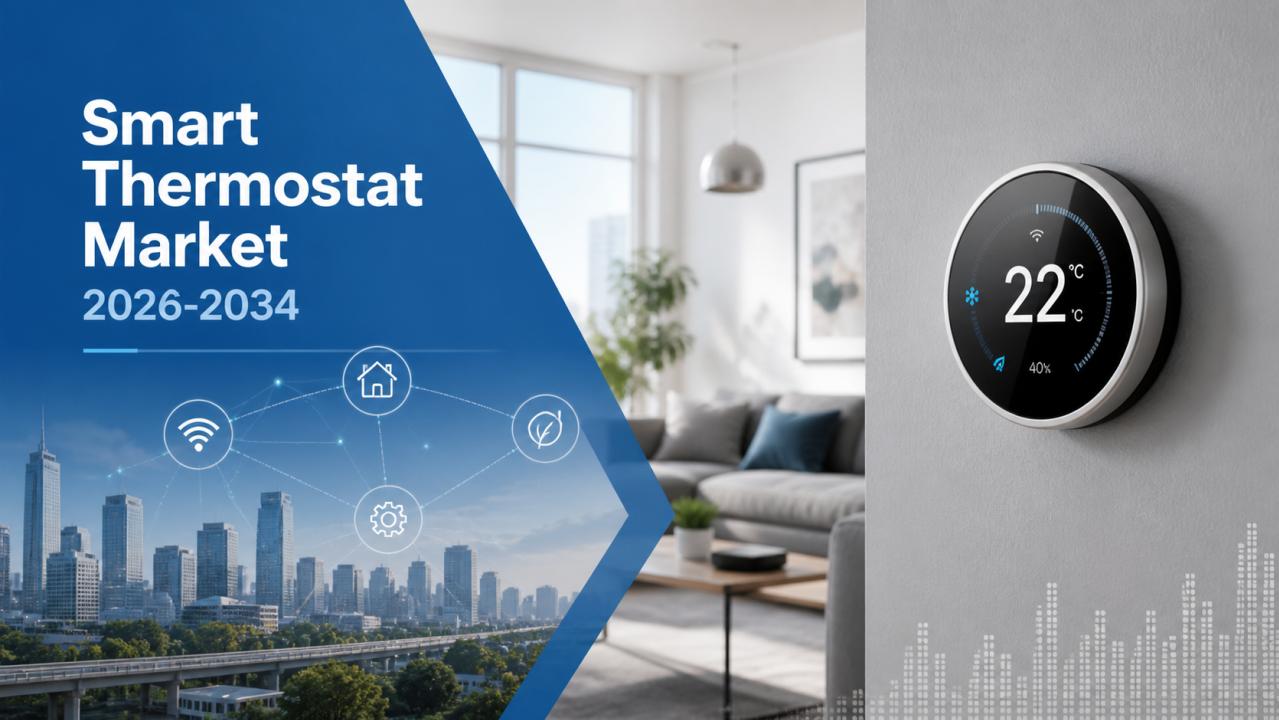
According to IMARC Group's latest research publication, "Smart Thermostat Market: Global Industry Trends, Share, Size, Growth, Opportunity and Forecast 2026-2034", The global smart thermostat market size was valued at USD 4.94 Billion in 2025 and is projected to reach USD 18.21 Billion by 2034, exhibiting a CAGR of 15.05% during the forecast period 2026-2034.
This detailed analysis primarily encompasses industry size, business trends, market share, key growth factors, and regional forecasts. The report offers a comprehensive overview and integrates research findings, market assessments, and data from different sources. It also includes pivotal market dynamics like drivers and challenges, while also highlighting growth opportunities, financial insights, technological improvements, emerging trends, and innovations. Besides this, the report provides regional market evaluation, along with a competitive landscape analysis.
How AI and Connectivity Are Reshaping the Future of the Smart Thermostat Market
- Learning smart thermostats have also entered the market‚ including AI (artificial intelligence) and ML (machine learning) algorithms that analyze user behavior and occupancy and automatically adjust a building's temperature settings to avoid wasting energy․
- Many utility-sponsored demand response programs‚ such as the Google Nest Rush Hour Rewards program‚ which includes more than 100 utility partners in the United States and Canada‚ provided more than USD 40 Million in rewards and incentives to participating households in 2024‚ which provides concrete value for adopting smart thermostats․
- In December 2025‚ Resideo Technologies's next-gen Honeywell Home X8S smart thermostat debuted․ It featured the largest touchscreen in a smart thermostat‚ streaming video from compatible doorbells‚ air quality sensing‚ and predictive alerts when HVAC equipment may need replacing‚ setting new standards for smart comfort․
- The Focus on Energy rebate program‚ established for purchases made on or after January 2026‚ offers a USD 50 rebate on qualifying smart thermostats and supplements government-backed programs that have driven the common adoption of residential smart thermostats in the United States․
- In September 2025‚ mwConnect announced a partnership with Network Thermostat to combine HVAC system control and networked lighting control systems for commercial building owners and operators to develop building automation solutions and energy management capabilities․
Grab a sample PDF of this report: https://www.imarcgroup.com/smart-thermostat-market/requestsample
Key Trends in the Smart Thermostat Market
- Commercial Installation: Commercial buildings commonly use smart thermostats to reduce energy waste and optimize heating and cooling systems, create temperature zones in large buildings, integrate with building management systems to manage HVAC, lighting and security devices, and participate in demand response programs that automatically set back devices during peak demand periods to help reduce utility costs and help achieve energy compliance․ In May 2024, Voltus and Resideo expanded their residential smart thermostat virtual power plant program to Commonwealth Edison and PSEG Long Island service territories․ Honeywell Home smart thermostat users are aggregated into a demand-side resource that protects the grid during peak events and provides grid benefits․ Users receive upfront incentives at installation and annual incentives․
- Growing Product Adoption in Industrial Applications: Smart thermostats are also used in industrial applications such as warehouses, factories and distribution centers․ Some of the common use cases in this area include monitoring air quality, tracking and regulating temperature of equipment, controlling energy use in facilities with multiple processes, sending alerts in real-time, optimizing temperatures, using data in future predictive maintenance of equipment and meeting regulatory compliance requirements․ In January 2025, Carrier India and Jamia Millia Islamia's University Polytechnic signed an MoU for setting up a Centre of Excellence for Professional Skill Development to impart HVAC skill training for installation and service of advanced climate control solutions in industrial and commercial settings․
- Growing Smart Home Ecosystem: The proliferation of smart home ecosystems is driving demand for smart thermostats that integrate with voice assistants, smart lights, home security systems, and energy management platforms․ Wireless technologies such as Wi-Fi, Zigbee, Z-Wave, and the Matter standard are enabling interoperability across different brands and platforms, expanding the total addressable market (TAM) for smart thermostats․ Eve Systems announced its first smart thermostat in January 2026 at CES 2026․ It is a Matter-over-Thread device, and claims to be a cloud-less, privacy-friendly device․ Aqara announced its Thermostat Hub W200, also Matter-over-Thread compatible, in January 2026․ The device supports Wi-Fi, Thread and Zigbee protocols for automated temperature control and smart homes․
- Device manufacturers have made meaningful investments into R&D of additional features such as occupancy sensors, geofencing, voice assistant integration, and AI analytics․ Alarm․com launched the ADC-T25 smart thermostat in July 2025․ The smart thermostat is compatible with most residential heating, ventilation and air conditioning (HVAC) systems and is intended to increase ease-of-installation and setup with a sleek look, built-in sensing and programmability to meet more advanced user needs․
- Supportive government programs: Government programs and utility-subsidized rebates have resulted in the rapid adoption of smart thermostats in residential and commercial buildings․ Most state energy efficiency programs in California, New York, and Massachusetts offer incentives for smart thermostat installation of between USD 25 and USD 100․ The Mass Save program provides rebates for ENERGY STAR labeled smart thermostats purchased and installed by existing residential natural gas and electric customers of participating utility companies through the Mass Save program․
Growth Factors in the Smart Thermostat Market
- Cost and energy savings: Smart thermostats are often employed to improve heating and cooling efficiency‚ and thereby save energy and money on electric and gas bills․ Research conducted by the United States Department of Energy has shown that homeowners can save money with energy efficient temperature settings․ Smart thermostats are programmed automatically‚ eliminating the need for manual programming․ These thermostats are a good solution for cost-conscious homeowners and building operators․
- Smart home adoption driving demand: Rapid development of smart home ecosystems has been a direct driver for smart thermostat sales․ Smart thermostats easily integrate into voice assistants‚ smart lighting‚ and smart home security systems to control the home․ Smart home adoption is strongest in North America‚ which has approximately 40% of the global smart thermostat market share․ This dominance is due to large amounts of infrastructure being built‚ and an early and willing customer base․
- Increasing awareness of global warming and sustainability: As consumers and businesses begin to acknowledge the importance of reducing their carbon footprints‚ greenhouse gas emissions and investing in renewable energy‚ they are increasingly turning to smart thermostats to assist them in achieving their goals․ Product manufacturers have responded to this by marketing the emissions savings offered by their products․ Most of this demand has come from residential applications‚ which are particularly measurable․
- Asset modernization of existing build stock: With a large global stock of old residential and commercial buildings which could benefit from energy retrofits in the years to come‚ building modernization programs across North America and Europe are putting an emphasis on HVAC upgrades and accompanying HVAC controls‚ and smart thermostats are a strong entry point for energy intensity and building performance code compliance․
- Expanding consumer adoption potential: Increase in disposable consumer income and willingness to invest in comfort and automation provides a wider addressable market for smart thermostats․ In August 2024‚ Copeland launched its Verdant VX4 smart thermostat including advanced demand response and exceptionally high run-time reduction features for commercial and multifamily buildings․ Ecobee's Smart Thermostat Essential with a full-color touchscreen and of low cost‚ introduced in January 2025‚ exemplifies manufacturers targeting both high-end and budget-conscious consumers․
Leading Companies Operating in the Global Smart Thermostat Industry:
- Alphabet Inc. (Google LLC - Nest Labs Inc.)
- Carrier Global Corporation
- Ecobee Inc. (Generac Power Systems Inc.)
- Emerson Electric Co.
- Honeywell International Inc.
- Johnson Controls International plc
- Lennox International Inc.
- Resideo Technologies Inc.
- Robert Bosch GmbH
- Schneider Electric SE
- Siemens AG
Smart Thermostat Market Report Segmentation:
Breakup By Product:
- Standalone Smart Thermostats
- Connected Smart Thermostats
- Learning Smart Thermostats
Learning smart thermostats account for the majority of the market share owing to their ability to employ advanced machine learning algorithms that automatically optimize temperature settings based on user preferences, occupancy patterns, and historical data, delivering personalized comfort with maximum energy efficiency.
Breakup By Component:
- Display
- Temperature Sensors
- Humidity Sensors
- Motion Sensors
- Others
Display holds the largest share of the component segment due to its user-friendly interface that enables real-time temperature monitoring, schedule creation, energy usage visualization, and intuitive system control without requiring technical expertise.
Breakup By Technology:
- Wired
- Wireless
- WiFi
- Zigbee
- Others
Wireless technology dominates the market owing to its ease of installation, flexible placement, remote control capabilities via smartphone applications, and seamless integration with broader smart home ecosystems without the constraints of complex wiring requirements.
Breakup By Application:
- Residential
- Commercial
- Industrial
Residential dominates the market due to the large global base of households seeking energy savings, comfort optimization, and smart home connectivity, supported by accessible pricing, utility rebate programs, and growing consumer awareness of smart home technologies.
Breakup By Region:
- North America (United States, Canada)
- Asia Pacific (China, Japan, India, South Korea, Australia, Indonesia, Others)
- Europe (Germany, France, United Kingdom, Italy, Spain, Russia, Others)
- Latin America (Brazil, Mexico, Others)
- Middle East and Africa
North America enjoys the leading position in the smart thermostat market owing to the region's rapid adoption of smart home ecosystems, strong emphasis on energy efficiency regulations, widespread utility-backed rebate programs, and a highly tech-receptive consumer base driving consistent demand for connected climate control solutions.
Recent News and Developments in the Smart Thermostat Market
- January 2026: Eve Systems debuted its first-ever smart thermostat at CES 2026, a Matter-over-Thread compatible device designed for privacy-first operation without any cloud dependency or subscription requirement, featuring remote control via major smart home hubs and presence-based automations.
- September 2025: mwConnect and Network Thermostat announced a strategic partnership to advance integration between HVAC system control and networked lighting control platforms, enabling unified building automation for commercial property managers seeking consolidated energy management.
- July 2025: Alarm.com launched the ADC-T25 smart thermostat, compatible with most common HVAC systems, featuring streamlined installation, a contemporary design, and advanced sensing capabilities, expanding the company's portfolio of connected home climate control solutions.
- January 2025: Ecobee launched the Smart Thermostat Essential, an affordably priced smart thermostat retaining the brand's full-color touchscreen and core comfort and convenience features, targeting a broader consumer segment seeking accessible smart home technology.
- October 2024: Ecobee released the Smart Thermostat Lite through channel distribution, a model developed with professional installer input to simplify deployment in residential settings and expand the brand's reach through contractor and trade networks.
- August 2024: Copeland launched the Verdant VX4 smart thermostat, featuring advanced demand response capabilities, significant runtime reductions, and a fingerprint-resistant glass design, catering to commercial and multifamily property operators seeking enhanced energy performance.
Note: If you require specific details, data, or insights that are not currently included in the scope of this report, we are happy to accommodate your request. As part of our customization service, we will gather and provide the additional information you need, tailored to your specific requirements. Please let us know your exact needs, and we will ensure the report is updated accordingly to meet your expectations.
About Us:
IMARC Group is a global management consulting firm that helps the world's most ambitious changemakers to create a lasting impact. The company provides a comprehensive suite of market entry and expansion services. IMARC offerings include thorough market assessment, feasibility studies, company incorporation assistance, factory setup support, regulatory approvals and licensing navigation, branding, marketing and sales strategies, competitive landscape and benchmarking analyses, pricing and cost research, and procurement research.
Contact Us:
IMARC Group
134 N 4th St. Brooklyn, NY 11249, USA
Email: sales@imarcgroup.com
Tel No:(D) +91 120 433 0800
United States: +1-201-971-6302