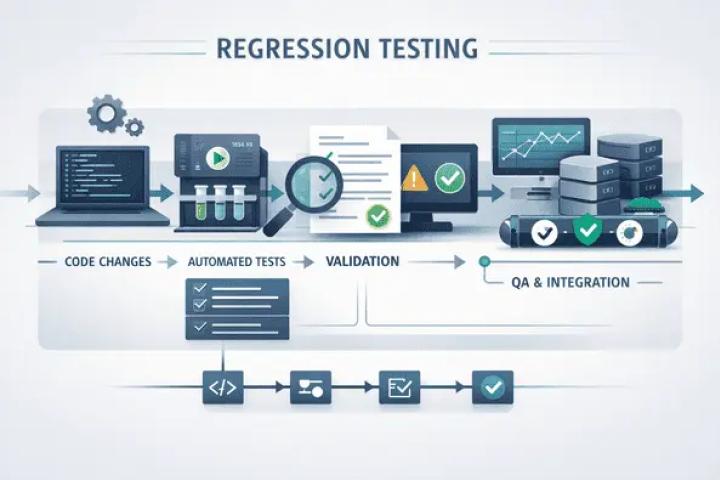

As software systems evolve, test suites grow alongside them. New features require new tests, bug fixes introduce additional validation, and over time, regression suites can become massive. While this growth is necessary for maintaining quality, it also introduces challenges related to execution time, maintenance, and reliability.
This is where regression testing tools play a crucial role. They help teams manage large and expanding test suites without slowing down development or compromising coverage.
Why Test Suites Grow Over Time
Test suites expand naturally as systems become more complex.
Common reasons include:
- Addition of new features and workflows
- Increased coverage for edge cases
- Fixes for previously discovered bugs
- Integration with more services and dependencies
While growth improves coverage, it also creates overhead if not managed properly.
Challenges of Large Test Suites
As regression suites grow, teams often face several issues:
- Longer execution times
- Increased maintenance effort
- Difficulty identifying relevant tests
- Higher chances of flaky or redundant tests
Without the right approach, large test suites can become a bottleneck instead of a safeguard.
How Regression Testing Tools Manage Scale
Modern regression testing tools are designed to handle these challenges by optimizing how tests are organized, executed, and maintained.
1. Test Prioritization
Not all tests need to run for every change.
Regression testing tools help by:
- Identifying high-impact test cases
- Prioritizing tests based on recent code changes
- Running critical tests earlier in the pipeline
This ensures faster feedback without sacrificing important coverage.
2. Parallel Test Execution
Execution time becomes a major concern as test suites grow.
To address this, tools support:
- Running tests in parallel across multiple environments
- Distributing workloads efficiently
- Reducing overall execution time
This allows large test suites to run within acceptable timeframes.
3. Smart Test Selection
Instead of running the entire suite every time, tools can select relevant tests.
This is based on:
- Code changes and impacted areas
- Dependency mapping
- Historical test results
By focusing only on affected parts of the system, teams can optimize testing efficiency.
4. Reducing Test Duplication
As test suites expand, duplication becomes common.
Regression testing tools help identify:
- Redundant test cases
- Overlapping coverage
- Unnecessary validations
Cleaning up duplication keeps the suite lean and maintainable.
5. Managing Test Maintenance
Maintenance becomes one of the biggest challenges at scale.
Modern tools address this by:
- Promoting reusable test components
- Simplifying updates across multiple tests
- Reducing manual effort in maintaining test logic
Some approaches further reduce maintenance by aligning tests with real system behavior. For example, tools like Keploy generate test cases from actual API interactions, helping teams keep tests relevant without constantly rewriting them.
6. Handling Flaky Tests
Large test suites often suffer from instability.
Regression testing tools help manage this by:
- Detecting flaky tests through repeated failures
- Isolating unstable test cases
- Providing insights into failure patterns
This improves overall trust in the test suite.
7. Continuous Optimization
Test suites should not grow without control.
Regression testing tools support continuous improvement by:
- Tracking execution metrics
- Identifying slow or ineffective tests
- Recommending optimizations
This ensures that the suite remains efficient over time.
Common Mistakes to Avoid
Teams often struggle with large test suites when they:
- Run all tests for every change without prioritization
- Ignore outdated or redundant tests
- Allow execution times to grow unchecked
- Overlook test stability
Avoiding these mistakes helps maintain a healthy testing process.
Real-World Perspective
In real-world environments, large test suites are unavoidable. The key is not to limit growth, but to manage it effectively.
Teams that use regression testing tools efficiently:
- Maintain fast feedback cycles
- Keep test suites reliable and relevant
- Reduce maintenance overhead
- Scale testing alongside system growth
This allows them to balance coverage with performance.
Practical Takeaways
To handle large and growing test suites effectively:
- Prioritize and select tests intelligently
- Use parallel execution to reduce runtime
- Eliminate redundant and outdated tests
- Maintain test stability and reliability
- Continuously monitor and optimize the suite
These practices ensure that test growth does not become a bottleneck.
Conclusion
Large test suites are a natural outcome of evolving software systems. However, without proper management, they can slow down development and reduce efficiency.
Regression testing tools provide the capabilities needed to handle this scale by optimizing execution, maintenance, and coverage. By using these tools effectively, teams can maintain high-quality systems without sacrificing speed.