The way businesses communicate has changed dramatically in recent years. Traditional face-to-face meetings are no longer the only option for collaboration, training, client communication, and team management. The rise of remote work, hybrid offices, online education, digital healthcare, virtual events, and global business operations has made video communication an essential part of modern life. Platforms such as Zoom, Microsoft Teams, and Google Meet have transformed the way individuals and organizations connect across different locations.
Today, businesses of every size are looking for secure, scalable, and feature-rich communication platforms that provide seamless virtual meeting experiences. Startups, enterprises, educational institutions, healthcare organizations, and digital service providers are increasingly investing in custom video conferencing applications to improve collaboration, reduce operational costs, and create stronger digital communication ecosystems.
This growing demand has created a massive opportunity for businesses that want to launch their own video communication platforms with customized features, branding, and monetization capabilities.
What Is a Zoom Clone Application?
A Zoom-inspired clone application is a custom-built video conferencing platform designed with features similar to Zoom while offering complete flexibility for customization, scalability, and business-specific functionality. Rather than copying an existing platform, clone development focuses on using proven communication architecture to build a highly optimized and personalized meeting solution.
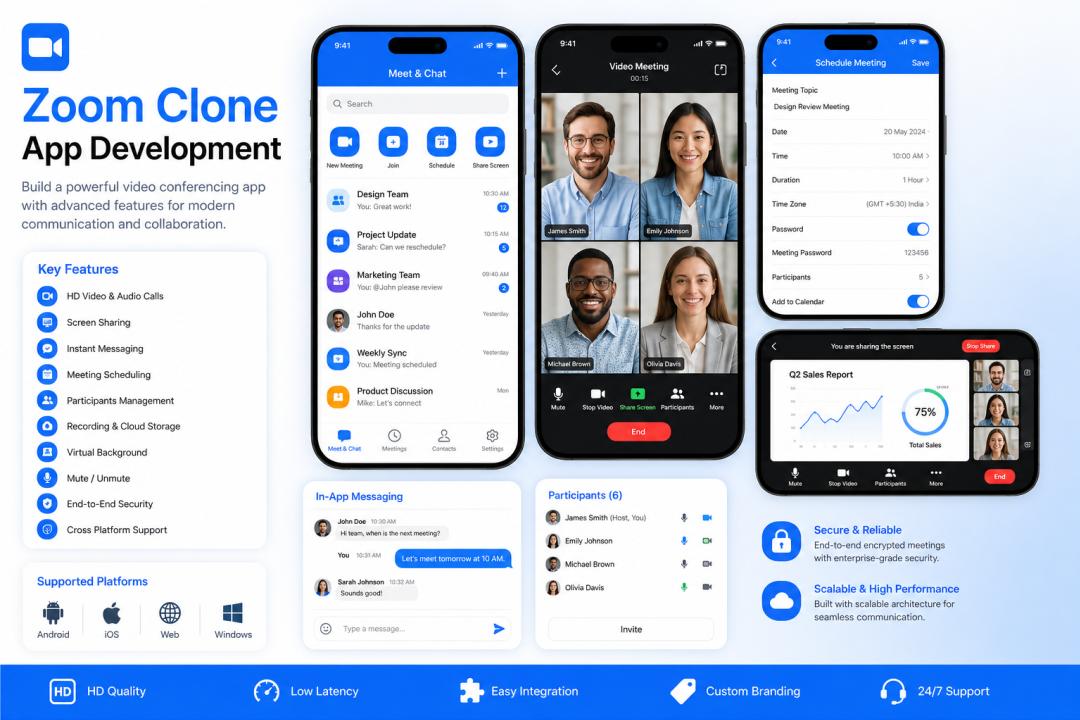
A modern video conferencing application typically includes high-definition video calls, crystal-clear audio communication, screen sharing, chat messaging, meeting scheduling, participant management, recording capabilities, webinar hosting, file sharing, and cross-device synchronization.
By using clone development, businesses can significantly reduce development time, accelerate market entry, and create a reliable communication platform tailored to their specific audience and industry requirements.
Why Businesses Are Investing in Video Conferencing Solutions
Digital communication has become a strategic necessity for organizations operating in competitive global markets. Companies can no longer rely solely on traditional communication channels when teams, clients, and customers are distributed across multiple locations.
A custom video conferencing platform allows businesses to maintain complete control over branding, communication infrastructure, user data, security policies, and customer experiences. Instead of depending on third-party communication tools, organizations can create their own digital collaboration ecosystem.
This approach improves internal productivity, strengthens client communication, reduces travel expenses, and creates opportunities for long-term digital transformation. Educational institutions can host virtual classrooms, healthcare providers can conduct online consultations, enterprises can organize internal meetings, and event organizers can host large-scale webinars—all within a customized platform.
Core Features Every Modern Video Meeting Platform Should Have
A successful video conferencing application begins with a smooth and secure onboarding experience. Users should be able to register quickly using email addresses, mobile numbers, or corporate credentials while benefiting from secure authentication and identity verification.
Once logged in, users expect instant meeting creation and scheduling capabilities. A simple interface should allow hosts to create meetings, share invite links, set passwords, and manage participant access with ease.
High-definition video and low-latency audio are the foundation of a reliable communication platform. Adaptive streaming technology ensures consistent call quality across different network conditions.
Screen sharing is another essential feature that allows presenters to share documents, presentations, software demos, and collaborative workspaces during meetings. In-meeting chat messaging enables participants to communicate without interrupting the speaker.
Recording functionality allows users to save meetings for training, compliance, documentation, or later review. Additional features such as virtual backgrounds, breakout rooms, waiting rooms, hand-raising, live reactions, and participant analytics further enhance engagement.
Push notifications, calendar integration, and meeting reminders improve attendance rates and ensure seamless scheduling across devices.
Technologies Behind Video Conferencing App Development
Building a modern communication platform requires a strong technical infrastructure capable of delivering real-time audio and video communication with minimal latency.
Frontend development focuses on creating responsive user experiences across mobile, desktop, and web platforms. Technologies such as Flutter, React Native, Swift, Kotlin, and modern web frameworks enable smooth cross-platform performance.
Backend development powers authentication, meeting management, messaging, recording storage, notifications, and real-time communication. Technologies such as Node.js, Python frameworks, Java Spring Boot, and scalable microservice architectures are commonly used.
Real-time communication technologies such as WebRTC play a major role in enabling peer-to-peer audio and video streaming.
Databases such as MongoDB, PostgreSQL, and Firebase manage user profiles, meeting history, recordings, chat messages, and analytics efficiently.
Cloud infrastructure provided by Amazon Web Services, Google Cloud, and Microsoft ensures global scalability, secure storage, and optimized media delivery.
The Importance of Security in Virtual Communication Platforms
Security is one of the most important factors in video conferencing application development. Business meetings, educational sessions, financial discussions, and healthcare consultations often involve sensitive information.
End-to-end encryption protects audio, video, and chat communication from unauthorized access. Secure authentication, password-protected meetings, role-based access controls, and waiting room features further strengthen platform security.
Data storage systems must protect recorded meetings, shared documents, and user credentials through encryption and secure cloud storage.
Compliance with international privacy standards helps build trust among users while reducing legal and operational risks.
How Video Meeting Platforms Drive Business Growth
Custom video communication platforms create powerful business opportunities beyond simple virtual meetings.
Organizations can improve employee productivity, enhance remote collaboration, and strengthen customer relationships through direct communication channels. Businesses can also offer paid webinars, virtual consulting services, online training programs, and premium collaboration tools.
Owning a communication platform creates valuable user insights, enabling businesses to understand engagement patterns, optimize services, and improve customer experiences.
Industries such as education, healthcare, legal services, finance, consulting, and e-learning benefit significantly from customized virtual communication ecosystems.
Zoom Clone App Development
At the center of digital collaboration innovation lies Zoom Clone App Development, a strategic solution for startups, enterprises, educational institutions, healthcare providers, and modern businesses looking to build scalable and secure video communication platforms.
By leveraging advanced real-time communication technologies, cloud infrastructure, intuitive user experiences, and enterprise-grade security, businesses can launch feature-rich meeting platforms that meet evolving market demands.
This development approach significantly reduces time-to-market while offering complete flexibility in branding, feature customization, audience targeting, and monetization strategies. Whether the goal is building an enterprise meeting solution, a virtual classroom platform, a telemedicine application, or a webinar hosting ecosystem, clone development provides the technological foundation for sustainable growth.
Monetization Strategies for Video Conferencing Platforms
One of the biggest advantages of owning a video communication platform is monetization flexibility.
Subscription-based pricing models allow users to access premium features such as longer meetings, larger participant limits, cloud recordings, webinar hosting, and advanced analytics.
Freemium models encourage user acquisition while motivating upgrades to premium plans.
Enterprise licensing allows businesses to sell communication solutions to organizations, educational institutions, and healthcare providers.
Additional revenue opportunities include virtual event hosting, API integrations, branded collaboration tools, and white-label platform licensing.
Challenges in Building Scalable Video Communication Platforms
Despite the opportunities, video conferencing development presents technical challenges.
Real-time video communication requires low latency, stable connectivity, adaptive bitrate optimization, and efficient bandwidth management.
Handling thousands of simultaneous users demands scalable server architecture and distributed media delivery systems.
Data privacy, cyber threats, recording storage, and global compliance requirements also require continuous monitoring and proactive security management.
However, with experienced developers and robust infrastructure, these challenges can be successfully managed.
Choosing the Right Development Partner
Selecting an experienced development partner is one of the most important steps in building a successful communication platform.
A reliable development company brings expertise in real-time communication architecture, UI/UX design, cloud deployment, cybersecurity, mobile development, and post-launch optimization.
Businesses should choose partners with proven experience in high-performance communication systems and scalable digital infrastructure.
The right team can transform a business idea into a competitive market-ready product.
Future Trends in Video Communication Technology
The future of video conferencing is being shaped by artificial intelligence, machine learning, immersive collaboration, and automation.
AI-powered meeting transcription, real-time translation, voice recognition, virtual assistants, smart analytics, and augmented collaboration environments will redefine digital communication.
Businesses that adopt these innovations early will gain significant competitive advantages in evolving digital markets.
Conclusion
Video communication has become an essential part of modern business operations, education, healthcare, and digital collaboration. Building a custom communication platform is no longer just a technological investment—it is a strategic business opportunity.
By investing in expert development inspired by platforms like Zoom, businesses can create secure, scalable, and feature-rich communication ecosystems that drive engagement, productivity, and long-term growth.
With the right technology, development strategy, and innovation-driven vision, your platform can become the next major success in the global communication industry.