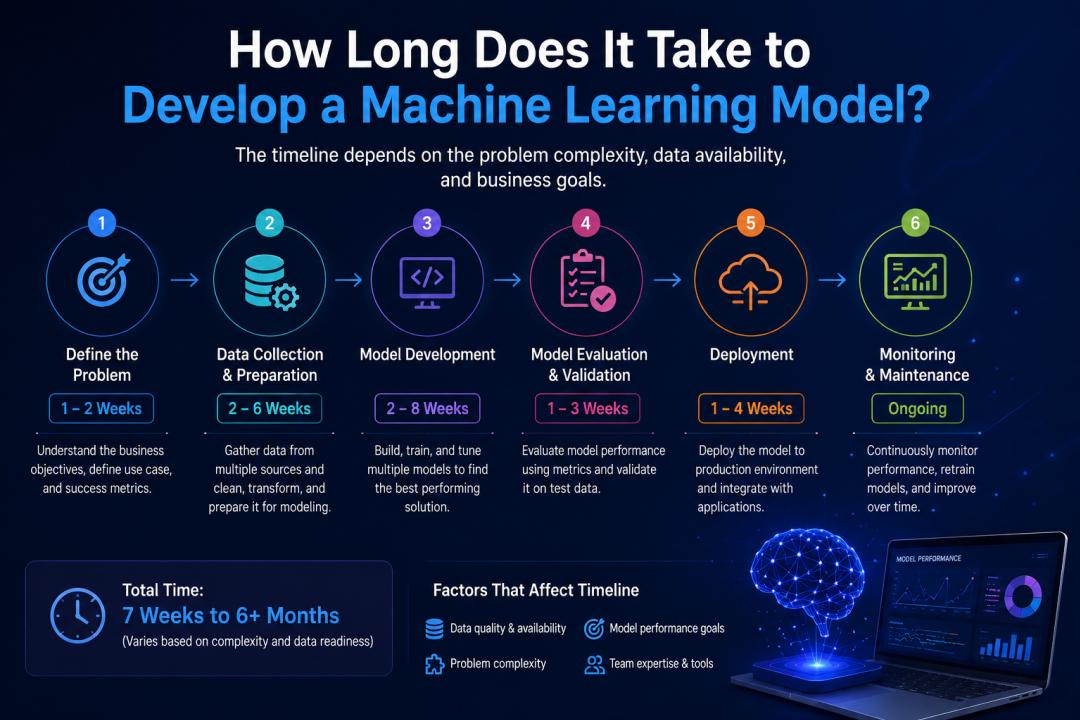
Machine learning is changing the way that businesses work. Whether it's making tailored recommendations, chatbots, fraud detection, or predictive analytics, machine learning models are contributing to their success. These are just a few examples of how machine learning models can enhance efficiency, automate processes, and enable businesses to make more informed decisions. One of the frequently asked questions businesses have before investing in AI solutions is: How long does it take to create a machine learning model?
There is no single correct answer because it is dependent on the complexity of the project, availability of data, business objectives and integration needs. Depending upon the type of machine learning project, you can finish in a few weeks, while in the more advanced cases, you can require several months.
This blog will discuss the entire process of machine learning model development and the factors affecting it.
Machine Learning Model Development: What is it?
Machine learning model development is the creation of an AI system that learns from the data and also makes forecasts or decisions without needing to be explicitly programmed for each and every job.
Typical development process consists of:
- Articulating the business question
- Gathering and assembling information
- Selecting algorithms
- Training the model
- Testing and optimization
- Deployment and monitoring
There is a need to plan and have technical knowledge at each stage, and it will directly influence the project timeline.
To understand how development time varies.
1. Project Complexity
One of the most significant contributors to project complexity is the project's complexity.
Simple Projects
Basic AI solutions such as:
- Spam filters
- Recommendation systems
- Sales forecasting tools
- can be generated fairly rapidly
Complex Projects
Advanced systems like:
- Autonomous vehicles
- Real-time fraud detection
- AI-powered healthcare solutions
Artificial intelligence tools that process language.
Need more advanced algorithms, more data and more testing, leading to a longer development process.
2. The availability and quality of data
All machine learning models are built on data. The data might not be complete or up to date, and it may not be organized, which can lead to delays in the project.
Data preparation may be the longest step in the development process since developers must:
- Remove duplicate data
- Handle missing values
- Organize datasets
- Label training data
- Ensure data accuracy
This step is often overlooked by many businesses, but can take up to 60% of the entire project duration.
An expert custom machine learning development firm can automate this process and apply sophisticated data processing methods.
3. Type of Machine Learning Model
Various machine learning methods have varying development times.
Supervised Learning
These are models that are trained and deployed from the labeled data and are in general much faster in terms of training and deployment as well.
Unsupervised Learning
These systems discover the patterns without any prior classification, the result of which needs more research and experimentation.
Deep Learning
Unlike shallow models, deep learning models need:
- Massive datasets
- High computing power
- Multiple training iterations
Therefore, deep learning projects are typically more time-consuming to develop.
4. Model Accuracy Requirements
Timelines are also determined by a level of accuracy.
For example:
- The use of an 80% accurate recommendation engine could be effective.
- A healthcare diagnosis system might need a greater accuracy of more than 95%.
Of course, the more accurate you get, the more testing, retraining, and optimization you have to do, and so on, leading to more development time.
5. Integration with existing systems.
Most often, machine learning models are not stand-alone programs. They frequently must connect with:
- Mobile apps
- Websites
- CRM platforms
- Enterprise software
- Cloud infrastructure
More testing & development are required for smooth integration.
That's why businesses often look for the most efficient AI integration services to make sure that the AI system integrates seamlessly with the existing digital infrastructure.
Step-by-Step Machine Learning Development Process
Requirement Analysis
The first step is to grasp the business issue and set project objectives.
Developers identify:
- The purpose of the AI solution
- Target users
- Expected outcomes
- Performance metrics
It typically takes 1-2 weeks based on the project's scope.
Data collection and preparation
The goals are determined, and the development team collects and consolidates the necessary information.
Tasks include:
- Collecting historical data
- Cleaning datasets
- Structuring information
- Labeling data
The quality of the data is paramount to the success of machine learning projects.
Model Development
During this stage, the developers select the best machine learning algorithms and start constructing the model.
Common technologies include:
- TensorFlow
- PyTorch
- Scikit-learn
A number of prototypes can be made in order to choose the most successful one.
Training and Testing
Historical data is used to train the model and tested for accuracy and efficiency.
Developers measure:
- Accuracy
- Precision
- Recall
- Response time
The model is retrained and optimized if the result is not satisfactory.
Deployment and Integration
Once it has been tested, the model is deployed in the real world.
This stage includes:
- API integration
- Cloud deployment
- Security testing
- Performance monitoring
This is the most crucial phase for businesses wanting the optimal AI integration services as it ensures a seamless implementation process without impacting ongoing operations.
Monitoring and Maintenance
But the machine learning development process doesn't stop when it's deployed.
All AI models need ongoing monitoring because:
- User behavior changes
- Market conditions evolve
- Data patterns shift
Model performance is maintained over time with regular updates and retraining.
Objective is to accelerate the development time of machine learning
Define Clear Objectives
Defining business goals eliminates confusion and aids development efficiency.
Use High-Quality Data
Organized and structured data can help to increase the speed of model training and enhance accuracy.
Start with an MVP
Creating an MVP enables businesses to get a quicker prototype of AI solutions before investing in extensive development.
Collaborate with AI experts
Businesses can benefit from a partner that can help them avoid common development pitfalls and expedite project delivery by collaborating with a trusted custom machine learning development company.
The Importance of AI Integration
Developing a machine learning model is only one part of the process. The integration is as important as other components that ensure business success.
If AI systems are not integrated appropriately, they can:
- Fail to communicate with existing software
- Cause workflow disruptions
- Provide bad user experience
This is why more businesses are turning to these providers that provide the best AI integration services to guarantee scalability, security, and smooth performance.
Final Thoughts
By collaborating with a reputable custom machine learning development company, businesses can enhance the accuracy of their models, minimize technical hurdles, and accelerate the process. Likewise, by selecting a provider that offers the highest quality AI integration services, the final AI solution will seamlessly integrate into the current business system.