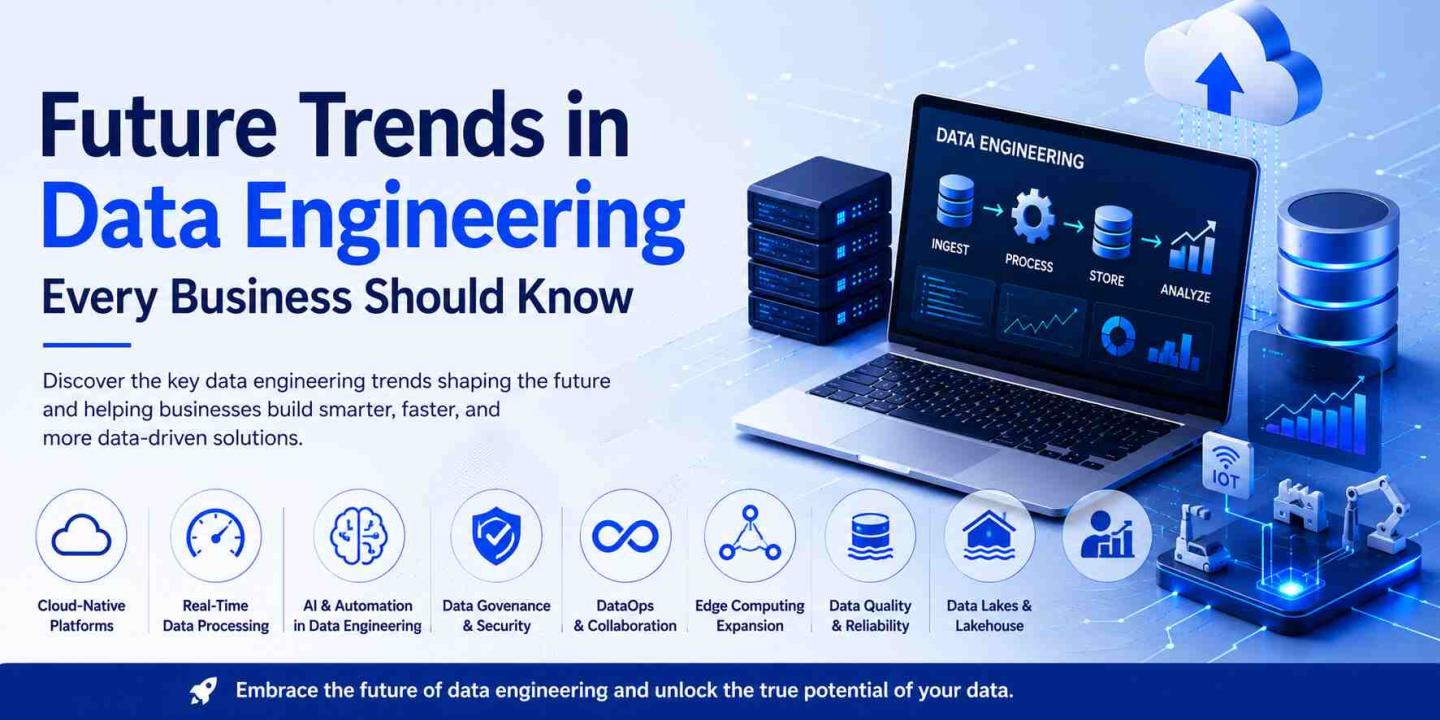
In today’s digital-first world, businesses generate massive amounts of data every second. From customer interactions and online transactions to operational metrics and IoT devices, organizations rely heavily on data to make informed decisions. However, collecting data alone is not enough. Businesses need efficient systems to manage, process, and analyze this information in real time. This is where modern data engineering plays a critical role.
As technology continues to evolve, companies are adopting advanced strategies to improve data management, scalability, and analytics. Understanding the future trends in data engineering can help businesses stay competitive, improve efficiency, and unlock new growth opportunities.
1. Rise of Cloud-Native Data Platforms
Cloud computing has transformed the way businesses manage their data infrastructure. Cloud-native data platforms are gradually replacing traditional on-premise systems because they offer greater flexibility, scalability, and cost efficiency.
Cloud-based architectures allow businesses to process large volumes of data without investing heavily in physical infrastructure. Companies are increasingly using platforms like Azure, AWS, and Google Cloud to build scalable data ecosystems that support real-time analytics and machine learning.
As more organizations move toward digital transformation, cloud-native solutions will become a major component of modern data engineering services. Businesses can scale resources instantly, reduce downtime, and improve collaboration across departments.
2. Real-Time Data Processing Will Become Essential
In the past, businesses analyzed data in batches, often waiting hours or even days for reports. Today, organizations require real-time insights to make faster and smarter decisions.
Industries such as finance, healthcare, retail, and e-commerce depend on real-time data processing for fraud detection, customer behavior analysis, inventory management, and personalized experiences. Technologies like Apache Kafka, Spark Streaming, and Flink are helping companies process streaming data in real time.
Real-time analytics enables businesses to respond quickly to market changes and customer demands. As competition increases, companies that adopt real-time data strategies will gain a significant advantage.
3. Artificial Intelligence and Automation in Data Engineering
Artificial intelligence (AI) is becoming a major part of data engineering. AI-powered tools can automate repetitive tasks such as data cleansing, transformation, monitoring, and pipeline management.
Automation reduces manual effort, minimizes errors, and improves operational efficiency. Machine learning algorithms can also identify anomalies, optimize workflows, and predict system failures before they occur.
In the future, businesses will increasingly rely on intelligent automation to manage complex data environments. Advanced AI solutions will help organizations process larger datasets faster while improving accuracy and performance.
4. Growing Importance of Data Governance and Security
As businesses collect more data, concerns about privacy, compliance, and cybersecurity continue to grow. Governments and regulatory bodies are implementing stricter data protection laws, making data governance more important than ever.
Organizations must ensure that sensitive information is stored securely and accessed only by authorized users. Data encryption, role-based access control, and compliance monitoring will become standard practices across industries.
Modern businesses are also focusing on building secure and compliant data infrastructures that meet regulations such as GDPR and other privacy standards. Strong governance policies help companies maintain customer trust and avoid costly penalties.
5. DataOps Will Improve Collaboration and Efficiency
DataOps is emerging as one of the most important trends in the data industry. Similar to DevOps in software development, DataOps focuses on improving collaboration between data engineers, analysts, and business teams.
By automating workflows and standardizing processes, DataOps helps organizations deliver high-quality data faster and more efficiently. It reduces bottlenecks, improves communication, and accelerates analytics delivery.
Companies adopting DataOps practices can improve productivity while ensuring consistency across data pipelines. As businesses demand faster insights, DataOps will become essential for modern data management strategies.
6. Expansion of Edge Computing
The growth of IoT devices and connected technologies is driving the demand for edge computing. Instead of sending all data to centralized cloud servers, edge computing processes data closer to the source.
This approach reduces latency, improves response times, and lowers bandwidth costs. Industries such as manufacturing, healthcare, logistics, and smart cities are increasingly adopting edge computing to support real-time operations.
As edge devices continue to generate massive amounts of information, businesses will need advanced data engineering services to manage and integrate edge data effectively with cloud environments.
7. Increased Focus on Data Quality
Poor-quality data can lead to inaccurate reports, bad business decisions, and operational inefficiencies. As organizations become more data-driven, maintaining high data quality will become a top priority.
Businesses are investing in tools and frameworks that automatically detect duplicates, inconsistencies, and missing values. Clean and reliable data improves analytics accuracy and supports better decision-making.
Future data engineering strategies will focus heavily on ensuring data accuracy, consistency, and reliability across all systems and platforms.
8. Data Lakes and Lakehouse Architectures
Traditional data warehouses are evolving into more flexible architectures such as data lakes and lakehouses. These systems allow businesses to store both structured and unstructured data in a centralized environment.
Lakehouse architectures combine the scalability of data lakes with the performance and reliability of data warehouses. This hybrid approach supports advanced analytics, AI workloads, and business intelligence applications.
Organizations adopting modern data architectures can process large datasets more efficiently while reducing storage and operational costs.
9. Self-Service Analytics Will Continue to Grow
Businesses no longer want to depend entirely on technical teams for analytics. Self-service analytics platforms allow non-technical users to access and analyze data independently.
Interactive dashboards, drag-and-drop reporting tools, and AI-powered insights are making analytics more accessible across organizations. This trend empowers teams to make data-driven decisions quickly without waiting for IT support.
To support self-service analytics, companies need robust data infrastructure and scalable data engineering services to ensure reliable, accurate information delivery.
Conclusion
The future of data engineering is evolving rapidly as businesses continue to embrace digital transformation, cloud technologies, AI, and real-time analytics. Organizations that invest in modern data strategies can improve efficiency, enhance decision-making, and gain a competitive edge in the market.
From cloud-native platforms and automation to edge computing and DataOps, these trends are shaping the future of enterprise data management. Businesses that stay ahead of these innovations will be better prepared to handle growing data demands and changing customer expectations.
As the need for scalable and reliable data solutions continues to grow, professional data engineering services will play a crucial role in helping organizations build secure, efficient, and future-ready data ecosystems.