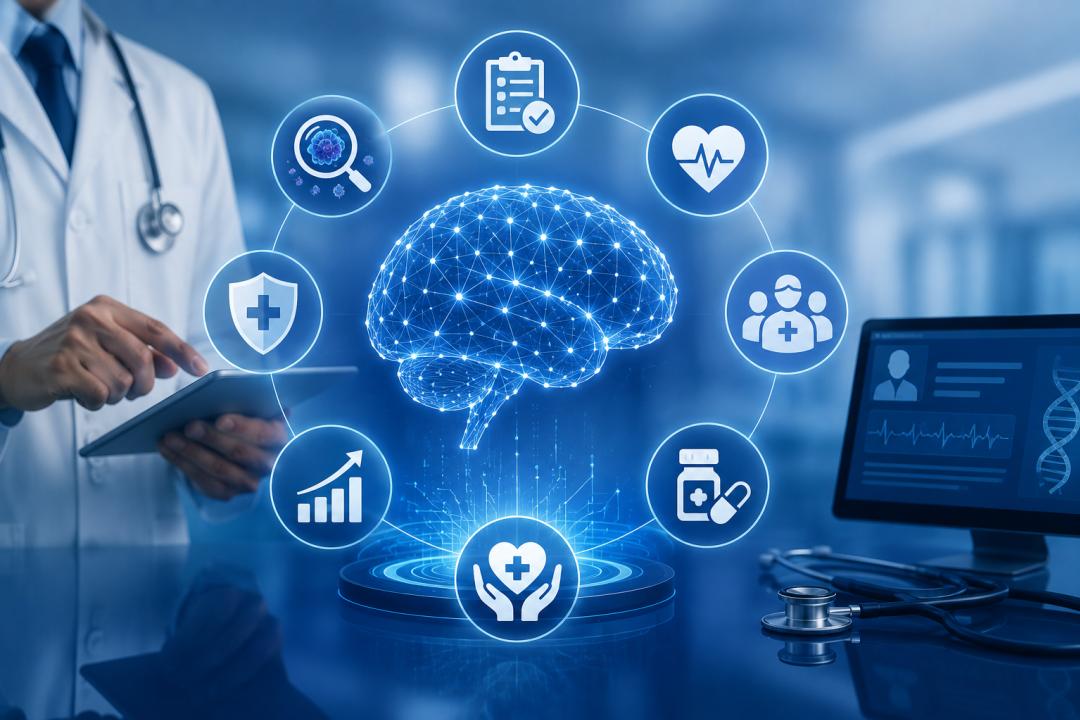
The healthcare industry is undergoing a significant transformation driven by advanced technologies such as Artificial Intelligence (AI) and Machine Learning (ML). As healthcare organizations strive to improve patient outcomes, reduce operational costs, and enhance clinical efficiency, machine learning has emerged as a powerful tool for innovation.
Machine learning enables healthcare systems to analyze vast amounts of medical data, identify patterns, make predictions, and automate complex processes. From disease diagnosis and personalized treatment plans to drug discovery and hospital management, machine learning is revolutionizing nearly every aspect of healthcare.
In this article, we'll explore the key benefits of machine learning in the healthcare industry and how it is shaping the future of patient care.
What is Machine Learning in Healthcare?
Machine learning is a subset of artificial intelligence that allows computers to learn from data and improve their performance without being explicitly programmed. In healthcare, ML algorithms analyze patient records, medical images, laboratory results, and real-time health data to support decision-making and improve healthcare delivery.
Healthcare providers use machine learning to:
- Detect diseases earlier
- Predict patient outcomes
- Personalize treatment plans
- Improve operational efficiency
- Enhance medical research
As healthcare data continues to grow, machine learning plays a crucial role in extracting actionable insights that can improve both clinical and business outcomes.
1. Improved Disease Detection and Diagnosis
One of the most significant benefits of machine learning in healthcare is its ability to improve diagnostic accuracy.
ML algorithms can analyze:
- Medical imaging scans
- X-rays
- MRIs
- CT scans
- Pathology reports
These systems can identify abnormalities and detect diseases such as cancer, heart disease, and neurological disorders with remarkable accuracy.
Benefits:
- Earlier disease detection
- Reduced diagnostic errors
- Faster diagnosis
- Better patient outcomes
By assisting healthcare professionals with data-driven insights, machine learning helps improve the quality of care.
2. Personalized Treatment Plans
Every patient responds differently to treatments. Machine learning helps healthcare app development solutions providers develop personalized treatment strategies based on individual patient data.
ML systems analyze:
- Medical history
- Genetic information
- Life>
- Previous treatment outcomes
This enables doctors to recommend therapies that are most likely to be effective for specific patients.
Benefits:
- Better treatment success rates
- Reduced adverse reactions
- Customized patient care
- Improved patient satisfaction
Personalized medicine is becoming increasingly important in modern healthcare.
3. Predictive Analytics for Better Healthcare Outcomes
Machine learning excels at predicting future events based on historical data.
Healthcare organizations use predictive analytics to:
- Identify high-risk patients
- Predict disease progression
- Forecast hospital admissions
- Detect potential complications
For example, machine learning models can predict the likelihood of a patient developing chronic diseases such as diabetes or cardiovascular conditions.
Benefits:
- Preventive healthcare
- Reduced hospital readmissions
- Improved resource allocation
- Enhanced patient monitoring
Predictive analytics enables healthcare providers to take proactive measures before problems become severe.
4. Faster Drug Discovery and Development
Traditional drug development is expensive and time-consuming, often taking years and billions of dollars.
Machine learning accelerates this process by:
- Identifying promising drug candidates
- Analyzing molecular structures
- Predicting drug interactions
- Optimizing clinical trials
Pharmaceutical companies are increasingly using machine learning to reduce research timelines and improve drug development success rates.
Benefits:
- Faster drug discovery
- Lower research costs
- Improved clinical trial efficiency
- Accelerated innovation
This can lead to quicker access to life-saving treatments for patients.
5. Enhanced Medical Imaging Analysis
Medical imaging generates enormous amounts of data that require expert interpretation.
Machine learning solutions can assist radiologists by:
- Highlighting abnormalities
- Detecting tumors
- Identifying fractures
- Analyzing organ conditions
These systems can process images much faster than traditional methods while maintaining high levels of accuracy.
Benefits:
- Improved imaging interpretation
- Faster diagnosis
- Reduced workload for radiologists
- Better patient care
Machine learning is becoming an essential tool in diagnostic imaging.
6. Remote Patient Monitoring
The rise of wearable devices and connected health technologies has created new opportunities for remote patient monitoring.
Machine learning can analyze data from:
- Smartwatches
- Fitness trackers
- Glucose monitors
- Heart rate monitors
This enables healthcare providers to monitor patients in real time and detect potential health issues before they become emergencies.
Benefits:
- Continuous health monitoring
- Early intervention
- Reduced hospital visits
- Improved chronic disease management
Remote monitoring is especially valuable for elderly patients and those with chronic conditions.
7. Improved Hospital Operations and Efficiency
Machine learning is not limited to clinical applications. It also helps healthcare organizations optimize administrative and operational processes.
Applications include:
- Staff scheduling
- Resource allocation
- Bed management
- Supply chain optimization
By automating routine tasks and improving operational decision-making, hospitals can increase efficiency and reduce costs.
Benefits:
- Lower operational expenses
- Better resource utilization
- Reduced administrative burden
- Improved workflow efficiency
Efficient operations ultimately contribute to better patient experiences.
8. AI-Powered Virtual Assistants and Chatbots
Healthcare organizations are increasingly using machine learning-powered chatbots and virtual assistants to support patients.
These tools can:
- Schedule appointments
- Answer common questions
- Provide medication reminders
- Offer symptom assessments
Benefits:
- Improved patient engagement
- 24/7 support availability
- Reduced workload for healthcare staff
- Faster response times
Virtual assistants help healthcare providers deliver more accessible care.
9. Better Clinical Decision Support
Machine learning can assist physicians by providing data-driven recommendations during the decision-making process.
Clinical decision support systems analyze:
- Patient records
- Medical literature
- Treatment guidelines
- Real-time health data
Benefits:
- More informed clinical decisions
- Reduced medical errors
- Improved treatment outcomes
- Enhanced physician productivity
These systems complement human expertise rather than replace healthcare professionals.
10. Reduced Healthcare Costs
One of the most attractive benefits of machine learning is its ability to reduce healthcare expenses.
Cost savings come from:
- Early disease detection
- Preventive care
- Improved operational efficiency
- Reduced hospital readmissions
- Automated administrative tasks
Benefits:
- Lower treatment costs
- Improved resource management
- Enhanced profitability for healthcare organizations
- Better access to care for patients
Machine learning helps create a more sustainable healthcare ecosystem.
Future of Machine Learning in Healthcare
The future of machine learning in healthcare looks extremely promising. Emerging innovations include:
- AI-powered diagnostics
- Precision medicine
- Robotic surgery assistance
- Predictive population health management
- Advanced clinical decision support
As healthcare organizations continue to embrace digital transformation, machine learning will play an increasingly important role in delivering smarter, faster, and more personalized care.
Conclusion
Machine learning is transforming the healthcare industry by improving diagnosis, personalizing treatments, enhancing patient monitoring, accelerating drug discovery, and optimizing hospital operations. Its ability to analyze vast amounts of healthcare data enables providers to make better decisions, improve patient outcomes, and reduce healthcare application development costs.
As technology continues to evolve, machine learning will become an essential component of modern healthcare systems, helping organizations deliver more efficient, accurate, and patient-centered care. Healthcare providers that embrace machine learning today will be better positioned to meet the growing demands of the future healthcare landscape.