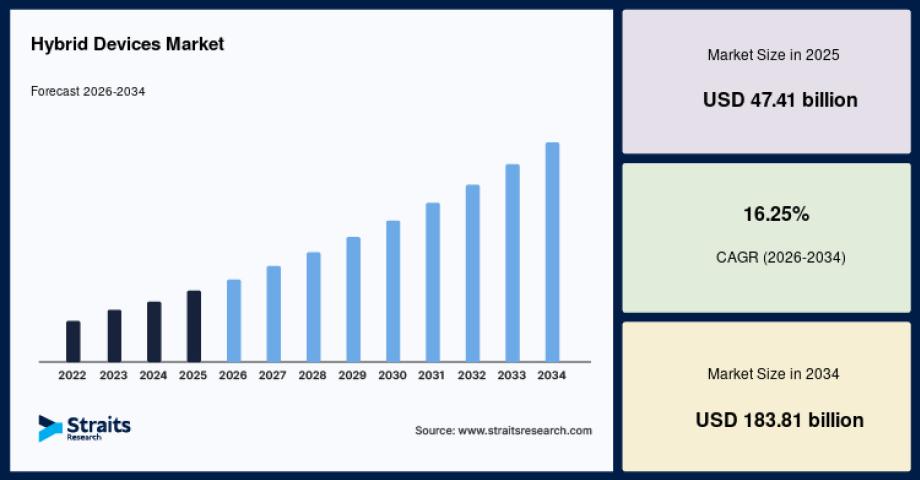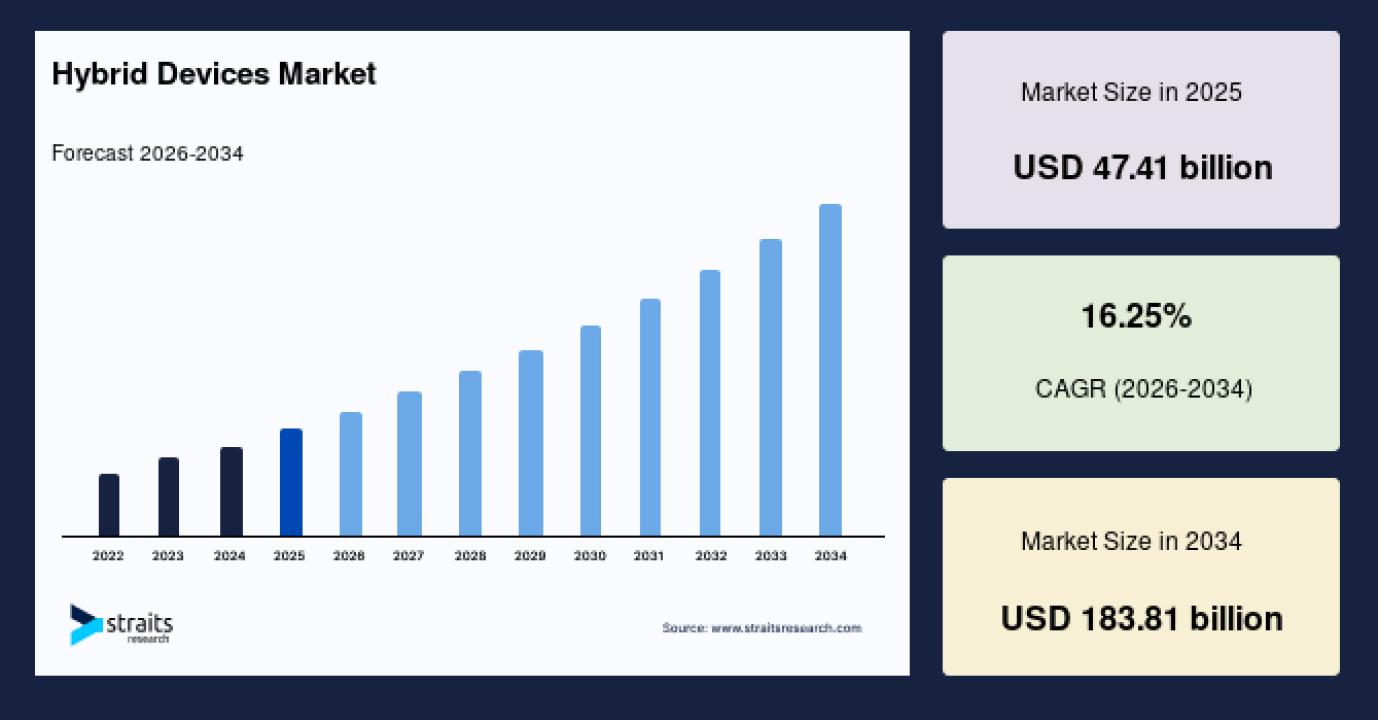
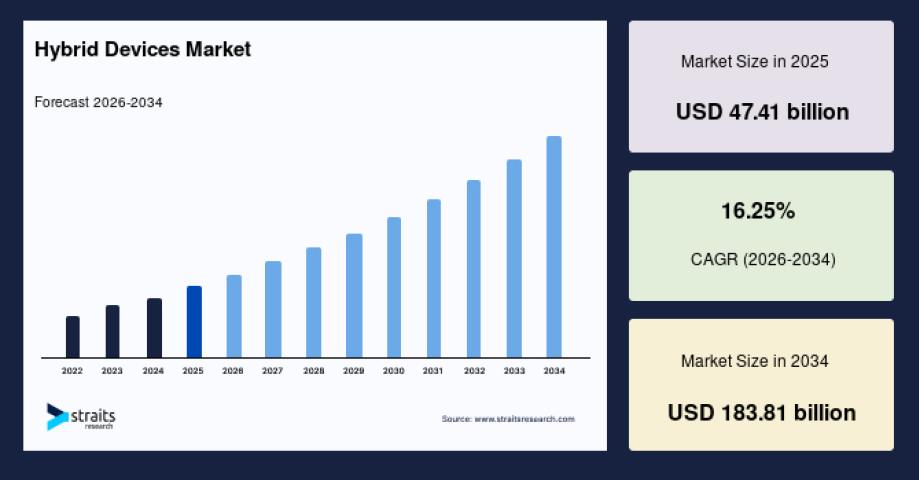
The global hybrid devices market is witnessing substantial growth due to increasing demand for versatile computing devices, rising adoption of remote and hybrid work models, and continuous advancements in mobile computing technologies. The global hybrid devices market size was valued at USD 47.41 billion in 2025 and is projected to grow from USD 55.11 billion in 2026 to USD 183.81 billion by 2034, registering a CAGR of 16.25% during the forecast period (2026–2034).
The market is expanding rapidly as consumers and enterprises increasingly seek devices that combine the functionality of laptops and tablets in a single platform. Hybrid devices offer portability, flexibility, enhanced productivity, and seamless user experiences, making them highly attractive for professionals, students, and business organizations. Technological advancements in touchscreen displays, detachable keyboards, and high-performance processors are further fueling market growth.
Market Drivers
One of the primary factors driving the hybrid devices market is the growing popularity of remote and hybrid work environments. Organizations are increasingly equipping employees with versatile devices that support mobility, collaboration, and productivity across different work settings.
Another significant growth driver is the increasing demand for lightweight and portable computing solutions. Consumers prefer devices that can easily transition between tablet and laptop modes while maintaining strong performance and extended battery life.
The rapid growth of digital learning and e-learning platforms is also contributing to market expansion. Educational institutions and students are increasingly adopting hybrid devices for online learning, content creation, and collaborative activities.
Furthermore, advancements in processor technologies, operating systems, touch interfaces, and connectivity solutions are enhancing device performance and creating new opportunities for manufacturers.
Market Challenges
Despite strong growth prospects, the hybrid devices market faces several challenges. One major restraint is the relatively high cost of premium hybrid devices compared to conventional laptops and tablets, which may limit adoption among price-sensitive consumers.
Another challenge is the intense competition among manufacturers, leading to pricing pressures and reduced profit margins. Companies must continuously innovate to differentiate their products and maintain market share.
Additionally, concerns regarding device durability, battery performance, and compatibility across various software applications may impact purchasing decisions for some users.
Market Segmentation
By Product Type:
- Detachable Hybrid Devices
- Convertible Hybrid Devices
- 2-in-1 Laptops
- Others
The detachable hybrid devices segment holds a significant market share due to their flexibility, portability, and ability to function independently as tablets.
By Operating System:
- Windows
- Android
- iOS
- Chrome OS
- Others
The Windows segment dominates the market owing to its widespread adoption in enterprise environments and compatibility with a broad range of productivity applications.
By Screen Size:
- Below 12 Inches
- 12–15 Inches
- Above 15 Inches
The 12–15 inches segment accounts for the largest market share due to its balance between portability and productivity.
By End User:
- Consumer
- Educational Institutions
- Enterprises
- Government Organizations
The enterprise segment represents a significant market share as businesses increasingly deploy hybrid devices to support workforce mobility and digital transformation initiatives.
Regional Insights
North America
North America dominates the global hybrid devices market due to high adoption of advanced computing technologies, strong enterprise demand, and widespread implementation of remote work practices. The United States remains a major contributor to regional growth.
Europe
Europe represents a significant market supported by increasing digitalization initiatives, growing demand for mobile work solutions, and expanding adoption of hybrid learning models across educational institutions.
Asia-Pacific
Asia-Pacific is expected to witness the fastest growth during the forecast period owing to rising consumer electronics demand, expanding internet penetration, growing educational technology investments, and increasing adoption of digital workplaces across China, Japan, India, and South Korea.
Latin America, Middle East, and Africa
These regions are emerging markets driven by improving digital infrastructure, increasing technology adoption, and growing investments in education and enterprise mobility solutions.
Key Players Analysis
The hybrid devices market is highly competitive, with leading manufacturers focusing on product innovation, advanced hardware integration, and strategic partnerships to strengthen their market positions. Key companies operating in the market include:
- Microsoft Corporation
- Lenovo Group Limited
- HP Inc.
- Dell Technologies Inc.
- Acer Inc.
- ASUSTek Computer Inc.
- Samsung Electronics Co., Ltd.
- Apple Inc.
- Huawei Technologies Co., Ltd.
- Fujitsu Limited
These companies continue investing in next-generation processors, AI-enabled features, enhanced display technologies, and productivity-focused innovations to meet the evolving demands of consumers and enterprises.
For Detailed Insights, Visit:
https://straitsresearch.com/report/hybrid-devices-market
About Us
Straits Research is a leading market research and intelligence organization specializing in research, analytics, and advisory services. The company provides comprehensive market reports, industry insights, and strategic business intelligence across multiple industries, helping organizations identify growth opportunities and make informed business decisions.
Contact Us
Email: sales@straitsresearch.com
Tel: +1 646 905 0080 (U.S.), +44 203 695 0070 (U.K.)