How to Build a
Prediction Market Platform in 2026: A Complete Developer and Business Guide
Prediction markets are no longer niche tools for forecasters
and economists. In 2026, they represent one of the fastest-growing segments in
decentralized finance, attracting institutional investors, fintech startups,
and blockchain developers alike. Whether the goal is to launch a crypto-native
platform like Polymarket or a regulated exchange like Kalshi, the market
opportunity is real — and the window to capture it is open.
This blog covers Step by
Step road map of building a prediction market platform: what it is, the
core features it must have, a step-by-step development roadmap, revenue models
that generate sustainable income, and why the prediction market space is a
legitimate business priority in 2026.
What Is a Prediction
Market? A Clear Definition
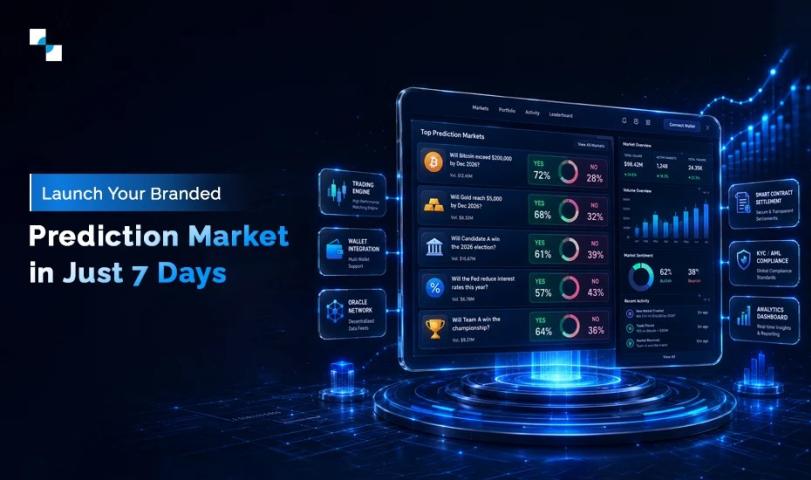
A prediction market is an outcome-driven trading system
where participants buy and sell contracts tied to the probability of future
events. Each contract's price reflects the collective belief of all market
participants about the likelihood of a specific outcome occurring.
Unlike traditional forecasting methods — surveys, analyst
reports, or expert panels — prediction markets aggregate real financial
commitments. When participants stake money on an outcome, they are incentivized
to research and reason carefully rather than guess arbitrarily. This produces
forecasts that consistently outperform conventional methods, which is why
governments, research institutions, and corporate strategy teams are
increasingly paying attention.
Platforms can settle predictions using fiat currency,
stablecoins, or native crypto tokens, depending on the audience and regulatory
environment they serve.
Key Features a
Prediction Market Platform Must Have in 2026
Building a platform that attracts users and retains them
requires more than a basic trading interface. The following features are
considered table-stakes for any competitive prediction market launched today.
1. Intuitive, Interactive
User Interface
Market participants range from first-time users to
professional traders. The platform interface must surface active markets
clearly, display real-time odds in an easy-to-read format, and deliver live
updates without requiring page refreshes. A well-designed UI directly reduces
drop-off and increases average session time.
2. Flexible Market
Creation Tools
Platform administrators and — on some models — whitelisted
users need the ability to create prediction events with defined outcomes,
settlement deadlines, and market rules. Flexible market creation makes it
possible to cover a broad range of events: financial markets, sports,
geopolitics, entertainment, corporate earnings, and more.
3. Real-Time Pricing
and Order Execution
Participants must receive instant updates on odds and
pricing. Delayed feeds undermine trust and push experienced traders toward
competing platforms. Real-time pricing also supports better prediction
accuracy, since markets respond dynamically as new information enters the
public domain.
4. Multi-Currency
Wallet and Payment Integration
A prediction market with global ambitions must accept both
crypto and fiat payments. Multi-wallet support — covering major networks like
EVM-compatible chains, as well as traditional payment rails — removes friction
from deposits and withdrawals, which is one of the most common reasons users
abandon platforms.
5. Analytics and
Market Insights Dashboard
Users need to track their prediction history, win rates, and
portfolio performance. Administrators need oversight of platform-wide activity,
market liquidity, user behavior, and anomaly detection. A robust analytics
layer serves both constituencies and supports data-driven decision-making on
both sides.
6. Multi-Layer
Security and Regulatory Compliance
Security is not a feature — it is the foundation. A
prediction market platform must protect users at every layer: smart contract
audits to eliminate exploitable logic, API authentication with rate limiting to
block abuse, KYC (Know Your Customer) and AML (Anti-Money Laundering)
verification to satisfy regulatory requirements, and geo-restrictions where
legally mandated. Platforms that cut corners on compliance are increasingly
being shut down or de-listed by payment processors.
7. Real-Time
Notifications and Event Alerts
Engagement drops sharply when users miss market resolution
events or fail to act before a deadline. Push notifications and in-app alerts
tied to market activity, outcome settlements, and personalized watchlists keep
participants active and informed.
Step-by-Step Guide to
Building a Prediction Market Platform
Development follows a logical sequence. Each phase builds on
the last, and skipping stages — particularly testing and compliance integration
— carries disproportionate risk in a financial-grade product.
Step 1: Define
Platform Goals, Audience, and Revenue Model
Every successful platform starts with a clearly articulated
purpose. At this stage, the development partner and business stakeholder
collaborate to answer a set of foundational questions: Who is the target
audience — retail crypto users, institutional traders, or enterprise clients?
What category of events will the platform cover? What regulatory jurisdiction
will it operate in? What does the monetization model look like?
The answers to these questions determine every downstream
technical and product decision, from smart contract architecture to the choice
of compliance stack.
Step 2: Select the
Technology Stack
Technology choices have long-term consequences for platform
speed, scalability, maintenance cost, and developer ecosystem access. A modern
prediction market platform typically combines:
• Frontend:
React or Next.js for a responsive, SEO-friendly user interface
• Backend:
Node.js or Python with RESTful or GraphQL APIs
• Blockchain
layer: Ethereum, Polygon, or Arbitrum for smart contract execution
• Cloud
infrastructure: AWS or GCP for scalable compute and storage
• Data
feeds: Oracle integrations for real-world event outcomes
Step 3: Design the
System Architecture:
Architecture design determines how the on-chain and
off-chain components interact. Smart contracts handle ownership, settlement
logic, and token distribution. Off-chain systems manage order matching, user
session state, and real-time data delivery — tasks that are too expensive or
slow to execute on-chain.
The frontend communicates with the backend via APIs, while
the backend connects to the blockchain to ensure transaction transparency.
Platforms must also decide whether to use an Automated Market Maker (AMM) model
— simpler to operate but less capital efficient — or an order book model, which
provides tighter spreads but requires deeper liquidity.
Step 4: Develop and
Audit Smart Contracts:
Smart contracts are the operational core of a decentralized
prediction market. They govern market creation, outcome resolution, position
tracking, and payout distribution. The code must be clean, well-documented, and
— critically — audited by an independent security firm before deployment.
Complex smart contract logic increases attack surface.
Simpler, modular contracts with clearly defined inputs and outputs are easier
to audit, cheaper to deploy, and less vulnerable to edge-case exploits that
have cost prediction market protocols millions of dollars historically.
Step 5: Integrate
Oracle and External Data Sources:
Prediction markets depend on reliable, tamper-resistant data
to determine outcomes. Oracles serve as the bridge between the blockchain and
the real world. Leading oracle solutions used in production prediction markets
include Chainlink, UMA's Optimistic Oracle, and Pyth Network.
Oracle selection should consider data source diversity,
dispute resolution mechanisms, latency, and cost. For high-stakes markets —
election outcomes, financial settlements — multiple oracle sources with a
consensus mechanism provide the highest level of fairness and tamper
resistance.
Step 6: Build the
User Interface and Experience:
The front-end experience determines whether a technically
sound platform succeeds commercially. Key UX priorities for prediction markets
include: clear probability displays (percentages and price levels visible at a
glance), fast trade execution flows that minimize confirmation steps, mobile responsiveness,
and accessible onboarding for users unfamiliar with prediction market
mechanics.
First-time users should be able to place a prediction within
two minutes of landing on the platform. Experienced traders should have access
to advanced order types and market depth data without navigating multiple
screens.
Step 7: Implement
Security and Compliance Infrastructure:
Security implementation covers four primary areas. At the
smart contract level: independent audits, formal verification where practical, and
upgrade mechanisms that allow patches without full redeployment. At the API
level: JWT authentication, OAuth integration, rate limiting, and DDoS
protection. At the user level: KYC verification via certified providers, AML
transaction screening, and geo-blocking for restricted jurisdictions. At the
infrastructure level: encrypted data storage, penetration testing, and incident
response procedures.
Compliance is not optional for platforms handling real
financial value. Regulatory alignment — even in jurisdictions with lighter
oversight — builds the institutional trust that drives long-term user
acquisition.
Step 8: Test
Rigorously Before Any Public Launch:
Testing a prediction market platform requires simulating
real-world conditions without exposing real capital to risk. The testing scope
should include: smart contract behavior at edge cases (simultaneous
resolutions, zero-liquidity markets, disputed outcomes), API performance under
concurrent load, UI interaction testing across device types and browsers, and
end-to-end settlement flows.
Deployment follows a staged approach: testnet first for
functional validation, then a closed beta with invited users to gather
structured performance feedback, then mainnet launch after addressing all
identified issues.
Step 9: Monitor,
Scale, and Continuously Improve Post-Launch
Launching is the beginning of the operational phase, not the
end of development. After go-live, the primary concerns are liquidity depth
(thin markets drive users away), platform latency under peak load, and the
cadence of new market creation to sustain engagement.
Ongoing technical support should include database query
optimization, caching layer tuning, smart contract upgrade management, and the
regular addition of new event categories to capture different user segments and
maintain platform relevance.
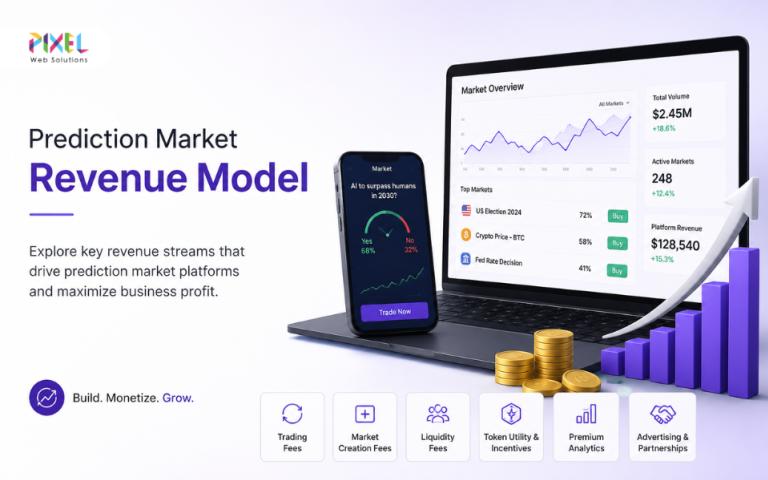
Revenue Streams for
Prediction Market Platforms
A well-structured prediction market generates income from
multiple channels simultaneously, creating a resilient business model that does
not depend on any single revenue source.
Transaction Fees:
A percentage-based fee charged on every trade executed on the platform. This is
the most consistent and scalable revenue stream, growing proportionally with
platform volume.
Market Creation Fees:
A one-time fee charged when any party — individual users or organizations —
creates a new prediction event. This incentivizes platform curation and discourages
low-quality market spam.
Trade Commissions:
A commission collected on successful prediction settlements. Unlike flat
transaction fees, commissions are outcome-linked and typically charged as a
percentage of winnings, which aligns platform incentives with participant
success.
Premium
Subscriptions: A tiered subscription model that provides paying users with
advanced analytics, faster data feeds, higher trading limits, and priority
access to new markets. This segment targets professional and semi-professional
traders who derive tangible value from information advantages.
Data Monetization:
Aggregated, anonymized market data has significant commercial value for
researchers, financial institutions, and media organizations. Licensing this
data through structured agreements creates a recurring, low-overhead revenue
stream.
Token Economy
Revenue: Platforms with native utility tokens generate fees from token
purchases, staking mechanics, governance participation, and in-platform reward
structures. A well-designed token economy also creates a self-reinforcing
engagement loop.
API Access Licensing:
Charging external developers and businesses for access to market data APIs
opens a B2B revenue channel. Third-party integrations also expand the
platform's reach and brand visibility beyond its direct user base.
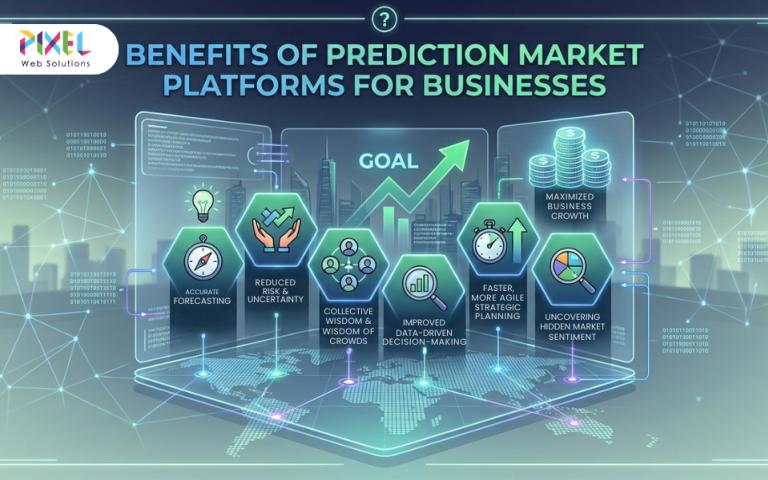
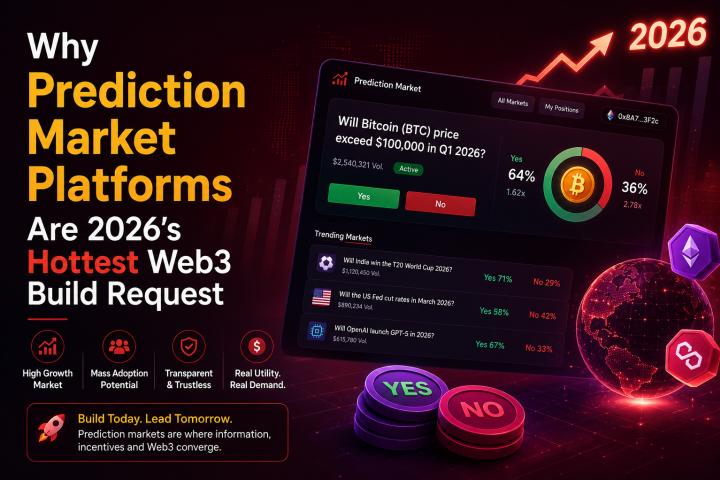
Why Prediction Market
Development Is a Strategic Priority in 2026
Several converging trends make 2026 an unusually favorable
time to build or invest in a prediction market platform.
Collective
Intelligence Produces More Accurate Forecasts:
Decades of academic research and real-world case studies
confirm that prediction markets consistently outperform traditional forecasting
methods — analyst panels, surveys, and internal expert judgment. When
participants commit real capital to their predictions, the resulting market
prices aggregate information more efficiently than any centralized process.
Governments, think tanks, and large corporations are
increasingly treating prediction market outcomes as decision-support inputs
rather than novelty data. This institutional validation is driving platform
adoption beyond the retail crypto audience.
Crypto and Web3
Infrastructure Has Matured:
The infrastructure required to build decentralized
prediction markets — Layer 2 scaling solutions, reliable oracle networks,
cross-chain bridges, and DeFi liquidity layers — is significantly more mature
and battle-tested in 2026 than it was two years ago. Platforms like Polymarket
have demonstrated that decentralized prediction markets can achieve meaningful
trading volumes while maintaining settlement transparency and operating without
a central authority.
Regulatory Clarity Is
Improving in Key Markets:
Regulated prediction market operators, such as Kalshi in the
United States, have successfully established that prediction markets can
operate within existing commodity trading frameworks. This regulatory precedent
reduces the uncertainty that previously deterred institutional investment and
mainstream adoption. Businesses entering the space now can engage with
regulators from a position of established legal precedent rather than
ambiguity.
Business Applications
Are Expanding Beyond Retail:
Prediction markets are increasingly being deployed for
internal enterprise use — forecasting product demand, sales performance,
regulatory outcomes, and technology adoption timelines. Fintech startups are
building vertical-specific platforms targeting specific industries. Media and
content companies are integrating prediction mechanics as audience engagement
tools. Each of these use cases represents a distinct addressable market beyond
traditional retail speculation.
Why Hivelance Is the
Right Partner for Prediction Market Development:
Building a
prediction market platform that operates at financial-grade reliability
requires more than general blockchain development experience. It requires deep
expertise in smart contract security, oracle integration, liquidity mechanics,
and regulatory compliance — combined with the ability to deliver a product that
real users want to engage with.
Hivelance brings all of these capabilities together as a
dedicated blockchain and AI solutions development firm. The team has a
documented track record building prediction market infrastructure, DeFi
platforms, and Web3 applications for clients across multiple jurisdictions.
Working with Hivelance on prediction market development
means:
·
Smart contracts built with security-first
architecture and independent audit readiness
·
Oracle integration using production-proven
providers including Chainlink and Pyth
·
Scalable system design that handles growth from
hundreds to millions of active users
·
Compliance infrastructure covering KYC, AML, and
geo-restriction requirements
·
Post-launch monitoring, performance
optimization, and ongoing feature development
·
A development partner that understands both the
technical and commercial dimensions of prediction market success
The prediction market opportunity is expanding. The
businesses that build thoughtfully, with the right infrastructure and the right
partners, are the ones that will establish lasting market positions.
Ready to build your prediction market platform? Connect with
the Hivelance team to discuss your project requirements.