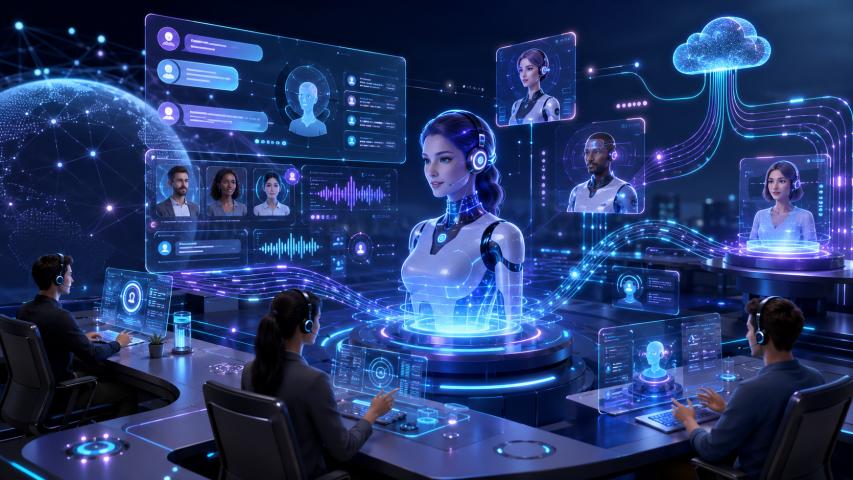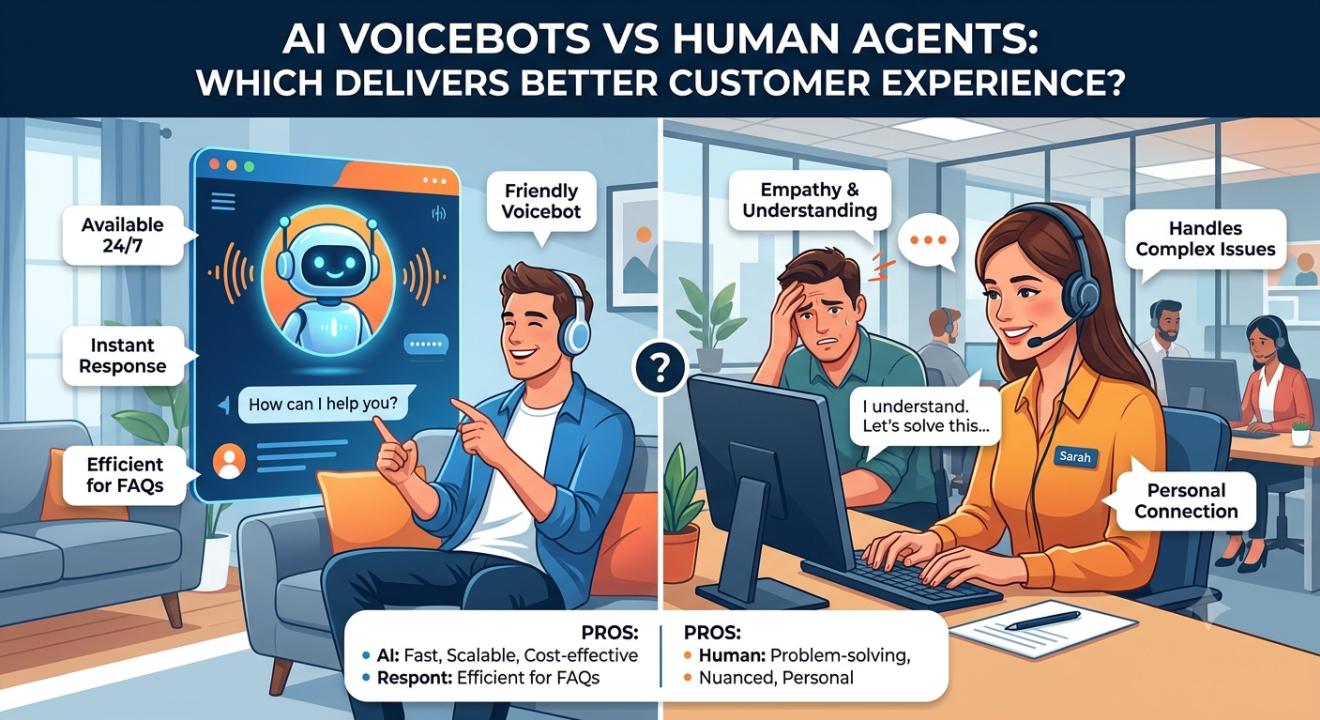
The modern customer service landscape is undergoing a monumental paradigm shift. For decades, the ring of a telephone in a contact center meant one thing: a human agent picking up the receiver, navigating desktop software, and attempting to resolve a customer problem. Today, that interaction looks radically different. The rise of Conversational AI has introduced sophisticated AI voicebots capable of handling fluid, natural spoken dialogue with startling human-like nuance.
This technological leap has sparked an intense debate among Chief Experience Officers (CXOs) and customer service leaders: AI Voicebots vs. Human Agents—which actually delivers a better Customer Experience (CX)?
To answer this question, we must look beyond binary arguments. The truth is neither universally digital nor entirely human. Instead, the ultimate customer experience lies at the intersection of immediate algorithmic efficiency and contextual emotional intelligence. This comprehensive analysis evaluates both sides across critical operational dimensions, examining where each triumphs, where they falter, and how tomorrow's market leaders are synthesizing them into a hybrid model.
The Case for AI Voicebots: Scalability and Speed
AI voicebots—powered by Advanced Large Language Models (LLMs), highly precise Automatic Speech Recognition (ASR), and natural Text-to-Speech (TTS)—have moved far past the rigid, frustrating Interactive Voice Response (IVR) menus of old. They don't require users to "press 1 for billing." Instead, they open with a simple, open-ended question: "How can I help you today?"
From a customer experience standpoint, voicebots solve the two most deeply despised pain points of traditional customer service: long hold times and restricted operational hours.
1. Zero Latency and Absolute Availability
Human capacity is inherently finite. When a major airline cancels hundreds of flights due to weather, or a bank experiences a sudden digital banking outage, human call centers quickly become bottlenecked. Hold times skyrocket into hours, instantly damaging brand sentiment. AI voicebots offer infinite scalability. They can handle ten concurrent calls or ten thousand simultaneously, ensuring that every customer is greeted on the very first ring. Operating 24/7/365, they accommodate consumers on their own terms, eliminating the restriction of traditional business hours.
2. Data Integration and Instant Execution
While a human agent must manually toggle between CRM databases, billing portals, and ticketing systems, an AI voicebot operates via direct API connectivity. The moment a customer verifies their identity via voice biometrics, the bot pulls their complete transaction history, open tickets, and behavioral profile instantaneously. This allows for rapid execution of transactional requests—such as processing a return, changing a booking, resetting a password, or checking an order status—in a fraction of the time a human agent would take.
3. Eliminating the "Agent Roulette"
Human customer service is plagued by variance. A customer's experience depends entirely on the specific agent they reach—their training, mood, fatigue levels, and tenure. AI voicebots deliver flawless consistency. They are never tired, never have a bad day, and never lose patience with an escalated customer. They strictly adhere to brand guidelines, compliance standards, and data security protocols with mathematical precision.
The Case for Human Agents: Empathy, Nuance, and Relationship Building
Despite the technological marvel of artificial intelligence, human beings possess a deep, biological monopoly on specific cognitive and emotional traits that silicon cannot replicate. When an interaction moves past simple data retrieval into highly nuanced territory, human agents remain entirely unmatched.
1. True Emotional Intelligence (EQ) and De-escalation
An AI can be programmed to say, "I understand that you are frustrated, and I apologize." However, a customer can easily perceive the difference between simulated compliance and true human empathy. In high-stakes situations—such as a fraudulent charge on a credit card, a denied medical claim, or a missed flight to a family funeral—customers are anxious, angry, or distressed. A skilled human agent reads micro-inflections in a caller's voice, matches their pace, offers sincere validation, and uses emotional intelligence to calm an upset customer. Empathy is a powerful driver of brand loyalty, and it requires a human heart.
The Paradox of Efficiency: While optimizing for speed makes perfect sense for transactional queries, forcing an anxious customer through an automated script during an emotional crisis can actively destroy brand trust. High-quality customer experience values thorough resolution over speed when the issue is complex.
2. Navigating Contextual Nuance and Ambiguity
Human speech is full of idioms, sarcasm, non-linear storytelling, and ambiguous phrasing. A customer might say: "Well, my machine is doing that weird clicking thing again, kind of like it did last summer before it gave up the ghost." An AI voicebot may struggle to parse "gave up the ghost" or quantify "weird clicking thing" without structured inputs. A human agent instantly synthesizes this context, drawing on tribal knowledge, past experiences, and intuitive leaps to diagnose the issue without forcing the customer to rephrase their problem into clean, robotic sentences.
3. Creative Problem-Solving and Flexibility
AI operates within defined boundaries, guardrails, and programmatic logic. It cannot break or bend a rule, even when doing so makes clear business sense. Human agents possess the agency and creative discretion to make judgment calls. If a long-time, high-value customer is technically outside a 30-day return window but presents an extraordinary circumstance, a human supervisor can choose to issue a credit to preserve a multi-year customer relationship. Humans can navigate "grey areas" where automated algorithms see only black and white.
Side-by-Side Comparison Matrix
To better evaluate how these two forces balance against each other, let us look at their direct performance across key customer service metrics:
| Metric | AI Voicebots | Human Agents |
| Average Speed to Answer (ASA) | Instantaneous (0 seconds). Eliminates hold times completely. | Variable. Dependent on call volumes, staffing levels, and peak hours. |
| Handling of Complex Issues | Poor. Struggles with multi-part problems or ambiguous context. | Excellent. Exceptional at deep diagnostics, triage, and abstract reasoning. |
| Emotional Support & EQ | Simulated. Synthesized text cannot provide genuine human connection. | Authentic. Naturally reads, mirrors, and effectively de-escalates high emotions. |
| Cost per Interaction | Extremely Low. Fractional incremental cost once infrastructure is built. | High. Involves continuous salaries, benefits, training, and facility overhead. |
| Scalability | Infinite. Handles traffic spikes effortlessly with zero extra headcount required. | Linear. Requires more staff, overtime, or outsourcing to scale up capacity. |
The Verdict: It’s Not AI vs. Human; It’s AI + Human
When asking who delivers a better customer experience, the definitive answer is: neither can do it alone. An organization that relies exclusively on AI voicebots will alienate customers who need empathy and creative problem-solving, building an image of a cold, unreachable corporation. Conversely, a company that relies entirely on human agents will struggle with high overhead costs, long hold times, and operational bottlenecks that frustrate modern, fast-paced consumers.
The highest tier of customer experience is achieved through a coordinated hybrid model, often called a "Human-in-the-Loop" architecture. In this ecosystem, AI voicebots and human agents operate as partners rather than competitors.
1. Smart Tiering and Frictionless Handoffs
The AI voicebot serves as a highly capable first line of defense. It filters out high-volume, low-complexity inquiries—such as balance inquiries, password resets, and package tracking. This concept, known as "deflection," keeps simple calls out of human queues. When the voicebot detects a complex issue, notices a customer becoming emotionally frustrated, or is handed a high-value tier account, it triggers a warm transfer to a human agent. Crucially, the AI passes a complete transcript and summary of the conversation to the agent's desktop screen, so the customer never has to repeat their story.
2. AI-Augmented Human Excellence
When a call transfers to a human agent, the AI's job isn't over; it transitions into a real-time copilot. The AI listens to the live call, automatically retrieving relevant knowledge-base articles, surfacing compliance scripts, and suggesting optimal solutions for the agent. This dramatically lowers the human agent's cognitive load, reducing Average Handle Time (AHT) while allowing them to focus entirely on building a meaningful relationship with the caller.
Conclusion: Designing Tomorrow’s CX Strategy
The question shouldn't be about whether to choose artificial intelligence or human labor to run your customer experience. The real challenge is determining exactly where to draw the line between automation and human interaction.
For transactional, quick, and predictable requests, AI Voicebots provide a superior experience by offering immediate, round-the-clock resolution.
For emotional, high-stakes, and nuanced scenarios, Human Agents deliver a superior experience through empathy and creative problem-solving.
Forward-thinking brands must invest heavily in both. By deploying sophisticated AI voicebots to handle routine tasks, companies give their human workforce the time and space to focus on what they do best: delivering authentic empathy, building deep customer relationships, and resolving complex issues that keep customers loyal for life.