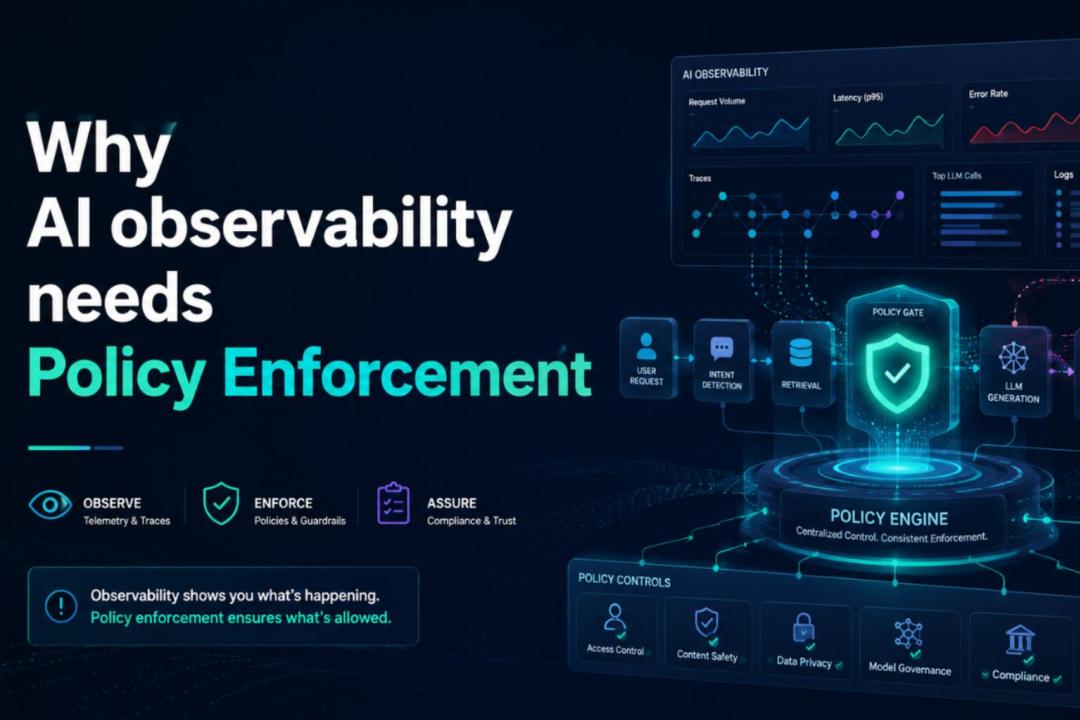
Artificial intelligence has moved far beyond experimentation. Enterprises are deploying large language models (LLMs), AI agents, retrieval-augmented generation (RAG) systems, and predictive models into customer-facing applications, internal workflows, and critical business processes.
Yet many organizations make a common mistake: they invest heavily in building AI systems but fail to invest equally in monitoring and observing them once they enter production.
An AI chatbot that performs well during testing may begin generating inaccurate responses after deployment. A RAG application may start retrieving outdated documents. An AI agent may execute unexpected actions. Token consumption may suddenly spike, increasing operational costs without a clear explanation.
Unlike traditional software, AI systems are probabilistic. Their behavior can change based on data, user interactions, model updates, and environmental factors. As a result, organizations need far more than infrastructure monitoring. They need comprehensive AI production monitoring and observability.
The reality is simple: you cannot govern what you cannot see.
This guide explains what AI production monitoring and observability are, why they matter, and how enterprises can implement a strategy that supports reliability, security, compliance, and continuous AI assurance.
What Is AI Production Monitoring?
AI production monitoring is the continuous process of tracking the health, performance, behavior, and risks of AI systems after deployment.
Its purpose is to ensure that AI applications continue to operate as expected while delivering accurate, secure, and compliant outcomes.
Unlike traditional application monitoring, AI production monitoring goes beyond infrastructure metrics such as CPU utilization, memory consumption, and API uptime.
Enterprise AI teams must monitor:
- Response latency
- Availability
- Model performance
- Output quality
- Hallucination rates
- User satisfaction
- Security threats
- Policy violations
- Operational costs
- Business outcomes
The challenge is that an AI system can appear healthy from an infrastructure perspective while simultaneously producing poor results.
For example:
- APIs may be responding normally.
- Servers may be fully operational.
- Network traffic may look healthy.
Yet the AI system could be generating inaccurate recommendations, exposing sensitive information, or producing outputs that violate organizational policies.
This is why AI monitoring requires a fundamentally different approach.
What Is AI Observability?
While monitoring focuses on identifying issues, observability focuses on understanding them.
Monitoring answers:
What happened?
Observability answers:
Why did it happen?
AI observability provides deep visibility into the internal behavior of AI systems.
This includes:
- User inputs
- Prompts
- Model outputs
- Retrieval processes
- Tool calls
- Agent actions
- Decision pathways
- Execution traces
Rather than simply reporting that an issue occurred, observability helps teams investigate the root cause.
For example, if an AI assistant generates an incorrect answer, observability can reveal:
- Which prompt was executed
- Which documents were retrieved
- Which model was used
- What context was provided
- Which tools were called
- Where the failure occurred
This level of visibility is essential for troubleshooting production AI systems.
Why Traditional Monitoring Is Not Enough for AI
Many organizations initially attempt to manage AI applications using existing monitoring tools.
While these tools remain valuable, they were not designed to understand AI behavior.
Traditional monitoring focuses on:
- Infrastructure health
- Server performance
- Application availability
- Network reliability
These metrics are necessary but insufficient.
Consider the following scenario:
An enterprise chatbot shows:
- 99.99% uptime
- Low latency
- No API errors
- Stable infrastructure
However, customers report:
- Incorrect answers
- Hallucinated information
- Missing citations
- Policy violations
From a traditional monitoring perspective, everything appears normal.
From a business perspective, the system is failing.
This observability gap creates significant risks for organizations deploying AI at scale.
Core Components of AI Production Monitoring
A successful monitoring strategy requires visibility across multiple dimensions.
Performance Monitoring
Performance monitoring measures how efficiently an AI system operates.
Key metrics include:
- Response times
- Throughput
- Availability
- Error rates
- Request volumes
These indicators help ensure that AI applications remain responsive and reliable under production workloads.
Quality Monitoring
Quality monitoring evaluates whether the system is producing useful and accurate outputs.
Metrics may include:
- Accuracy
- Hallucination rates
- Relevance scores
- Grounding effectiveness
- Response consistency
Quality monitoring becomes particularly important for customer-facing and decision-support applications.
Cost Monitoring
AI systems can generate significant operational expenses.
Organizations should continuously track:
- Token consumption
- API usage
- Model costs
- Compute utilization
- Tool execution expenses
Without visibility into these metrics, AI spending can quickly exceed expectations.
User Experience Monitoring
User adoption ultimately determines AI success.
Organizations should measure:
- Satisfaction ratings
- Escalation rates
- Session completion rates
- User feedback
- Retention metrics
Poor user experiences often reveal issues that technical metrics fail to capture.
Security Monitoring
AI systems introduce entirely new attack surfaces.
Monitoring should include:
- Prompt injection attempts
- Sensitive data exposure
- Unauthorized access patterns
- Adversarial inputs
- Suspicious user behavior
Security monitoring plays a critical role in protecting enterprise AI deployments.
Understanding AI Observability for LLM Applications
Modern AI systems involve complex workflows that require specialized observability capabilities.
LLM Applications
Large language model applications require visibility into:
- Prompt execution
- Model selection
- Response generation
- Token utilization
- Failure events
For example, if customer support responses suddenly become less accurate, teams need to understand whether the issue originates from prompts, models, or context.
RAG Systems
Retrieval-Augmented Generation systems introduce additional complexity.
Observability should track:
- Retrieval quality
- Document relevance
- Context coverage
- Source selection
- Citation effectiveness
A RAG application may fail not because the model is inaccurate, but because the retrieval layer supplied poor information.
Without observability, identifying this distinction becomes difficult.
AI Agents
AI agents can perform multi-step actions across systems and workflows.
Organizations should monitor:
- Decision chains
- Tool usage
- Action sequences
- Goal completion rates
- Failure paths
Agent observability is particularly important because autonomous systems can amplify errors if left unchecked.
The Hidden Risks Organizations Miss
Many AI failures emerge gradually rather than as obvious outages.
Observability helps organizations detect these risks before they become major incidents.
Hallucinations
Hallucinations occur when AI systems generate information that appears credible but is factually incorrect.
Without monitoring and evaluation mechanisms, hallucinations may remain undetected for extended periods.
Model Drift
Over time, real-world conditions change.
Customer behavior evolves.
Business processes change.
New data patterns emerge.
As these shifts occur, model performance can deteriorate.
Monitoring helps organizations identify drift before it affects outcomes.
Retrieval Drift
In RAG systems, knowledge sources constantly evolve.
New documents are added.
Old documents become obsolete.
Search rankings change.
Retrieval quality can decline even when the underlying model remains unchanged.
Policy Violations
Organizations increasingly define policies governing acceptable AI behavior.
Examples include:
- Data handling requirements
- Content restrictions
- Compliance obligations
- Industry regulations
Observability helps detect violations before they create regulatory exposure.
Bias and Fairness Issues
AI systems may perform differently across user populations.
Monitoring fairness metrics helps organizations identify:
- Unequal outcomes
- Demographic disparities
- Emerging bias risks
Continuous oversight is critical because fairness can change over time.
Agent Misalignment
AI agents may pursue objectives in unexpected ways.
Observability allows teams to inspect decision pathways and verify that actions align with organizational intent.
AI Production Monitoring and Compliance
Regulators are increasingly focused on AI accountability.
Organizations must demonstrate that AI systems operate responsibly and within established governance frameworks.
Monitoring supports compliance by providing:
- Audit trails
- Traceability
- Explainability
- Incident documentation
- Risk visibility
- Governance evidence
Many emerging AI regulations emphasize ongoing oversight rather than one-time assessments.
Organizations must be able to answer questions such as:
- How did the model make this decision?
- What information influenced the output?
- Were policies followed?
- Was the system behaving as intended?
Without monitoring and observability, these questions become difficult to answer.
Key Metrics Every Enterprise Should Track
| Category | Key Metrics |
|---|---|
| Performance | Latency, uptime, throughput, error rate |
| Quality | Accuracy, hallucination rate, relevance score |
| Cost | Token usage, API spend, compute costs |
| Security | Prompt injection attempts, data exposure events |
| Governance | Policy violations, risk events, compliance alerts |
| User Experience | Satisfaction scores, escalation rates |
| Agent Performance | Task completion rate, tool success rate |
| Retrieval Quality | Document relevance, retrieval precision |
These metrics provide a balanced view of technical performance, business outcomes, and governance risks.
Building an Enterprise AI Monitoring Strategy
Organizations should approach AI monitoring strategically rather than reactively.
Step 1: Inventory AI Systems
Create a complete inventory of:
- LLM applications
- AI agents
- Predictive models
- RAG systems
- Third-party AI services
Visibility begins with knowing what exists.
Step 2: Define Monitoring Objectives
Different systems require different monitoring priorities.
Examples include:
- Customer support quality
- Fraud detection accuracy
- Agent reliability
- Regulatory compliance
Clear objectives guide monitoring efforts.
Step 3: Implement Tracing and Observability
Capture detailed execution traces across the AI workflow.
This enables:
- Root-cause analysis
- Failure investigation
- Governance oversight
Observability should extend across all major AI components.
Step 4: Establish Governance Policies
Define acceptable behavior.
Specify:
- Risk thresholds
- Escalation criteria
- Compliance requirements
- Monitoring responsibilities
Policies provide the foundation for effective oversight.
Step 5: Create Alerting Mechanisms
Organizations should receive alerts when:
- Hallucinations increase
- Costs spike
- Drift emerges
- Policies are violated
Timely intervention reduces operational risk.
Step 6: Conduct Continuous Reviews
Monitoring should not be treated as a one-time implementation project.
Regular reviews help organizations adapt to:
- New risks
- Changing business requirements
- Regulatory developments
Step 7: Integrate Monitoring Into AI Assurance
Monitoring should become part of a broader AI assurance program that continuously evaluates reliability, security, compliance, and governance effectiveness.
Why Monitoring Alone Is Not Enough
Monitoring is essential, but it addresses only part of the challenge.
Monitoring tells you:
What happened?
Observability tells you:
Why it happened?
Governance tells you:
Whether it should have happened.
Together, these capabilities form the foundation of continuous AI assurance.
Organizations that rely solely on monitoring often struggle to understand root causes or evaluate policy compliance.
Successful AI programs integrate all three disciplines.
How TruSys AI Enables Continuous AI Monitoring and Governance
As enterprises deploy increasingly sophisticated AI systems, visibility alone is no longer enough.
Organizations need a comprehensive approach that combines observability, governance, risk management, and assurance.
TruSys AI helps enterprises:
- Monitor AI applications in production
- Track AI execution traces and workflows
- Detect model drift and performance degradation
- Identify policy violations and compliance risks
- Evaluate fairness and reliability signals
- Maintain audit-ready governance records
- Support continuous AI assurance programs
Rather than functioning solely as an observability platform, TruSys AI enables organizations to operationalize AI governance across the entire lifecycle.
This approach allows teams to move from reactive issue detection to proactive risk management.
Conclusion
AI systems are increasingly making recommendations, influencing decisions, interacting with customers, and processing sensitive information.
As these systems become more important, organizations must gain visibility into how they behave in production.
AI production monitoring provides the ability to track performance, quality, cost, security, and business outcomes.
AI observability provides the ability to understand why issues occur and how to resolve them.
AI governance provides the framework for ensuring that AI systems operate responsibly and in alignment with organizational objectives.
Together, these capabilities enable continuous AI assurance.
Enterprises that invest in monitoring, observability, governance, and assurance are better positioned to scale AI safely, reliably, and compliantly.
Ready to Improve Visibility Into Your Production AI Systems?
AI systems are already making business decisions, interacting with customers, and handling critical workflows. Ensure you can see what they are doing—and why.
Learn how TruSys AI helps organizations implement continuous AI monitoring, observability, governance, risk management, and assurance across production AI environments.
Book a demo today and discover how continuous AI assurance can strengthen enterprise AI performance, trust, and compliance.
Frequently Asked Questions
What is AI production monitoring?
AI production monitoring is the continuous tracking of AI system performance, quality, reliability, security, cost, and governance metrics after deployment.
What is the difference between AI monitoring and AI observability?
Monitoring identifies what happened, while observability explains why it happened by providing visibility into internal AI processes and execution paths.
Why is AI observability important for LLM applications?
LLMs are probabilistic systems that can generate unexpected outputs. Observability helps teams investigate prompts, responses, context, and model behavior.
How do organizations monitor AI agents?
Organizations monitor agent actions, tool usage, decision chains, task completion rates, and policy compliance to ensure reliable operation.
What metrics should enterprises track for production AI?
Key metrics include latency, hallucination rate, token consumption, user satisfaction, policy violations, security incidents, and agent performance.
How does AI observability support compliance?
Observability creates audit trails, decision traces, and governance evidence that support regulatory compliance and accountability requirements.
What are the risks of not monitoring AI systems?
Risks include hallucinations, model drift, retrieval failures, compliance violations, security incidents, rising costs, and reduced user trust.
How does continuous AI governance differ from observability?
Observability explains system behavior, while continuous AI governance evaluates whether that behavior aligns with policies, regulations, and organizational objectives.