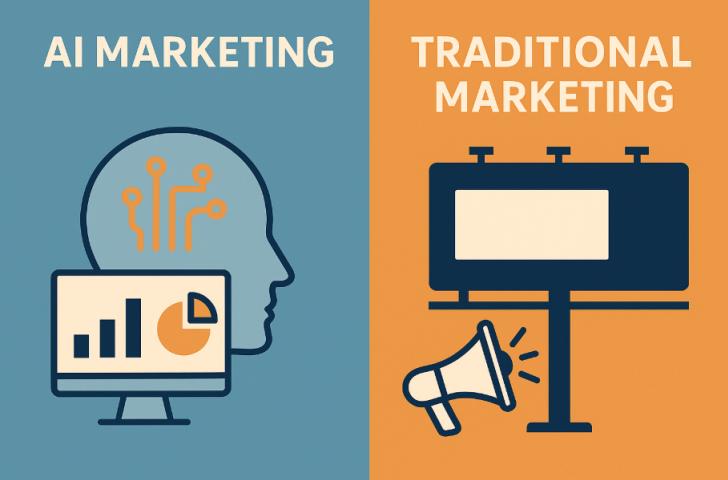

Customer Relationship Management (CRM) systems were never designed to be intelligent. They were built to record, organize, and retrieve customer information in a structured way. For a long time, that was enough.
Businesses could track leads, store communication history, and manage sales pipelines in a centralized system. But as customer expectations grew and data volumes exploded, traditional CRM systems started showing their limits.
They could tell businesses what happened but not what will happen next.
This gap is exactly where AI in CRM is creating a major shift. Instead of acting as passive databases, CRM systems are becoming intelligent systems that can interpret data, learn from behavior, and guide decisions in real time.
But the transformation is not just technical. It is fundamentally changing how businesses think about customers, sales, and long-term relationships.
The CRM Shift Nobody Planned for: From Records to Intelligence
The original idea of CRM was simple: keep customer data organized so teams could access it when needed. Sales representatives would manually update records, marketing teams would segment lists, and support teams would log tickets.
Over time, this created a massive pool of customer data — but most of it remained underused.
The introduction of AI in CRM changes the role of this data completely. Instead of being static history, it becomes a live intelligence system.
Now, CRM platforms can analyze patterns across thousands of interactions, identify intent signals, and even predict future customer actions.
This means CRM is no longer just a system of record — it is becoming a system of prediction and recommendation.
And that shift changes everything.
When CRM Starts Thinking Instead of Just Storing
The most important change AI brings to CRM is not automation — it is interpretation.
A traditional CRM can show you that a lead visited your pricing page three times. An AI-powered CRM can interpret what that behavior likely means.
Is the customer comparing options? Are they close to making a purchase decision? Or are they hesitating due to pricing concerns?
AI systems try to answer these questions by analyzing similar behavior patterns from past customers. Over time, they learn what actions typically lead to conversions and what leads to drop-offs.
This ability to interpret behavior at scale is what makes AI in CRM fundamentally different from traditional CRM systems.
Instead of overwhelming teams with raw data, it starts highlighting meaning.
The Rise of Predictive Customer Journeys
One of the most powerful applications of AI in CRM is predictive modeling.
Every customer follows a journey — from awareness to consideration to decision. But in reality, these journeys are not linear. Customers move back and forth, pause, compare, and sometimes disappear entirely.
AI helps bring structure to this complexity.
By analyzing historical patterns, machine learning models can predict where a customer is in their journey and what they are likely to do next.
For example:
- A lead showing repeated engagement with product demos might be classified as “high purchase intent”
- A dormant customer might be flagged as “at risk of churn”
- A returning visitor might be recommended a specific product category based on past interest
This shifts CRM from reactive tracking to proactive engagement.
Businesses are no longer waiting for customers to act — they are anticipating their needs.
AI in CRM Is Quietly Rewriting Sales Strategy
Sales teams have always relied on experience, intuition, and pipeline visibility to close deals. AI is now adding a new layer: data-backed decision support.
Instead of manually deciding which lead to follow up first, CRM systems can now prioritize leads based on conversion probability. Instead of guessing deal outcomes, AI models can forecast revenue with increasing accuracy.
But the real shift is subtler.
AI is beginning to influence how sales conversations are structured. It can suggest talking points, recommend timing for follow-ups, and even identify potential objections before they arise.
This doesn’t replace sales teams. It changes their role.
They move from managing data to acting on intelligence.
Customer Support Is Becoming Predictive, Not Reactive
Support teams traditionally respond after a problem occurs. A customer raises a ticket, and the system tracks resolution.
With AI in CRM, that cycle is changing.
AI systems can now detect early signals of dissatisfaction — such as repeated login failures, negative sentiment in messages, or unusual usage patterns.
Instead of waiting for a complaint, businesses can intervene early.
Support agents also benefit from real-time AI assistance. When a customer reaches out, the CRM can instantly surface similar past cases, suggested responses, and resolution paths.
This reduces resolution time and improves consistency across support interactions.
The outcome is a support system that feels less reactive and more aware.
The Hidden Challenge Behind AI in CRM Adoption
While the promise of AI in CRM is strong, adoption is not straightforward.
The biggest challenge is not technology — it is data.
Most organizations do not realize how fragmented their customer data really is. Information is often spread across multiple systems: email platforms, marketing tools, sales software, and support dashboards.
AI needs clean, connected, and structured data to function effectively. Without it, predictions become unreliable.
Another challenge is trust. Business teams are often hesitant to rely on AI-driven recommendations, especially when dealing with high-value customers or complex deals.
There is also the question of control — how much decision-making should be automated, and how much should remain human-led?
These challenges are shaping how companies approach AI adoption in CRM systems.
Where AI in CRM Is Heading Next
The future of AI in CRM is not just smarter analytics — it is autonomous assistance.
CRM systems are gradually moving toward becoming self-optimizing platforms. Instead of just recommending actions, they will begin executing certain workflows automatically.
We are also seeing the rise of generative AI inside CRM systems. This allows platforms to create personalized emails, proposals, and follow-up messages at scale, based on customer context.
In the long run, CRM systems may evolve into full AI-driven customer engagement engines — continuously learning, adapting, and acting without constant human intervention.
But even as automation increases, the role of humans will remain critical — especially in strategy, relationship building, and complex decision-making.
Final Thoughts
The evolution of AI in CRM represents more than a software upgrade. It represents a shift in how businesses understand and interact with customers.
CRM systems are no longer passive repositories of data. They are becoming active participants in decision-making, capable of analyzing behavior, predicting outcomes, and guiding actions.
However, the real value of AI in CRM does not come from technology alone. It comes from how effectively organizations use insights to build better customer experiences.
The businesses that succeed will be the ones that combine machine intelligence with human judgment — not replace one with the other.
Because at its core, CRM has always been about relationships. AI is simply changing how those relationships are understood and managed.