Most people use mobile hotspot, WiFi, and mobile data almost interchangeably without thinking about what’s actually happening behind the scenes. They all get you online, but they work in different ways, and knowing the difference matters a lot more once you’re travelling and relying on whatever connection you can get.
Mobile Hotspot vs WiFi
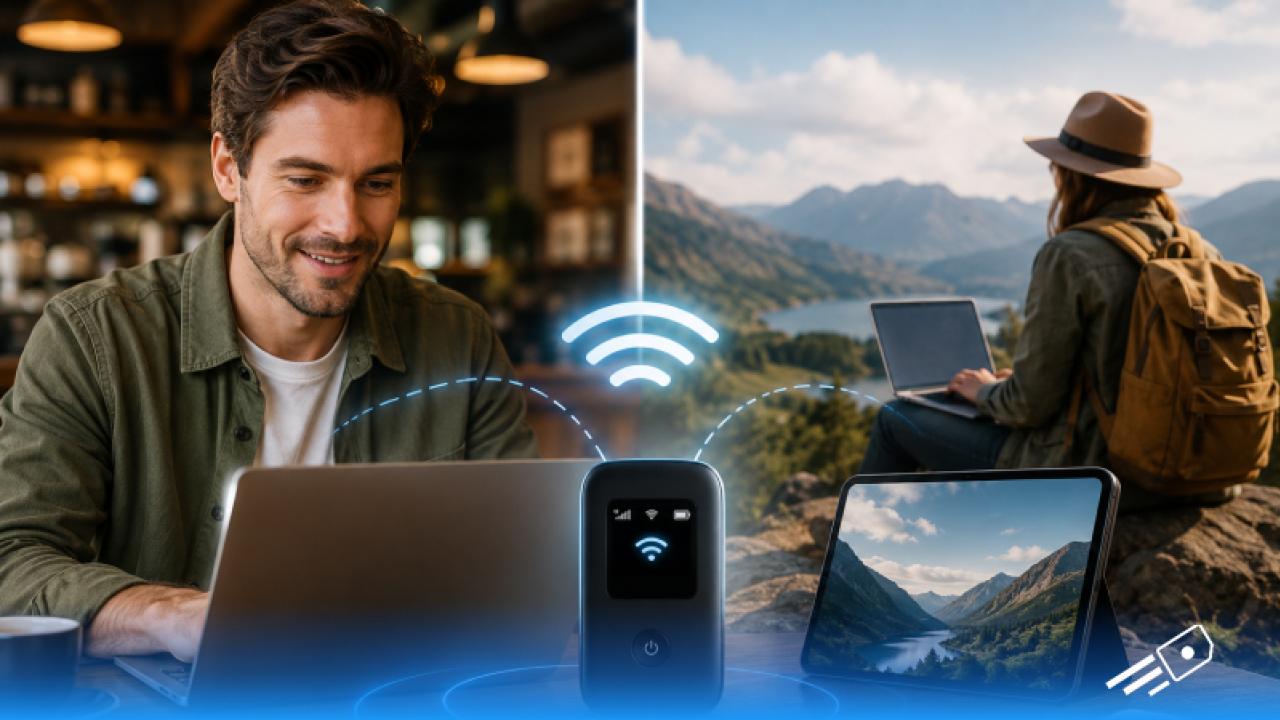
Mobile hotspot vs WiFi really comes down to the source and control. WiFi lets you connect to someone else’s fixed network, which is most of the time convenient and free. But know that you’re at the mercy of however many people are using it. A mobile hotspot, however, turns your own phone into the network. It uses your mobile data and shares it with other devices. It’s a bit more reliable, but it’s only as good as your data plan and the network signal in that location.
| Mobile Hotspot | WiFi | |
| Source | Your phone’s mobile data | A fixed router/network |
| Where it works | Anywhere with mobile signal | Only within range of the router |
| Security | Private, password set by you | Public WiFi is often unsecured |
| Cost abroad | Depends on your data plan/roaming | Often free (cafés, hotels) |
| Reliability | Consistent if signal is strong | Inconsistent – depends on network load |
| Number of devices | Limited by your plan/phone | Usually supports many devices |
Mobile Data vs WiFi
In terms of Mobile data vs WiFi, each has its own advantages. Mobile data connects you directly to a network tower, meaning you’re not relying on anyone else’s router or password. But without a local data plan, using it abroad can get expensive fast through roaming charges. WiFi is usually free when travelling, but you’re gambling on the quality of whatever network you connect to, and public WiFi comes with genuine security risks if you’re doing anything involving logins or payments.
| Mobile Data | WiFi | |
| How it Connects | With network towers | With router |
| Availability | Wherever there’s a signal | Within router range |
| Speed consistency | Can vary by location/network | Stable most of the time |
| Security | Mostly private and safe | Shared risk if on public WiFi |
| Abroad | Roaming charges may apply | Free or included |
Quick note: If you want a deeper breakdown of how mobile data actually moves between your phone and your network provider, the “What is Mobile Data” guide covers the basics in more detail.
Personal Hotspot vs Tethering: Are They the Same?
Short answer – almost. A personal hotspot is a way of sharing your phone’s data connection with nearby devices over WiFi. While tethering is the broader term that includes hotspot as well as other wired methods, like connecting your laptop to your phone directly via USB cable. So, in the hotspot vs tethering conversation: every hotspot is a form of tethering, but not every tethering method is a wireless hotspot.
Which Should You Actually Rely On While Travelling?
In most cases, the best setup is a mobile hotspot powered by a local eSIM rather than your home network’s roaming data. This avoids the unpredictability of public WiFi entirely. With a local eSIM plan active, your hotspot runs on local data rates, which makes using your phone to connect a laptop or a travel companion’s device a genuinely practical option rather than an expensive one.
It also simplifies things significantly. Instead of separately connecting every device to different WiFi networks throughout the day, one hotspot connection covers everything through a single, consistent source, something eSIM Cards plans are built to support across most destinations without extra setup.
Worth knowing: eSIM Cards plans come with unlimited data, an international number, and calling included – all at affordable prices. That means your hotspot isn’t just convenient, it’s also reachable on a real number without juggling a separate SIM for calls.
Want to Understand Hotspots in More Depth?
This covers how mobile hotspot vs WiFi compares, but there’s more worth knowing about how hotspots actually work, data limits, and getting the most out of one while travelling. The full guide on “What is a mobile hotspot” breaks it down in more detail before your next trip.