According to IMARC Group's report titled "India HVAC Market Size, Share, Trends and Forecast by Product Type, End User, and Region, 2026-2034", The report offers a comprehensive analysis of the industry, including market share, growth, trends, and regional insights.
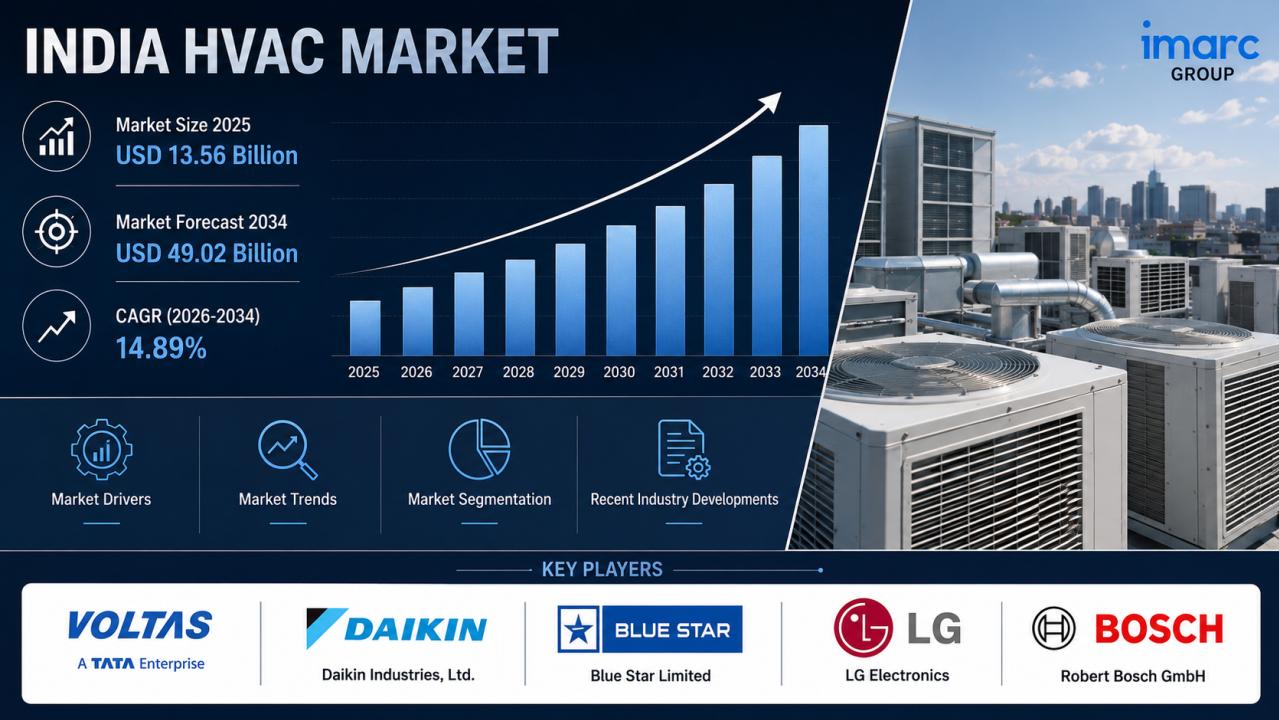
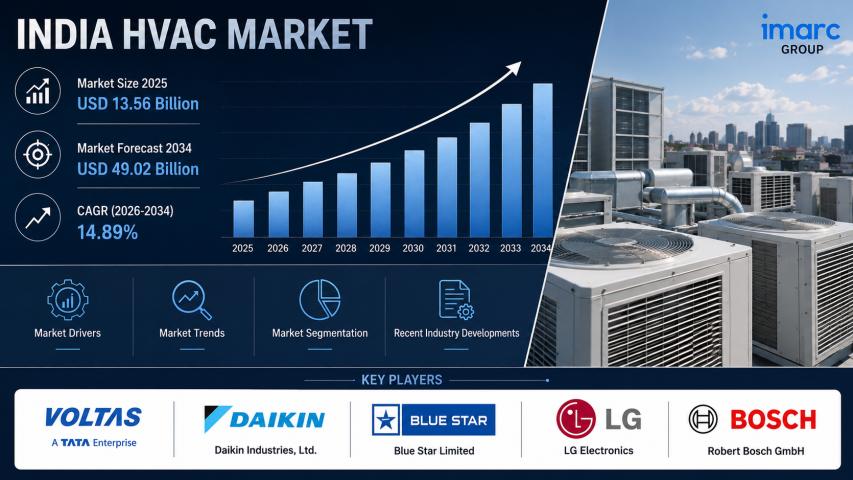
The hvac market in india stood at USD 13.56 Billion in 2025 and is projected to reach USD 49.02 Billion by 2034, at a CAGR of 14.89%. For corporate investors and construction sector leaders, this represents a structural shift not a cyclical upturn backed by climate data, policy reform, and sustained urban demand.
- Market value nearly doubled from USD 6.77 Billion in 2020 to USD 13.56 Billion in 2025.
- Direct expansion systems lead product type at 62.4%, driven by split and window AC adoption across homes and small commercial premises.
- Residential end users dominate at 55.8%; commercial accounts for 44.2% and is rising through VRF and chiller deployments.
- North India holds the largest regional share at 32.6%; South India at 28.4% is the fastest-growing region through 2034.
- PLI scheme investments are reducing import dependency in compressors, motors, and controllers.
The Strategic Market Challenge: Navigating the HVAC Market in India
The most overlooked structural challenge in this sector is the widening gap between installation demand and certified technician availability. As tier-2 and tier-3 city penetration accelerates through easier financing and longer summers, the shortage of trained installers and refrigerant-handling professionals is slowing project timelines and compressing after-sales margins. A meaningful share of compressors and electronic controllers remains import-dependent, leaving manufacturers exposed to currency volatility and logistics disruptions even as PLI-led localization progresses steadily.
India's Strategic Vision for the HVAC Market:
- India Cooling Action Plan (ICAP): The Ministry of Environment, Forest and Climate Change targets a 25–40% reduction in cooling energy demand by 2037–38, directly shaping OEM product roadmaps and institutional procurement criteria.
- BEE Star Labelling Reforms: The Bureau of Energy Efficiency's progressive rating cycles raise the minimum efficiency floor for room ACs, phasing out fixed-speed units and incentivizing inverter adoption across all price tiers.
- PLI Scheme for White Goods: The Production Linked Incentive scheme targets AC components compressors, heat exchangers, and motors to reduce import reliance and improve cost competitiveness for both Indian and global OEMs.
- Smart Cities and Infrastructure Push: Government-backed smart city projects, metro rail expansion, and hospital development are generating institutional demand for centralized HVAC and building management systems.
➤ Access Industry-Focused Insights and Future Forecasts - Request Sample Report
Why Invest in the India HVAC Market: Key Growth Drivers & ROI
- Climate Stress Creating Non-Discretionary Demand: India recorded approximately 536 heatwave days during summer 2024, per the India Meteorological Department. In 2025, the national average temperature ran 0.28°C above the 1991–2020 long-period average. Cooling systems are no longer optional this structurally de-risks HVAC investment horizons.
- Urbanization Building Long-Term Volume: City migration and active tier-2 and tier-3 residential development generate consistent demand for split ACs, packaged units, and centralized HVAC. Voltas sold over 2 million units in FY 2024 the highest annual volume by any single brand in India reflecting the scale of mass-market absorption already underway.
- Financing Access Expanding the Addressable Market: Zero-cost EMI schemes and NBFC-led consumer financing are lowering the effective entry cost for first-time buyers. Tier-2 and tier-3 cities represent the largest untapped volume pool, with organized retail and dealer-financed purchases accelerating first-time adoption.
- Commercial Real Estate Anchoring High-Value B2B Demand: Office space additions, retail malls, hospitality projects, and healthcare infrastructure are sustaining commercial procurement at 44.2% of end-user share. VRF systems and smart chillers are increasingly the default specification for new commercial builds.
India HVAC Market Trends & Future Outlook:
The hvac market in india is shifting rapidly across four key dimensions through 2034.
- Inverter Technology Is Now the Baseline: In Q1 2025, Samsung India doubled its room AC sales by expanding its AI-enabled inverter portfolio, capturing 10% market share confirming inverter units are a competitive requirement, not a premium feature.
- IoT and AI Integration Going Mainstream: Wi-Fi-enabled ACs with mobile-app control and predictive maintenance alerts are growing in metro markets, enabling recurring service revenue alongside hardware sales.
- Refrigerant Transition Rewarding Early Movers: Manufacturers are shifting to lower-GWP alternatives per India's HFC phase-down obligations, driving compressor and heat exchanger redesigns that create compliance-driven advantages.
- Centralized HVAC Standard for Large Projects: Office complexes, hospitals, and metro rail projects increasingly specify VRF systems and integrated building management as standard components not optional upgrades.
- Market Anchored at USD 27.14 Billion in 2030: Growth is broad-based, with tier-2 city penetration and commercial HVAC upgrades driving the second-half acceleration toward USD 49.02 Billion by 2034.
➤ Explore the Complete TOC and Data Coverage - Get Full Brochure
By the IMARC Group, the Top Competitive Landscape & their Positioning:
- Voltas
- Daikin Industries, Ltd.
- Blue Star Limited
- LG Electronics
- Robert Bosch GmbH
Covering an in-depth analysis of the competitive landscape, market structure, key player positioning, competitive dashboards, top winning strategies, and detailed profiles of all major industry participants you will gain access to all these exclusive insights within the full research report.
Market Segmentation Breakdown and Share Analysis:
Product Type Insights:
- Direct Expansion Systems (62.4% market share)
- Central Air Conditioning Systems (37.6% market share)
End User Insights:
- Residential (55.8% market share)
- Commercial (44.2% market share)
Regional Insights:
- North India (32.6% market share)
- South India (28.4% market share)
- East India (15.5% market share)
- West India (23.5% market share)
Regulatory Landscape & Policy Catalysts in India
- BEE Minimum Energy Performance Standards set progressively higher efficiency thresholds for room ACs, phasing out fixed-speed models and redirecting procurement toward inverter systems industry-wide.
- PLI Scheme (Ministry of Heavy Industries) provides production-linked incentives for compressors, motors, and heat exchangers, strengthening domestic supply chains for both residential and commercial HVAC segments.
- Energy Conservation Building Code (ECBC) mandates HVAC efficiency requirements for commercial buildings above defined thresholds, making VRF and building management system specifications a compliance requirement.
- India Cooling Action Plan governs long-term OEM investment priorities, refrigerant sourcing strategy, and after-sales service certification requirements through 2037–38.
- Kigali Amendment HFC Phase-Down commits India to phased reductions in hydrofluorocarbon refrigerants, accelerating OEM investment in R-32 and R-290 alternatives.
- Smart Cities Mission (Ministry of Housing and Urban Affairs) establishes centralized HVAC and indoor air quality monitoring as standard components of public infrastructure procurement.
Note: If you need specific information that is not currently within the scope of the report, we can provide it to you as a part of the customization.
➤ Tailor the Research to Your Exact Business Needs - Request Customization
Frequently Asked Questions (FAQs):
Q1: What is the current value and projected growth of the India HVAC market?
According to IMARC Group, the India HVAC market reached USD 13.56 Billion in 2025 and is projected to reach USD 49.02 Billion by 2034, at a CAGR of 14.89% during 2026–2034. Growth is driven by rising heatwave intensity, urbanization, and expanding commercial real estate.
Q2: Which product type leads the market?
Direct expansion systems hold 62.4% of product type share in 2025, driven by split and window AC adoption. Central air conditioning systems account for the remaining 37.6%, serving hospitals, malls, and large office buildings through VRF units and water-cooled chillers.
Q3: Which end-user segment dominates, and how will it evolve?
Residential leads at 55.8% in 2025, supported by rising incomes and longer summers. Commercial at 44.2% is growing through office expansion, retail development, and healthcare infrastructure, with VRF and smart chiller demand expected to narrow the gap by 2034.
Q4: Which region offers the strongest investment opportunity?
North India at 32.6% offers the largest absolute volume through extreme heat and dense urban populations across Delhi-NCR, Punjab, and Uttar Pradesh. South India at 28.4% is the fastest-growing region, anchored by IT and commercial real estate in Bengaluru, Hyderabad, and Chennai.
Q5: How is the PLI scheme shaping market competition?
The PLI scheme incentivizes domestic manufacturing of compressors, controllers, and copper components, reducing import dependency and improving cost competitiveness. Manufacturers with in-country production capacity are positioned to gain durable supply chain and pricing advantages through 2034.
Strategic Insight & Verdict
Based on market structure, policy direction, and demand trajectory, we at IMARC Group have observed that India's HVAC sector presents a compelling, multi-decade investment case anchored by climate-driven non-discretionary demand, BEE efficiency mandates, and deepening commercial infrastructure development. Investors entering with clear segment focus, localization commitment, and service network depth will capture the most defensible returns through 2034.
Verified Data Source: India HVAC Market Report by IMARC Group