If you are shopping for a modern luxury vehicle or keeping up with your scheduled vehicle maintenance, looking at the back of a Volvo trunk can feel like trying to crack a secret code. While older models relied on the number of engine cylinders to dictate their naming structure, the modern Swedish lineup features a completely unified architecture.
Whether you're shopping local dealer lots or looking for specialized auto repair in Wilmington, knowing the differences between B5, B6, and T8 engine types can help you buy the right car for your life>
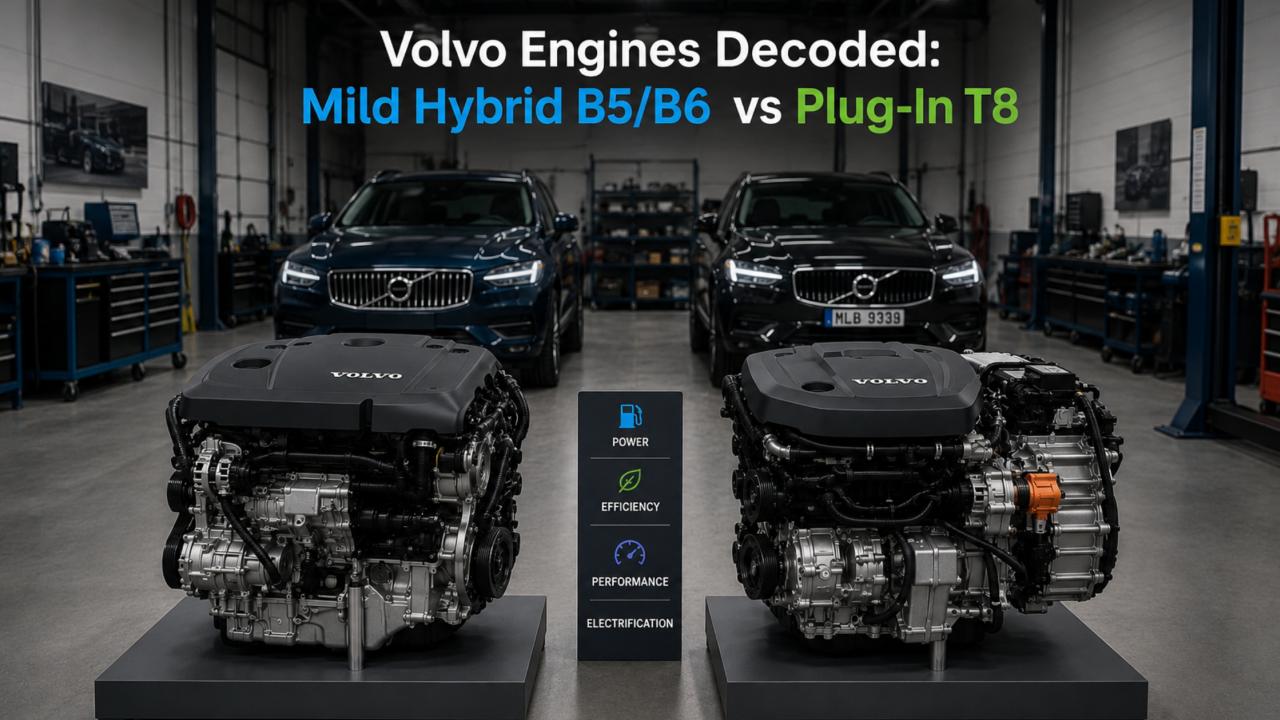
All three setups share the exact same structural foundation, yet they utilize vastly different forced induction and hybrid networks to deliver distinct driving characteristics.
The Volvo B5 Core Powertrain
The B5 setup serves as the modern entry point for Volvo's core luxury vehicles, including the popular XC40, XC60, and XC90 SUVs. Do not let the branding fool you; this is no longer a five-cylinder engine. Instead, the B5 is anchored by a highly efficient, direct-injected 2.0-liter inline four-cylinder setup.
To squeeze out optimal efficiency, Volvo pairs these turbocharged engines with a 48-volt mild-hybrid network. This configuration utilizes an Integrated Starter Generator (ISG) connected to a small lithium-ion battery.
The mild-hybrid system does not drive the car on pure electrical power. Instead, it acts as a mechanical assistant recovering kinetic energy normally lost while braking, smoothing out the automatic engine start-stop functions, and providing a subtle torque boost during initial takeoffs.
1. Performance Metrics: 247 horsepower and 258 lb-ft of torque.
2. Driving Experience: Exceptionally smooth, quiet, and linear. It feels like a premium traditional gas vehicle, prioritizing fuel economy without feeling sluggish.
3. Maintenance & Repair Notes: Because it features a single turbocharger, it is the mechanically least complex engine in the modern lineup. Standard vehicle engine repair for the B5 typically centers around managing direct-injection carbon buildup, keeping up with strict synthetic oil changes to preserve the turbo seals, and monitoring the condition of the 48V auxiliary battery loop.
The Volvo B6 High-Output System
If you step up to a heavier or larger model like the full-sized XC90 or V90 Cross Country, you will frequently encounter the B6 badge. Because moving a heavy premium vehicle requires more low-end grunt, Volvo modified the core 2.0-liter block to alter the Volvo B6 engine performance curve dramatically.
To achieve this, the B6 utilizes a highly advanced, modernized version of a "twin-charged" configuration. Unlike older systems, it pairs a traditional exhaust-driven turbocharger with an innovative 48V electric supercharger (often called an e-booster). Because it runs on electricity rather than engine belts, this electric supercharger can spin up to full speed in a fraction of a second, forcing air into the engine to eliminate low-end turbo lag instantly before smoothly handing off duties to the main turbocharger at higher RPMs.
1. Performance Metrics: 295 horsepower and 310 lb-ft of torque.
2. Driving Experience: Aggressive, crisp, and muscular. It provides immediate acceleration off the line and has more than enough muscle for high-speed highway passing or towing (5,000 lb. capacity).
3. Maintenance & Repair Notes: By swapping out the older->Volvo engine reliability by model year emphasize that this shifts the diagnostic focus to the vehicle’s high-tech 48V electrical network. Resolving issues on a B6 generally requires specialized diagnostic scanning of the power electronics, monitoring the 48V lithium auxiliary battery modules, and ensuring the intricate digital control modules governing the e-booster stay fully updated.
The Volvo T8 Plug-In Hybrid (Recharge)
Sitting at the absolute apex of the lineup is the T8 powertrain, also known as the "Recharge" system. This setup represents an entirely separate engineering philosophy, moving away from mild assistance and stepping directly into full Volvo hybrid engine technology.
The modern 455-hp T8 architecture represents a brilliant lesson in mechanical simplification. While older generations of the T8 plug-in were "twin-charged" with a complex mechanical supercharger, Volvo completely removed the supercharger when they upgraded to the extended-range 18.8 kWh battery. Because the new, beefier 143-horsepower rear electric motor provides massive, instant torque right off the line, a supercharger is no longer necessary to mask turbo lag. The gas engine over the front axle is now purely turbocharged, reducing mechanical points of failure under the hood.
Because it is a true Plug-In Hybrid (PHEV), you plug this vehicle into a dedicated wall charger. A full charge unlocks roughly 35 to 41 miles of completely silent, gas-free electric driving range. When that battery depletes, the vehicle instantly transitions back into a standard hybrid, running on the gas engine seamlessly.
1. Performance Metrics: A combined, astonishing 455 horsepower and 523 lb-ft of torque.
2. Driving Experience: Dual-personality. In "Pure" mode, it drives like a serene, peaceful EV. In "Power" mode, both power sources combine to propel a massive luxury SUV from 0 to 60 mph in a sports-car-rivaling 5.0 seconds.
3. Maintenance & Repair Notes: The T8 is an incredibly sophisticated piece of machinery. Servicing a T8 requires specialized diagnostic scanners and technicians certified in high-voltage safety. Common specialized service areas include maintaining the complex independent cooling loops that regulate the battery pack temperatures and ensuring the high-voltage isolation seals remain perfectly intact.
Powertrain Engineering Comparison
To wrap your head around how these three iterations stack up mechanically, it helps to view their technical specifications side-by-side:
Volvo B5 Mild Hybrid
Induction System: Single Turbocharger
Drive Type: Traditional Mechanical All-Wheel Drive
Electrical Setup: 48-Volt low-voltage system
Battery Capacity: Very small, smooths start/stop with a small auxiliary battery
Electric Range: 0 (cannot drive on electric power alone)
0-60 MPH Speed: 7.3 seconds
Volvo B6 Mild Hybrid
Induction System: Turbocharger + Electric Supercharger
Drive Type: Regular Mechanical All-Wheel Drive
Electrical Setup: 48-Volt Low Voltage system
Battery Capacity: Negligible (only auxiliary battery)
Electric Range: 0 miles
0-60 MPH Speed: 6.4 seconds
Volvo T8 Plug-In Hybrid
Induction System: Single Turbocharger + Rear Electric Motor
Drive Type: Electric All-Wheel Drive (eAWD)
Electrical Setup: High-Voltage Plug-In Hybrid Electric Vehicle (PHEV) system
Battery: 18.8 kWh Lithium-Ion pack
Electric Range: 35 to 41 miles of pure electric driving
0-60 MPH Speed: 5.0 seconds
Preserving Your Volvo Hybrid Investment
Deciding on the ideal option comes down to your personal driving environment and long-term ownership goals. The B5 provides a simple, highly reliable approach to daily luxury commuting with fewer mechanical failure points over time. The B6 provides the added performance and low-end torque required for larger families and heavier utility needs, trading a small amount of mechanical simplicity for sharper throttle response. Meanwhile, the T8 PHEV stands as a marvel of modern efficiency and blistering speed, making it an incredible choice for owners who can take full advantage of charging at home.
No matter which configuration sits in your driveway, these systems are some of the most advanced and most engineered European systems. Specialized sensors and complex factory diagnostics mean you have to bypass generic franchise shops to preserve your investment. Protecting the performance and longevity of these hybrid networks means needing a dedicated team of independent specialists who are equipped with the factory scan tools and advanced European training needed for elite Volvo auto repair.