Every solar panel loses a small amount of output capacity every year it operates — this isn't a defect, it's a normal, well-documented characteristic of how photovoltaic cells age. The question that matters for buyers and installers isn't whether degradation happens, but how much, how fast, and what actually influences the rate. Getting this right matters for setting realistic expectations with clients and for comparing panel technologies on something more solid than marketing claims.
What "Degradation" Actually Means
Degradation refers to the gradual decline in a panel's power output relative to its original rated capacity. A panel rated at 400W when new won't produce exactly 400W five, ten, or twenty years later — but the decline is slow, predictable, and well within what modern panels are designed and warrantied for.
The most widely cited long-term research on this comes from the National Renewable Energy Laboratory (NREL), whose studies — tracking large numbers of installed systems across different climates and panel generations — have become the reference point most of the solar industry works from.
The Numbers: What's Actually Well-Established
Across multiple independent long-term studies, a consistent pattern emerges:
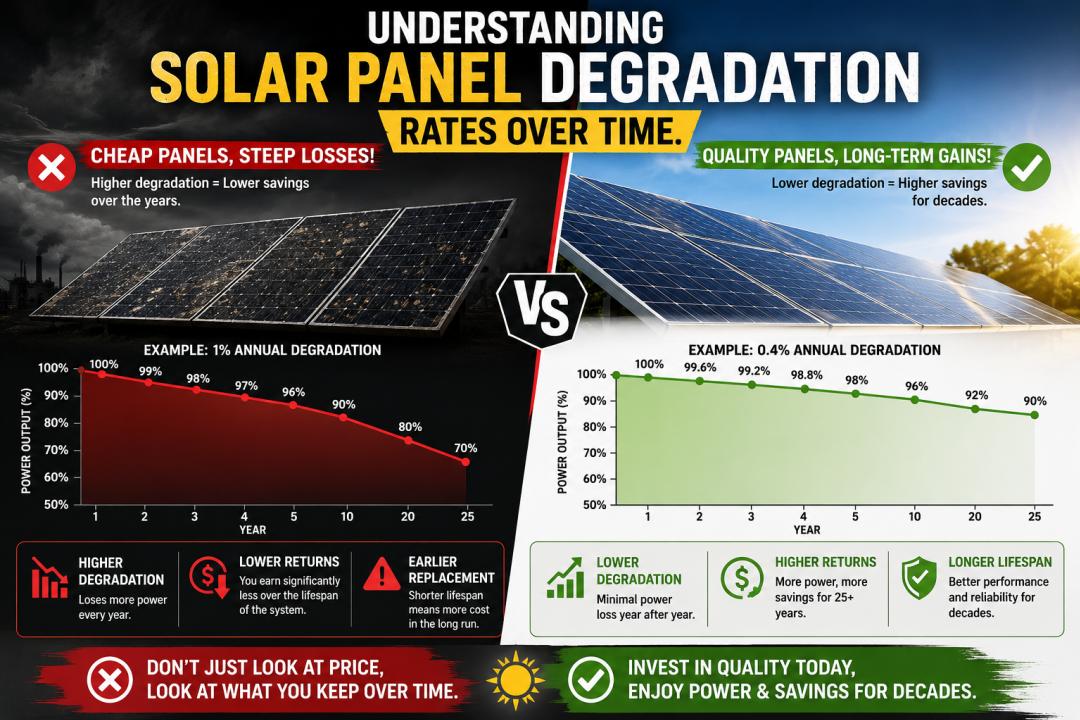
- Median degradation sits around 0.5% per year. This figure has been repeatedly confirmed across follow-on studies, not just a single data point from one analysis.
- Most of the loss happens early. The first year typically sees a larger drop — commonly in the range of roughly 1.5% to nearly 5% — after which the rate slows dramatically and stabilizes into the long, slow decline that continues for the rest of the panel's operating life.
- Newer panel technology tends to degrade slower. Panels built on newer N-type cell architectures (TOPCon, HJT) generally show lower degradation rates than older P-type PERC designs, reflecting real improvements in cell manufacturing over the past decade.
- Climate is a real factor, not a minor one. Panels installed in hotter climates degrade meaningfully faster than panels in cooler ones — heat accelerates the underlying chemical and material processes that cause degradation over time. Some field studies have found panels in hot climates degrading at roughly double the rate of panels in cooler regions.
Why the First Year Looks Different
The larger first-year drop is a distinct phenomenon called light-induced degradation (LID) — a stabilization effect that happens as a panel is first exposed to sustained sunlight. It's a known, expected part of a panel's early life, not a sign of a defective unit. Once this initial stabilization period passes, the panel settles into its long-term, much slower degradation curve. This is why year-over-year comparisons only really become meaningful after the first year of operation, not immediately after installation.
What This Means in Practice
For a rough sense of scale: a panel degrading at the median rate of about 0.5% per year will still be producing somewhere in the neighborhood of 85-90% of its original rated output after 25 years — which is consistent with why most manufacturer performance warranties are structured around a 25 to 30-year window with a guaranteed output floor toward the end of that period.
This has practical implications for how projects should be evaluated:
- Compare degradation rates, not just panel efficiency. Two panels with identical day-one efficiency ratings can perform very differently over 20+ years if their degradation rates differ.
- Factor in climate when setting expectations. A system installed in a consistently hot environment should be expected to degrade somewhat faster than the same panel model in a milder climate — this isn't a flaw in the panel, it's physics.
- Don't mistake first-year loss for a problem. A panel producing slightly less in its second year of operation than its first is behaving exactly as expected, not underperforming.
- Treat manufacturer warranty curves as a floor, not a prediction. Real-world data across multiple independent studies consistently shows panels degrading slower than the conservative figures manufacturers build into their warranty terms.
The Practical Takeaway
Degradation is a normal, gradual, and well-understood part of how solar panels age — not a hidden flaw or a reason for concern. Modern panels, particularly those built on newer cell technology, degrade slowly enough that a well-installed system can be expected to deliver strong output for decades. Understanding the realistic numbers — rather than either the alarmist figures sometimes used by aggressive resellers or the overly conservative figures baked into warranty fine print — is what allows buyers and installers to set expectations that actually match how these systems perform in the real world.