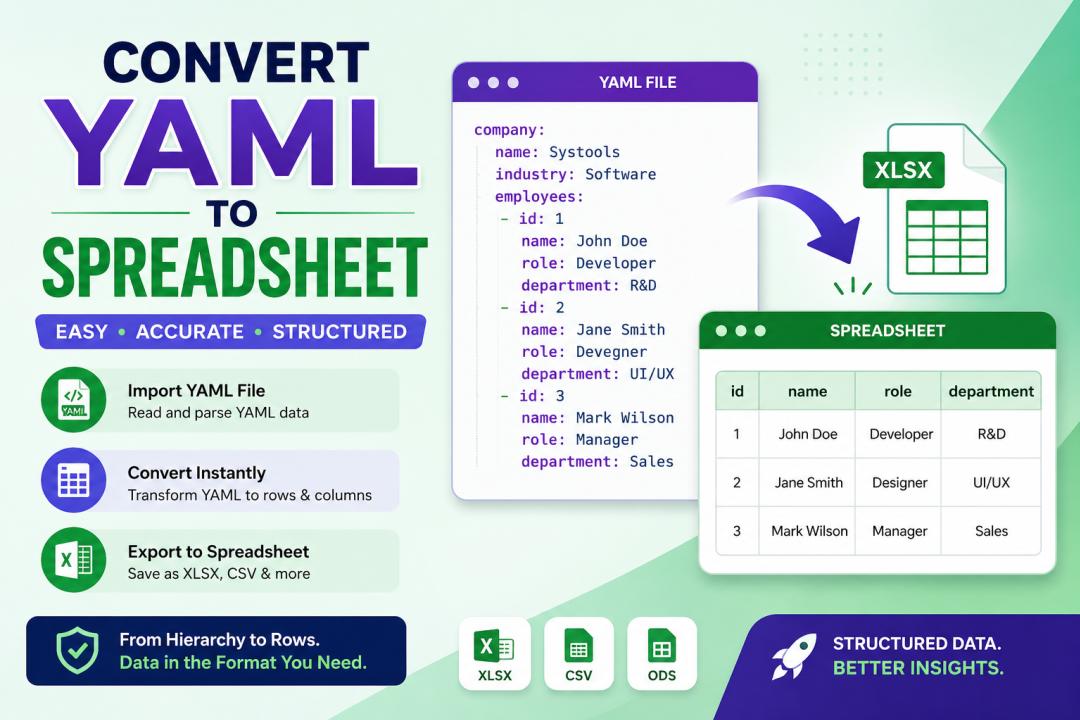
Convert YAML to spreadsheet formats when you need structured YAML data in a format that's easier to read, analyze, share, and report on. While YAML is widely used for configuration files, application settings, and data exchange, spreadsheets such as Excel and CSV remain the preferred choice for business users and analysts.
Whether you're working with application configurations, inventory records, cloud deployment files, or exported datasets, converting YAML to Excel can save time and improve accessibility. Let's break down the easiest ways to do it.
Why Convert YAML to XLS/XLSX Format?
YAML files are designed to be human-readable. However, they are not always convenient for sorting, filtering, reporting, or collaboration.
Here are some common reasons users convert YAML to spreadsheet file:
View structured data in rows and columns
Filter and sort information quickly
Share data with non-technical teams
Create reports and dashboards
Import data into business applications
For example, development teams often maintain application settings in YAML while business teams prefer working with Excel files. Converting between the two bridges that gap. This leads us to understand how the formats differ.
Method 1: Convert YAML to Spreadsheet Using Online Tools
Online conversion tools offer a quick way to transform YAML files into spreadsheet-compatible formats.
Steps to Convert YAML Online
Open a free online converter.
Upload your YAML file.
Select the desired output format.
Start the conversion process.
Download the converted spreadsheet.
Many web-based converters can process simple YAML structures without requiring software installation. This makes them attractive for occasional tasks.
Benefits
No installation required
Simple user interface
Fast for small files
Accessible from any browser
Limitations
File size restrictions
Data privacy concerns
Limited support for nested YAML structures
Batch conversion often unavailable
Internet connection required
Method 2: Convert YAML/YML to Spreadsheet Using Expert Utility
For users who need a direct and user-friendly way to convert YAML to spreadsheet formats, SysTools YAML Converter offers an automated approach that eliminates manual effort. The software is designed to process YAML files and export data into commonly used formats. This is particularly useful for IT administrators, analysts, developers, and business users working with large collections of YAML files.
Steps to Convert YAML Files
Install and launch the aforementioned tool.
Add single or multiple YAML files.
Preview the loaded data.
Select XLS or XLSX as the export format.
Choose the destination folder.
Start the conversion process.
Key Benefits of Using Advanced Approach
Batch YAML file conversion
Export to XLS and XLSX formats
Maintains data integrity
User-friendly interface
Preview before conversion
Supports large YAML files
No coding required
Why Choose an Offline Tool Over Online Converters?
Offline conversion tools offer several advantages beyond convenience.
Better Security: Files remain on your local system. Sensitive information is not uploaded to third-party servers.
Batch Processing: Multiple YAML files can be processed simultaneously, saving considerable time.
Improved Accuracy: Dedicated conversion engines can handle nested YAML structures more reliably than many free web tools.
Large File Support: Desktop software typically handles larger datasets without browser limitations.
Consistent Results: Conversion settings remain the same across projects, which helps maintain output quality.
Frequently Asked Questions
Q1: Can YAML be converted directly to Excel?
A: Yes. YAML files can be converted directly to XLSX format using online converters, Python scripts, or dedicated software such as a desktop-based utility.
Q2: How do I convert YAML to JSON Format?
A: You can use automated approach or a Python script to convert a YAML file into JSON file format without facing any difficulties.
Q3: Is there a way to convert multiple YAML files at once?
A: Yes. Batch conversion is commonly available in desktop solutions such as SysTools YAML Converter and certain scripting workflows.
Q4: Which method is best for non-technical users?
A: An automated GUI-based converter is generally the easiest option because it requires no coding knowledge and supports bulk processing.
Final Thoughts!
Convert YAML to spreadsheet formats whenever you need YAML data in a more accessible, report-friendly, and analysis-ready structure. Online tools work well for occasional conversions, while Python provides flexibility for developers. For users seeking a faster and simpler experience, an offline solution offers a practical solution with batch processing, spreadsheet export options, and an easy-to-use interface.
The best method depends on your technical expertise, data volume, and security requirements. Choose the approach that matches your workflow, and you'll be able to transform YAML data into usable spreadsheets with minimal effort.