Market Outlook
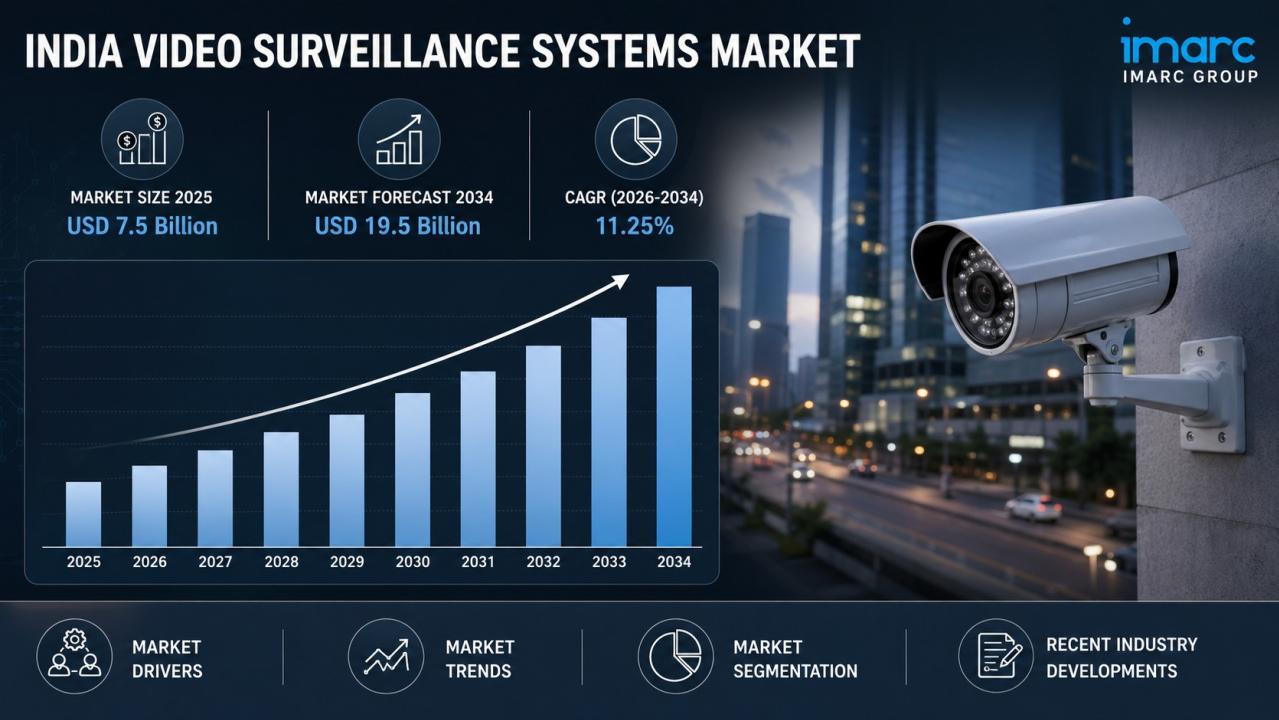
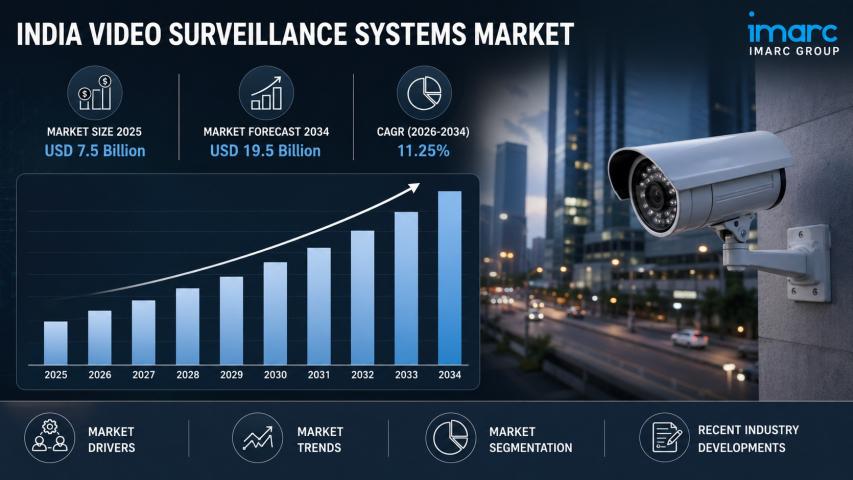
The India video surveillance systems market was valued at USD 7.5 Billion in 2025 and is projected to reach USD 19.5 Billion by 2034, growing at a compound annual growth rate of 11.25% between 2026 and 2034. Growth is being driven by rising security concerns across public and private sectors, sustained government investment in smart city and safe city surveillance infrastructure, and a sweeping regulatory overhaul that is reshaping the competitive landscape in favour of certified, cyber-secure domestic manufacturing.
India's surveillance industry underwent its most consequential regulatory shift in years on April 1, 2026, when the government's Essential Requirements framework, enforced through mandatory STQC and BIS certification, came into effect for all CCTV cameras sold in the country. The mandate effectively barred uncertified internet-connected cameras, including those from dominant Chinese brands such as Hikvision and Dahua, which together had once controlled nearly a third of the Indian market. In the vacuum left by their exit, domestic manufacturer CP PLUS, owned by listed company Aditya Infotech, saw its market share surge from 20.2% in FY25 to 45.4% by the third quarter of FY26, as government and enterprise buyers increasingly prioritised cybersecurity and data sovereignty in procurement decisions.
Market Snapshot:
- Market Size (2025): USD 7.5 Billion
- Forecast Market Size (2034): USD 19.5 Billion
- CAGR (2026-2034): 25%
- STQC/BIS Essential Requirements Mandate Effective Date: April 1, 2026
- CP PLUS (Aditya Infotech) Market Share Growth: From 20.2% (FY25) to 45.4% (Q3 FY26)
- PLI Scheme Investment (Electronics, incl. Surveillance Components): Over Rs. 1.46 lakh crore generated, 950,000+ jobs created across 14 sectors
What Are the Growth Factors of the India Video Surveillance Systems Market?
- Government Cybersecurity Mandate Reshaping Domestic Manufacturing:
The Essential Requirements framework, enforced through mandatory STQC and BIS certification since April 1, 2026, has fundamentally restructured India's surveillance camera market by barring uncertified, internet-connected cameras from sale. This regulatory shift is directly benefiting Indian manufacturers who had already invested in local assembly, compliance infrastructure and cybersecurity engineering, positioning domestic cybersecurity credentials as a core growth driver rather than a compliance afterthought.
- Sustained Government Investment in Smart City and Safe City Surveillance:
Government-backed Safe City surveillance projects continue to anchor large-scale demand, with roughly 90% of projects worth Rs. 1.44 lakh crore finalised by March 2025 and approximately 76,000 cameras now integrated with command-and-control centres feeding traffic, waste and emergency management modules. The Smart Cities Mission and state-level surveillance programmes continue to expand deployment across transport networks, public spaces and municipal utilities nationwide.
- Rising Domestic Manufacturing and Surveillance Chip Localization:
India's Production Linked Incentive scheme has generated over Rs. 1.46 lakh crore in investment and created more than 950,000 jobs across 14 sectors since its 2020 launch, indirectly strengthening the domestic electronics supply chain feeding surveillance hardware production. Emerging chip startups such as BigEndian are now developing ARM-based processors specifically for surveillance applications, targeting an estimated 25% of India's surveillance chip requirements within three to five years as the industry works to reduce dependence on imported semiconductor components.
- AI and IoT Integration Driving Value-Added Surveillance Adoption:
Technological shifts toward IP-based, AI-enabled analytics and cloud-based storage are expanding addressable market value beyond hardware into software and services. As enterprises and government agencies increasingly demand intelligent video analytics, facial recognition and predictive threat detection capabilities, the average revenue captured per surveillance installation continues to rise across commercial, industrial and public infrastructure deployments.
➤ Request Sample Report (TOC & Charts): https://www.imarcgroup.com/india-video-surveillance-systems-market/requestsample
What Are the Key Trends Shaping the Market?
- Mandatory Cybersecurity Certification Reshaping the Competitive Landscape:
The STQC and BIS Essential Requirements certification mandate represents one of the most consequential regulatory shifts the Indian surveillance sector has experienced, requiring manufacturers, distributors and system integrators to redesign products and align supply chains with new cybersecurity engineering standards. Companies such as Matrix Comsec, which had proactively aligned their network camera portfolios with these requirements ahead of the deadline, are now positioned as first movers in the newly compliant market.
- Domestic Players Filling the Vacuum Left by Restricted Chinese Brands:
With dominant Chinese surveillance brands effectively excluded from new sales following the April 2026 mandate, homegrown manufacturers and system integrators are racing to fill the resulting market vacuum. CP PLUS's dramatic share gain from 20.2% to 45.4% within roughly a year exemplifies this shift, with the broader industry described as undergoing a 'CCTV gold rush' as domestic OEMs and startups scale up to meet displaced demand.
- Emergence of Indigenous Surveillance Chip Manufacturing:
India's surveillance chip opportunity alone is estimated to approach USD 1 billion as camera penetration expands across sectors, prompting startups like BigEndian to develop ARM-based processors domestically, with commercial launch targeted for mid-2026. This move toward indigenous chip design addresses a critical vulnerability, as Indian surveillance manufacturers currently remain dependent on imported memory, sensors and advanced semiconductor components.
- AI-Powered Video Analytics and Edge Computing Adoption:
Industry events such as IFSEC India have highlighted the growing role of AI and IoT-based security solutions, with hundreds of exhibiting brands showcasing sophisticated analytics and edge-computing surveillance technologies. This growing adoption of intelligent, self-monitoring camera systems is improving operational efficiency and scalability, positioning AI-enabled surveillance as a core differentiator for both government and enterprise procurement decisions going forward.
What Are the Major Market Challenges?
- Continued Import Dependence on Critical Components:
Despite growing domestic assembly and certification capacity, Indian surveillance manufacturers remain substantially dependent on imported memory chips, image sensors and advanced semiconductor components sourced from established global supply chains. This dependency exposes the industry to currency fluctuations and geopolitical supply risk, even as emerging domestic chip initiatives work to progressively localise a greater share of this value chain.
- Compliance Transition Costs for Manufacturers:
Meeting the STQC and BIS Essential Requirements certification standard has required manufacturers to make significant investments in cybersecurity engineering, product redesign and testing infrastructure ahead of the April 2026 deadline. This transition cost burden has been particularly challenging for smaller domestic players and new entrants lacking the balance sheet strength of larger, established manufacturers.
- Data Privacy and Surveillance Ethics Concerns:
The rapid expansion of AI-powered facial recognition and video analytics capabilities across public and private surveillance deployments continues to raise data privacy and civil liberties concerns among consumer advocacy groups and policymakers. Balancing the security benefits of advanced surveillance technology against individual privacy rights remains an ongoing regulatory and public policy challenge as deployment scales nationwide.
➤ Explore the Full Report with Charts, Table of Contents, and List of Figures: https://www.imarcgroup.com/india-video-surveillance-systems-market
How Is the Market Segmented?
- By System Type: Analog Surveillance, IP Surveillance, and Hybrid Surveillance, reflecting the industry's ongoing transition from legacy analog infrastructure toward IP-based and hybrid network architectures.
- By Component: Hardware, Software, and Services, spanning cameras and recording equipment through to video management software and installation, monitoring and maintenance services.
- By Application: Commercial, Military and Defense, Infrastructure, Residential, and Others, covering the full range of public and private sector surveillance deployment needs across India.
- By Enterprise Size: Small Scale Enterprise, Medium Scale Enterprise, and Large Scale Enterprise, reflecting the varied surveillance infrastructure needs and budgets across business sizes.
- By Customer Type: B2B and B2C, spanning both large-scale government and enterprise procurement as well as growing residential and small-business adoption.
- Regional Insights: North India, South India, East India, and West India, with demand concentrated around major metropolitan smart city projects and industrial manufacturing hubs.
Competitive Landscape:
The India video surveillance systems market is undergoing rapid competitive realignment following the April 2026 cybersecurity certification mandate, which has significantly weakened the position of previously dominant Chinese brands. Domestic manufacturers with established local assembly, compliance infrastructure and STQC certification are capturing outsized share gains, while emerging chip startups and AI analytics providers are creating new competitive fronts around indigenous technology and cybersecurity credentials.
Recent News or Developments:
On April 1, 2026, India's Essential Requirements framework for CCTV cameras came into effect, mandating STQC and BIS certification for all cameras sold in the country and effectively barring uncertified, internet-connected cameras, including dominant Chinese brands such as Hikvision and Dahua, from the domestic market.
By the third quarter of FY26, CP PLUS, owned by listed company Aditya Infotech, saw its market share surge from 20.2% in FY25 to 45.4%, as government and enterprise buyers increasingly prioritised cybersecurity certification and data sovereignty following the regulatory shift.
In mid-2026, Indian chip startup BigEndian advanced plans to launch ARM-based processors designed specifically for surveillance applications, targeting an estimated 25% of India's surveillance chip requirements over the next three to five years while also eyeing expansion into Africa, Southeast Asia and Latin America.
Customization Note: If you require any specific information not covered within this report's scope, we will provide it as part of the customization.
➤ Request Report Customization: https://www.imarcgroup.com/request?type=report&id=31350&flag=E
Frequently Asked Questions (FAQs):
Q1. How big is the India video surveillance systems market?
The India video surveillance systems market was valued at USD 7.5 Billion in 2025.
Q2. What is the future outlook of the India video surveillance systems market?
The India video surveillance systems market is projected to exhibit a CAGR of 11.25% during 2026-2034, reaching a value of USD 19.5 Billion by 2034.
Q3. What major regulatory change is reshaping the India video surveillance systems market?
The Essential Requirements framework, enforced through mandatory STQC and BIS certification since April 1, 2026, has barred uncertified cameras, including dominant Chinese brands, significantly benefiting compliant domestic manufacturers.
Q4. Which domestic manufacturer has gained significantly from the regulatory shift?
CP PLUS, owned by Aditya Infotech, saw its market share surge from 20.2% in FY25 to 45.4% by Q3 FY26, as buyers increasingly prioritised cybersecurity-certified, domestically manufactured surveillance systems.
Q5. What are the key factors driving the India video surveillance systems market?
The India video surveillance systems market is driven by the STQC/BIS cybersecurity certification mandate favouring domestic manufacturing, sustained government investment in smart and safe city surveillance, rising indigenous chip development, and growing AI and IoT-powered analytics adoption.