India Automotive Components Market Outlook
The report titled "India Automotive Components Market Size, Share, Trends and Forecast by Vehicle Type, Component, Demand Category, and Region, 2026–2034" comprises the overall market analysis of India, size, growth trends, key drivers, and regional insights of the India automotive components industry and other important aspects related to the report.
How Big is the India Automotive Components Market?
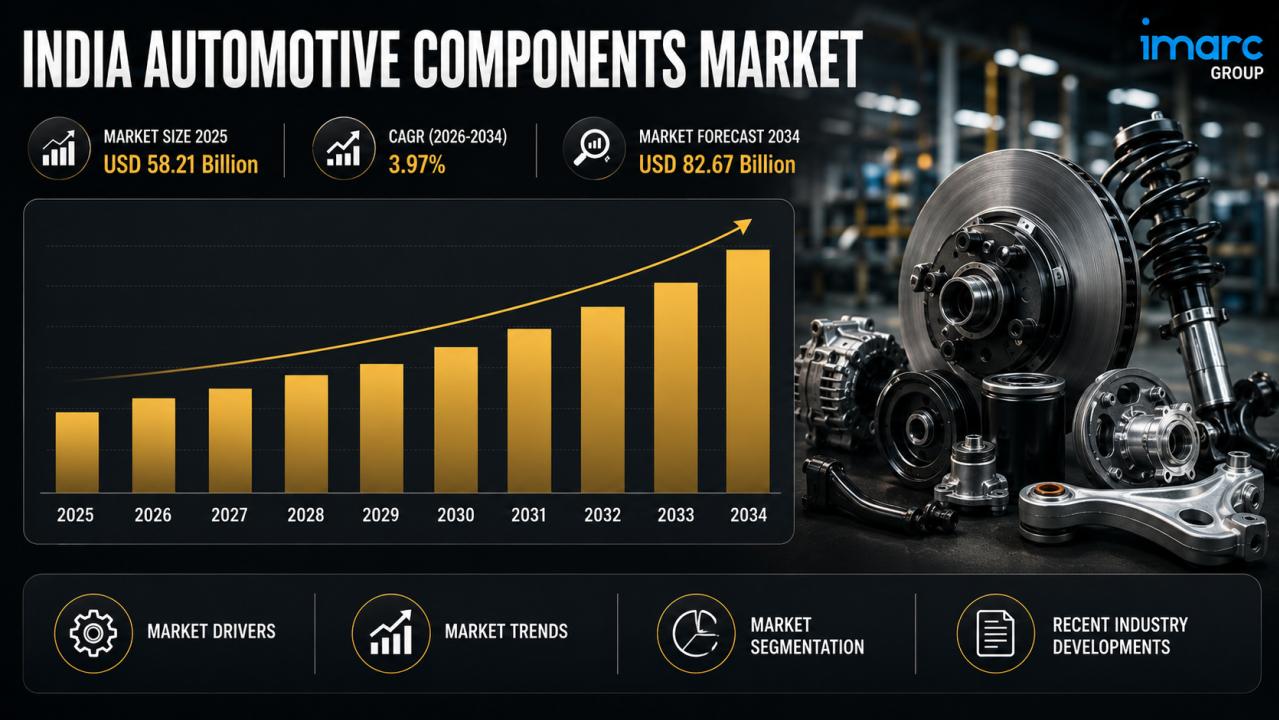
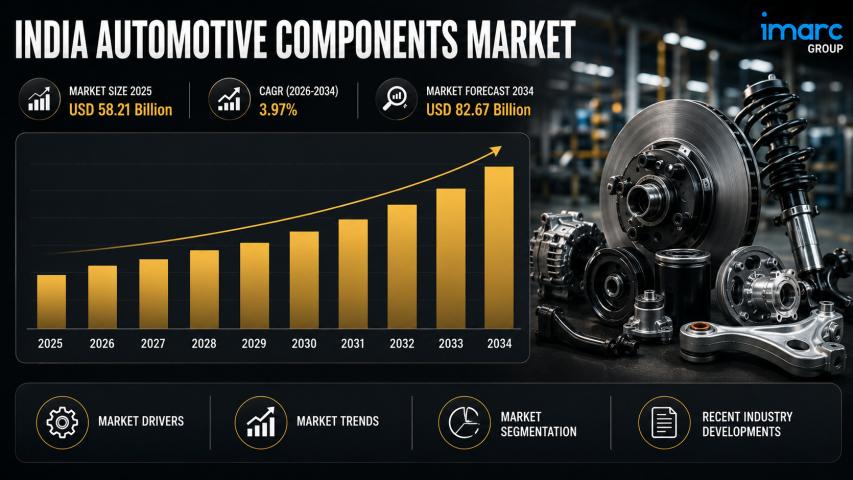
The India automotive components market size reached USD 58.21 Billion in 2025. Looking forward, IMARC Group expects the market to reach USD 82.67 Billion by 2034, exhibiting a compound annual growth rate (CAGR) of 3.97% during 2026–2034. The sector is experiencing a strategic transformation, pivoting from traditional internal combustion engine (ICE) parts to meet the demands of aggressive electrification, stricter emission regulations, and global supply chain diversification.
What are the Key Developments and Emerging Trends in the India Automotive Components Market?
- Surge in EV Component Localization:
With the government aggressively targeting higher EV adoption by 2030, manufacturers are localizing the production of battery management systems, power electronics, and electric drivetrains. Establishing domestic lithium-ion battery production is a massive priority to reduce component costs and improve supply chain resilience.
- Adoption of Lightweight Materials:
The increasing emphasis on meeting stringent Corporate Average Fuel Efficiency (CAFE) norms and reducing emissions is accelerating the shift toward lightweight materials. Manufacturers are heavily substituting traditional heavy metals with aluminum, carbon fiber composites, and high-strength plastics.
- The 'China Plus One' Strategy:
Global OEMs are actively diversifying their supply chains, positioning India as a highly reliable export hub for precision-engineered, cost-effective parts. As a result, exports are structurally expanding as Indian manufacturers secure long-term contracts from North American and European automakers.
- Smartification and Premiumization:
The transition toward software-defined vehicles is driving demand for advanced electronic components and connected systems. The market is witnessing a massive shift toward higher-value technological upgrades like advanced driver-assistance systems (ADAS), digital instrument clusters, and premium acoustic equipment.
➤ Grab a sample copy of this report: https://www.imarcgroup.com/india-automotive-components-market/requestsample
What Factors are Driving Growth in the India Automotive Components Market?
- Unprecedented Vehicle Production Volumes:
The massive scale of domestic vehicle manufacturing acts as the foundational growth engine. With total vehicle production continuously expanding across passenger and commercial categories, the domestic demand for original equipment (OE) parts guarantees a massive, non-discretionary procurement pipeline.
- Aggressive PLI Scheme Execution:
The government's Production Linked Incentive (PLI) scheme for the automotive sector has been highly successful. By directly incentivizing the localized manufacturing of advanced automotive technology (AAT) components, the scheme provides critical financial support for capacity expansions and complex R&D initiatives.
- Federal Infrastructure Outlays:
The sustained government push for new expressways and freight corridors directly translates to higher demand for commercial vehicles, heavy-duty trucks, and construction equipment, strongly bolstering the commercial auto parts and heavy-forging segments.
- Surging Aftermarket Demand:
The continuous expansion of vehicles on the road, alongside the increasing average age of the vehicle fleet, acts as a massive growth catalyst for the replacement parts segment. The structured aftermarket is scaling rapidly, driven by the formalization of independent repair shops and multi-brand service centers.
How will the India Automotive Components Market Evolve in the Coming Years?
The India automotive components market is positioned for solid and sustained expansion throughout the forecast period. It is transitioning from a highly fragmented manufacturing base into a globally competitive, technology-driven ecosystem. The convergence of heavy government subsidies, aggressive global sourcing diversification, and the electric mobility transition will heavily compound long-term market viability.
The market generated a revenue of USD 58.21 Billion in 2025 and is projected to reach USD 82.67 Billion by 2034, compounding at 3.97% annually. While traditional engine parts will maintain baseline volume dominance due to the existing ICE vehicle fleet, advanced electrical components and EV powertrains will continuously outpace overall industry growth, securing substantially higher profit margins.
➤ Explore the Full Report with Charts, Table of Contents, and List of Figures: https://www.imarcgroup.com/india-automotive-components-market
Deep-Dive Segment Insights
- By Vehicle Type:
The market includes Passenger Cars, Two-Wheelers, Three-Wheelers, Light Commercial Vehicles, Medium and Heavy Commercial Vehicles, and Off the Road Vehicles. Passenger Cars absolutely dominate the market, commanding a 35% share in 2025. This is driven by expanding middle-class income levels and a strong consumer preference for personal mobility and premium utility vehicles.
- By Component:
Segmented into Engine Parts, Body and Chassis, Suspension and Brakes, Drive Transmission and Steering Parts, and Electrical Parts and Equipments. Engine Parts lead the component category with a 28% market share in 2025. This dominance reflects the critical role of these parts in overall vehicle performance and consistent demand from existing ICE manufacturing pipelines.
- By Demand Category:
Divided into OEM and Replacement. The OEM segment comprises the largest market share at 60% in 2025. This commanding lead highlights India's robust vehicle manufacturing ecosystem and the direct, high-volume supply relationships between component manufacturers and major automakers.
- By Region:
Segmented into North India, South India, East India, and West India. North India represents the absolute market leader with a 31% share in 2025. This supremacy is fueled by the dense concentration of automotive manufacturing hubs and established Tier-1 supplier networks across the Delhi NCR, Haryana, and Rajasthan corridors.
Competitive Landscape & Key Player Positioning:
Covering an in-depth analysis of the competitive landscape, market structure, key player positioning, competitive dashboards, top winning strategies, and detailed profiles of all major industry participants you will gain access to all these exclusive insights within the full research report.
To defend their market share against global disruption, top companies are aggressively executing strategic acquisitions to acquire high-end technological capabilities (such as software and ADAS), forming international joint ventures to localize complex EV drivetrains, and expanding their global manufacturing footprints to directly service OEMs in North America and Europe.
Recent Developments:
- Sansera Engineering Inks Joint Venture (January 2026): Highlighting the industry’s push into complex metallurgy, Sansera Engineering announced a strategic joint venture with Japan's Nichidai Corporation. The JV will focus on manufacturing precision forged and machined components in aluminum and steel, specifically targeting differential assemblies and driveline systems.
- NDR Auto Components Interior Expansion (October 2025): NDR Auto Components formally established a 50:50 joint venture with Hayashi Telempu. The new entity, NDR Hayashi Automotive India, is strategically designed to scale the domestic manufacturing of premium interior and trim components to cater to the premiumization of passenger vehicles.
- ZF's Next-Generation Steering Technology (September 2025): ZF Friedrichshafen AG unveiled its advanced next-generation steer-by-wire system for the Indian market. Eliminating traditional mechanical connections, the system drastically enhances vehicle design freedom, lowers weight, and integrates seamlessly with advanced driver-assistance systems (ADAS).
- Sona Comstar Manufacturing Milestone (Mid-2025/2026): Transitioning rapidly to support the EV ecosystem, Sona BLW Precision Forgings (Sona Comstar) achieved a historic milestone by manufacturing its 500 millionth differential gear and 10 millionth differential assembly, solidifying its position as a globally dominant supplier for both ICE and EV powertrain architectures.
Customization Note: If you require any specific information not covered within this report's scope, we will provide it as part of the customization.
➤ Request Report Customization: https://www.imarcgroup.com/request?type=report&id=32577&flag=E
Frequently Asked Questions (FAQs):
Q1. What is the current size of the India automotive components market?
The India automotive components market size was valued at USD 58.21 Billion in 2025.
Q2. What is the projected market size by 2034 and the CAGR from 2026 to 2034?
The market is projected to reach USD 82.67 Billion by 2034, growing at a steady compound annual growth rate (CAGR) of 3.97% during the 2026–2034 forecast period.
Q3. Which vehicle type dominates the India automotive components market?
Passenger Cars hold the absolute largest market share at 35% in 2025, heavily driven by rising middle-class disposable incomes and the surging domestic demand for premium sport utility vehicles (SUVs).
Q4. Which demand category commands the highest share in the market?
The OEM (Original Equipment Manufacturer) category leads the market with a 60% share in 2025, reflecting the massive scale of direct supply contracts supporting new vehicle manufacturing across the country.
Q5. Which region holds the leading position in the India automotive components market?
North India represents the absolute market leader with a 31% share in 2025, primarily fueled by the dense concentration of automotive manufacturing plants and Tier-1 suppliers across the Delhi-NCR and Haryana corridors