Automotive MOSFET market: Power semiconductors move deeper into vehicle electrification
The increasing electrification and electronic complexity of vehicles is changing the role of power semiconductors in automotive systems. MOSFETs are no longer limited to conventional switching applications; they are increasingly used across electric powertrains, battery management systems, onboard chargers, DC-DC converters, thermal management, power distribution, and other vehicle electronics.
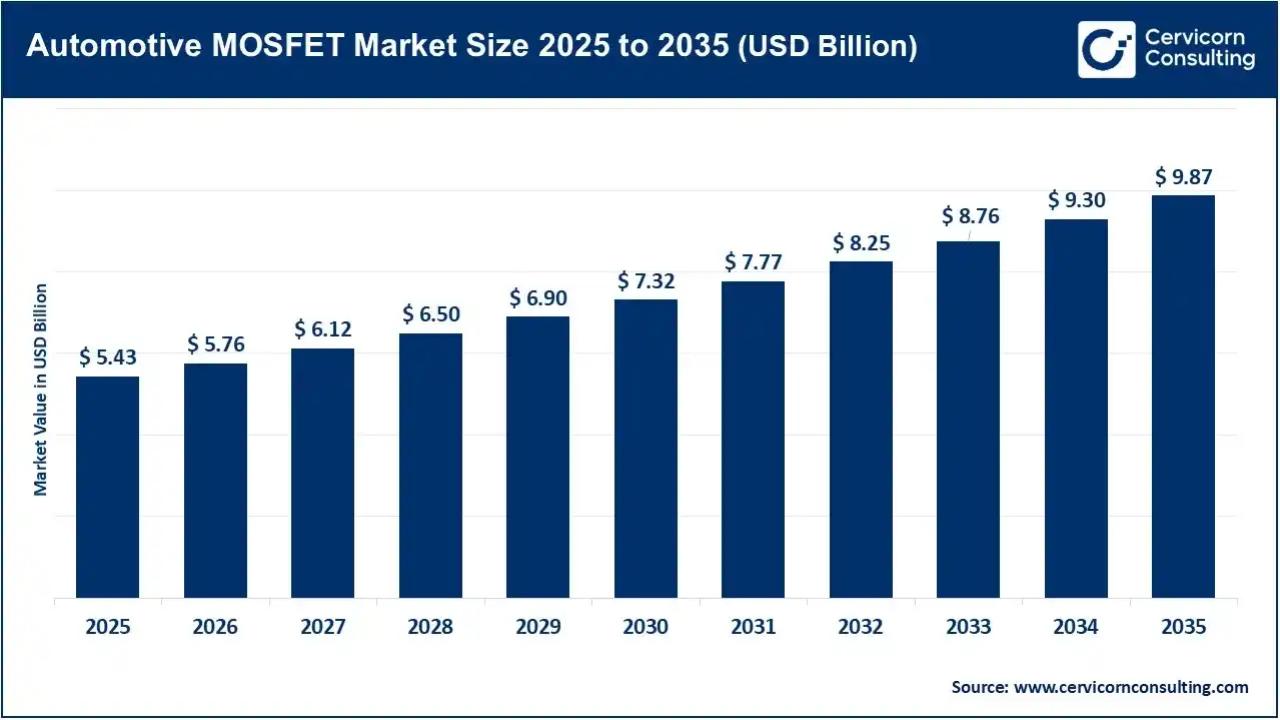
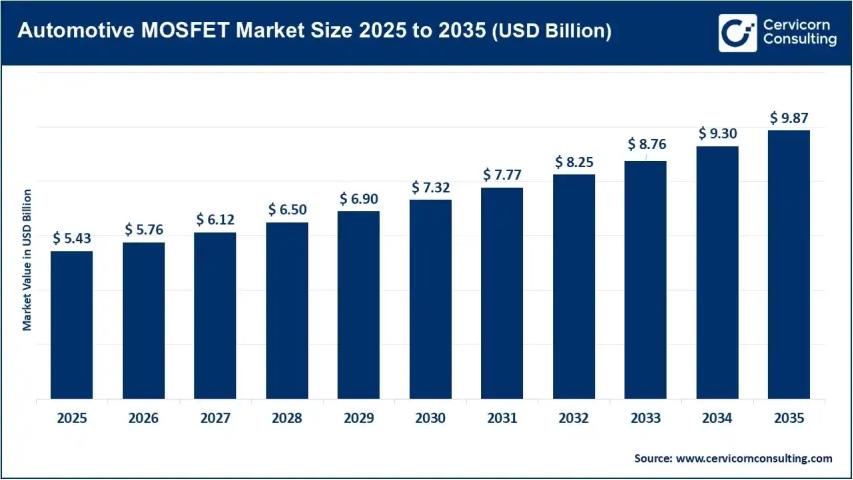
The global automotive MOSFET market was valued at USD 5.43 billion in 2025 and is projected to exceed USD 9.87 billion by 2035, expanding at a 6.16% CAGR from 2026 to 2035.
Why automotive MOSFET demand is increasing
Vehicle electrification is increasing the number of power-management stages within automobiles. Electric and hybrid vehicles require semiconductor components to manage energy across batteries, motors, charging systems, and electrical loads.
At the same time, modern vehicles are incorporating more electronic functions, including electric steering, electronic braking, thermal management, advanced lighting, connectivity, ADAS, infotainment, and automated control systems. This expanding electronic content is creating additional applications for MOSFETs.
The shift toward 48V electrical architectures is another development supporting demand, particularly for electrically controlled pumps, compressors, fans, steering, braking, and other auxiliary systems.
SiC MOSFETs are changing the technology landscape
Silicon MOSFETs continued to dominate the market in 2025, accounting for approximately 68% of market revenue, supported by established manufacturing capabilities, automotive qualification, supplier availability, cost advantages, and broad adoption across low- and medium-voltage applications.
However, SiC MOSFETs are expected to record the fastest growth during the forecast period. Their higher efficiency, thermal performance, and suitability for high-power applications make them increasingly relevant to electric vehicles and higher-voltage architectures.
The development of 800V-class and other high-voltage EV platforms is particularly relevant because efficient power conversion becomes increasingly important in traction inverters, eAxles, onboard chargers, and DC-DC converters.
Mitsubishi Electric's introduction of its fifth-generation SiC-MOSFET technology for EV and PHEV drive inverters and eAxles in 2026 illustrates the industry's movement toward higher-performance power devices.
EV powertrains create new opportunities
The powertrain and power-management segment represented 22% of the automotive MOSFET market in 2025, making it the largest application area.
MOSFETs support switching, power conversion, motor control, and energy management across conventional, hybrid, and electric propulsion systems. As electric powertrains become more sophisticated, semiconductor requirements are also shifting toward higher efficiency, power density, thermal performance, and reliability.
The EV segment is expected to experience the fastest growth among vehicle types. MOSFETs are used in battery management systems, traction inverters, DC-DC converters, electric motors, charging systems, and auxiliary electronics, creating multiple demand points within a single vehicle.
Get a Free Sample: https://www.cervicornconsulting.com/sample/3025
Battery management is becoming increasingly important
Larger and more sophisticated EV battery packs require advanced monitoring, protection, switching, and energy-management capabilities.
MOSFETs play an important role in battery disconnect and protection functions, making battery management systems an important growth application. As automakers place greater emphasis on battery safety, efficiency, lifecycle management, and charging performance, demand for automotive-grade power semiconductor components is expected to increase.
This trend also creates opportunities for semiconductor manufacturers developing devices specifically optimized for battery protection and motor-control applications. For example, Infineon's OptiMOS 8 100 V power MOSFET technology introduced in 2026 was positioned for applications including battery protection and motor control.
High-voltage architectures are reshaping demand
The high-voltage MOSFET segment is expected to register the fastest growth as electric and hybrid vehicles increasingly adopt higher-voltage electrical architectures.
Higher-voltage systems require power devices capable of efficient switching under demanding electrical conditions. This is particularly relevant to traction systems, DC-DC converters, battery protection, charging systems, and other high-power applications.
The transition toward higher-voltage platforms also supports the adoption of SiC MOSFETs, which can offer performance advantages in high-power automotive applications.
Asia Pacific remains the largest regional market
Asia Pacific accounted for 51% of automotive MOSFET market revenue in 2025, making it the leading regional market.
The region benefits from its large automotive manufacturing base, growing EV production, established semiconductor capabilities, and expanding battery ecosystem. China, Japan, South Korea, and India are key contributors to regional demand.
China's position as a major global vehicle and EV manufacturing hub creates significant demand for MOSFETs used in inverters, onboard chargers, DC-DC converters, battery management systems, and other power-management applications. Japan and South Korea contribute through their established automotive electronics, semiconductor, and battery industries, while India's expanding EV and semiconductor ecosystem is creating additional opportunities.
North America is positioned for faster growth
North America is expected to register the fastest growth during the forecast period. Increasing EV adoption, investments in battery and vehicle manufacturing, demand for advanced automotive electronics, and efforts to strengthen domestic semiconductor production are supporting the regional market.
The development of localized semiconductor and EV supply chains is particularly relevant. U.S. semiconductor incentives and investments aimed at strengthening manufacturing capacity and supply-chain resilience could create additional demand for automotive-grade MOSFETs.
Automotive qualification remains a critical barrier
While electrification is creating new opportunities, automotive MOSFET manufacturers must meet stringent reliability and qualification requirements.
Power semiconductor components need to operate reliably despite temperature variations, vibration, electrical stress, and prolonged operating cycles. Automotive manufacturers also require extensive testing and validation before incorporating new semiconductor technologies into vehicle platforms.
The AEC-Q101 qualification framework establishes reliability and qualification requirements for discrete semiconductor devices, including power MOSFETs. This creates additional engineering and validation requirements compared with many other semiconductor applications.
For semiconductor manufacturers, therefore, technological performance alone is not sufficient. Automotive qualification, reliability, manufacturing consistency, and long-term supply capabilities are equally important when competing for vehicle-platform adoption.
The role of government semiconductor initiatives
Government policies are becoming increasingly connected to automotive MOSFET development because semiconductors and electric mobility are being treated as strategic industries.
India is supporting semiconductor manufacturing, design, packaging, and R&D through its semiconductor ecosystem initiatives. The United States is using the CHIPS Program to strengthen semiconductor manufacturing and supply-chain resilience, while Europe is supporting semiconductor development through the European Chips Act.
Japan and South Korea are also supporting semiconductor and automotive technology development. These initiatives can influence where semiconductor manufacturing capacity is established and how regional automotive supply chains evolve.
What is changing across automotive applications?
The automotive MOSFET market is moving from conventional switching toward increasingly sophisticated power-management applications.
EV adoption is increasing semiconductor content per vehicle and creating demand across traction, battery, and charging systems. Higher-voltage platforms are supporting high-voltage switching and SiC MOSFET adoption. Larger battery packs are increasing the need for battery protection and power control. Fast charging is creating opportunities for advanced onboard-charging systems, while zonal vehicle architectures are increasing demand for localized power distribution and intelligent switching.
Electric commercial vehicles represent another potential growth area because their higher power requirements can increase demand for high-current and high-performance MOSFET solutions.
Silicon remains important as SiC expands
The automotive MOSFET technology landscape is likely to remain diversified.
Silicon MOSFETs continue to benefit from mature automotive qualification, established manufacturing infrastructure, cost advantages, and broad use across lighting, HVAC, pumps, fans, power distribution, body electronics, and control systems.
SiC MOSFETs, meanwhile, are gaining relevance in high-voltage and high-power EV applications where efficiency and thermal performance are particularly important.
GaN MOSFETs represent an emerging technology opportunity. Their high-frequency switching capabilities could support selected automotive power-conversion applications, although automotive adoption remains at an earlier stage compared with silicon and SiC.
What companies should monitor
For automotive semiconductor manufacturers, automakers, Tier 1 suppliers, and technology providers, several developments will shape the market over the coming years:
- Growth of EV and hybrid vehicle production
- Expansion of higher-voltage vehicle architectures
- Adoption of SiC MOSFETs
- Increasing battery-pack capacity and complexity
- Growth of onboard charging and fast-charging systems
- Expansion of 48V electrical systems
- Increasing semiconductor content per vehicle
- Development of zonal electrical architectures
- Automotive semiconductor localization
- Greater focus on efficiency, thermal performance, reliability, and power density
The automotive MOSFET market is therefore evolving alongside the broader transformation of vehicle electrical and electronic architectures. While silicon devices will continue serving a wide range of established applications, the increasing adoption of EVs and higher-voltage systems is creating opportunities for SiC and other advanced power-semiconductor technologies.
As the automotive industry moves toward more electrified, connected, and electronically controlled vehicles, MOSFETs are becoming an increasingly important component of the vehicle's power-management infrastructure.