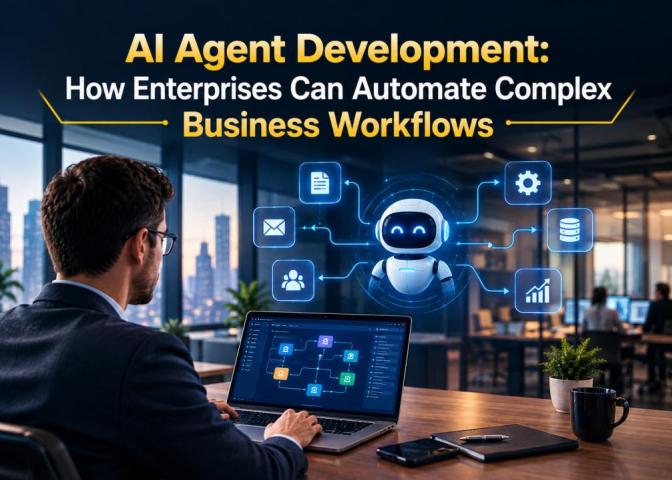
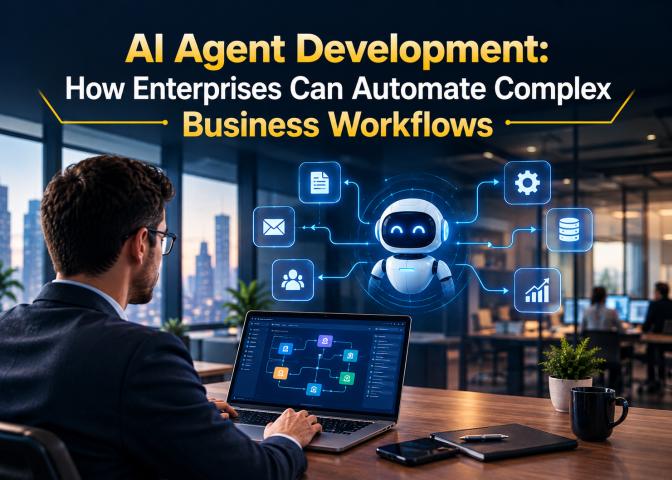
Artificial Intelligence is evolving rapidly. From traditional rule-based systems to Generative AI capable of creating text, images, code, and other content, technology has already transformed the way businesses work. The next major evolution is Agentic AI—an approach that enables AI systems to act more independently, make decisions, use tools, and complete complex tasks with minimal human intervention.
Unlike traditional AI systems that simply respond to a single prompt, Agentic AI can understand an objective, break it into smaller tasks, plan actions, execute them, evaluate results, and adapt when necessary.
In simple terms, Agentic AI moves AI from answering questions to taking action toward achieving goals.
What Is Agentic AI?
Agentic AI refers to artificial intelligence systems designed to operate as intelligent agents. These agents can pursue a specific goal by reasoning, planning, using available tools, and taking multiple actions.
For example, imagine asking an AI:
"Analyze our monthly sales data, identify the reasons for declining revenue, prepare a report, and suggest actions to improve sales."
A traditional AI system may require separate prompts for each task. An Agentic AI system, however, can potentially:
Understand the overall objective.
Access the required sales data.
Analyze trends and patterns.
Identify possible causes.
Create a structured report.
Generate recommendations.
Review the results before presenting the final output.
This ability to work through multiple steps makes Agentic AI one of the most important developments in the AI landscape.
How Does Agentic AI Work?
Agentic AI typically combines several important capabilities.
1. Goal Understanding
The AI agent first understands what the user wants to achieve.
Instead of focusing only on a single question, it identifies the larger objective.
For example:
Goal: Find suitable candidates for a Python developer role.
The agent may understand that it needs to search for candidates, compare skills, evaluate experience, and create a shortlist.
2. Planning
Once the goal is understood, the AI agent can break the objective into smaller tasks.
For example:
Define required skills.
Search available candidate data.
Compare resumes.
Rank candidates.
Prepare a shortlist.
Planning helps the AI handle complex workflows more effectively.
3. Reasoning and Decision-Making
Agentic AI evaluates information and determines what action should be taken next.
If one approach does not provide the expected result, the agent may adjust its strategy.
For example, if a data source does not contain enough information, the agent can decide to use another approved source or request additional input.
4. Tool Usage
One of the most powerful features of Agentic AI is its ability to work with tools.
Depending on the system, an AI agent may interact with:
Databases
APIs
Search systems
Spreadsheets
Business applications
Code execution environments
CRM platforms
Internal knowledge bases
This allows AI to move beyond generating text and participate in real business workflows.
5. Memory and Context
Agentic AI systems may use short-term context and, where appropriate, longer-term memory to maintain continuity across tasks.
This can help an agent remember previous steps, avoid repeating actions, and make better decisions during a workflow.
6. Reflection and Evaluation
Advanced AI agents can review their own outputs before completing a task.
For example, an AI agent generating a business report may check whether:
All required sections are included.
The data analysis is complete.
The recommendations match the findings.
Important errors or missing information need attention.
This evaluation process can improve the quality and reliability of results.
Agentic AI vs Generative AI
Generative AI and Agentic AI are closely related, but they serve different purposes.
Generative AI | Agentic AI |
|---|---|
Creates content | Takes actions to achieve goals |
Responds mainly to prompts | Can manage multi-step workflows |
Generates text, images, code, and more | Plans, reasons, uses tools, and executes tasks |
Often works one interaction at a time | Can perform sequences of actions |
Focuses on content generation | Focuses on goal completion |
Generative AI can be an important component inside an Agentic AI system. An AI agent may use a Large Language Model (LLM) to understand instructions and generate content while using planning, memory, tools, and workflows to complete larger tasks.
Real-World Applications of Agentic AI
Customer Support
AI agents can analyze customer queries, access relevant information, provide responses, and assist with routine actions.
For example, an AI support agent could:
Understand a customer's issue.
Search the relevant knowledge base.
Check account information.
Suggest a solution.
Escalate complex cases to a human team.
Software Development
Agentic AI can support developers throughout the software development lifecycle.
An AI agent may help with:
Understanding requirements.
Generating code.
Reviewing code.
Identifying bugs.
Running tests.
Creating documentation.
Suggesting improvements.
This does not mean AI replaces developers. Instead, it can automate repetitive tasks and allow developers to focus on complex problem-solving.
Data Analysis
Organizations can use AI agents to automate parts of the data analysis process.
For example, an AI agent could:
Collect data from approved sources.
Clean and organize the data.
Analyze important trends.
Generate visualizations.
Identify unusual patterns.
Prepare a summary for decision-makers.
This can make data-driven decision-making faster and more accessible.
Recruitment and HR
Agentic AI can assist with repetitive recruitment workflows.
Potential applications include:
Screening applications against defined criteria.
Matching skills with job requirements.
Scheduling interviews.
Preparing candidate summaries.
Answering common candidate questions.
Human oversight remains important, particularly for decisions that significantly affect people.
Sales and Marketing
AI agents can help teams automate and improve business processes.
Examples include:
Researching potential customers.
Organizing lead information.
Preparing personalized outreach drafts.
Analyzing campaign performance.
Identifying customer trends.
Generating follow-up recommendations.
Healthcare and Other Regulated Industries
AI agents may assist professionals with administrative workflows, documentation, information retrieval, and analysis. However, high-stakes decisions require strong safeguards, validation, privacy protection, and appropriate human oversight.
The Role of LLMs in Agentic AI
Large Language Models are an important part of many Agentic AI systems.
LLMs help agents:
Understand natural-language instructions.
Interpret complex requests.
Generate plans.
Reason through available information.
Produce reports and responses.
Decide when additional information or tools may be needed.
However, an LLM alone is not necessarily an AI agent.
An Agentic AI system generally combines an LLM with additional components such as:
LLM + Planning + Tools + Memory/State + Evaluation + Workflow
Together, these components enable more autonomous and goal-oriented behavior.
Important Technologies Used in Agentic AI
Learning Agentic AI often involves understanding several related technologies and concepts:
Large Language Models
LLMs provide the language understanding and generation capabilities behind many modern AI applications.
Retrieval-Augmented Generation (RAG)
RAG helps AI systems retrieve relevant information from approved knowledge sources before generating a response.
This can be useful for applications that need access to company documents, policies, product information, or internal knowledge.
Vector Databases
Vector databases can store embeddings and support semantic retrieval of relevant information.
APIs and Tool Integration
AI agents become more useful when they can interact safely with external applications and services.
Agent Frameworks
Frameworks and orchestration tools can help developers design multi-step AI workflows, manage tool calls, coordinate agents, and build AI-powered applications.
Multi-Agent Systems
In some systems, multiple specialized AI agents can collaborate.
For example:
One agent performs research.
One agent analyzes data.
One agent generates content.
One agent evaluates the final output.
The results can then be combined to complete a larger workflow.
Benefits of Agentic AI
Agentic AI offers several potential advantages for businesses and individuals.
Improved Productivity
Repetitive and time-consuming workflows can be partially automated, allowing teams to focus on higher-value work.
Faster Decision Support
AI agents can help collect, organize, and analyze information more quickly.
Scalable Operations
Organizations may be able to handle increasing workloads without scaling every manual process at the same rate.
Better Workflow Automation
Agentic AI can connect multiple steps in a process instead of treating every action as an isolated task.
Continuous Operation
Some AI-powered workflows can run continuously or on scheduled triggers, subject to appropriate monitoring and controls.
Challenges of Agentic AI
Despite its potential, Agentic AI also introduces important challenges.
Accuracy
AI-generated outputs can contain mistakes. Systems should validate important information before taking consequential actions.
Security
AI agents that access tools, applications, or data need carefully designed permissions and access controls.
Privacy
Organizations must protect sensitive and confidential information when building AI-powered workflows.
Lack of Control
Greater autonomy can increase risk if an agent takes unexpected actions. Guardrails, approval steps, and monitoring are essential.
Bias and Fairness
AI systems can reflect or amplify biases present in data or system design. Testing and human review are important.
The goal should not be to make AI completely uncontrolled. The goal should be to build capable AI systems with clear boundaries, safeguards, and human oversight where needed.
How to Start Learning Agentic AI
For beginners, a structured learning path can make the topic easier to understand.
Step 1: Learn Python
Python is widely used for AI, automation, data processing, and AI application development.
Focus on:
Variables and data types
Conditions and loops
Functions
Object-oriented programming
APIs
JSON
File handling
Step 2: Understand AI and LLM Basics
Learn the fundamentals of:
Artificial Intelligence
Machine Learning
Generative AI
Large Language Models
Tokens and context
Prompt engineering
Embeddings
Step 3: Learn RAG Concepts
Understand how AI applications retrieve relevant information.
Learn about:
Embeddings
Chunking
Vector search
Vector databases
Retrieval
Context generation
Step 4: Learn Tool and API Integration
Practice connecting AI applications with external tools and services.
Step 5: Build Simple AI Agents
Start with a basic agent that can:
Receive a goal.
Decide on a sequence of steps.
Use approved tools.
Generate an output.
Evaluate the result.
Step 6: Explore Multi-Agent Workflows
Once comfortable with single agents, learn how specialized agents can collaborate on larger tasks.
The Future of Agentic AI
The future of AI is moving toward systems that can do more than simply generate answers.
Agentic AI has the potential to support autonomous and semi-autonomous workflows across software development, business operations, customer support, analytics, finance, education, and many other industries.
Future AI systems may increasingly work as digital collaborators that can:
Understand goals.
Create plans.
Use software tools.
Access relevant information.
Perform multi-step tasks.
Evaluate outcomes.
Request human approval when required.
The most successful implementations will likely combine AI capability with human expertise, strong security, reliable data, and responsible governance.
Conclusion
Agentic AI represents an important step in the evolution of artificial intelligence. While Generative AI focuses primarily on creating content, Agentic AI extends these capabilities by enabling systems to plan, reason, use tools, and work toward completing larger goals.
For students and professionals, learning Agentic AI can open opportunities in AI application development, automation, intelligent workflows, RAG systems, LLM engineering, and multi-agent systems.
As organizations continue exploring practical AI adoption, the demand for people who understand Python, LLMs, RAG, APIs, vector databases, AI agents, and responsible AI development is likely to grow.
The future of AI is not only about generating intelligent answers—it is increasingly about building intelligent systems that can safely help people accomplish meaningful work.