Artificial intelligence is moving beyond systems that simply respond to questions or generate content. Modern AI development is increasingly focused on building systems that can interpret context, reason over information, make decisions, interact with software, and execute actions toward a defined objective.
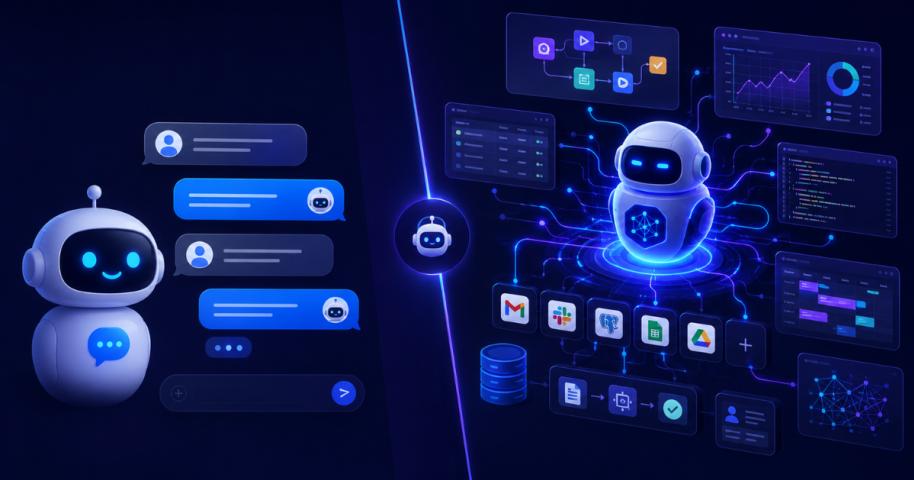
This shift is important because conventional chatbots and rule-based automation are primarily designed to respond to an input. A more advanced AI system can take an objective as its starting point and determine the sequence of actions required to achieve it. Instead of only answering, “What should I do?”, the system can potentially determine what needs to happen next, retrieve relevant information, evaluate alternatives, and initiate an approved action.
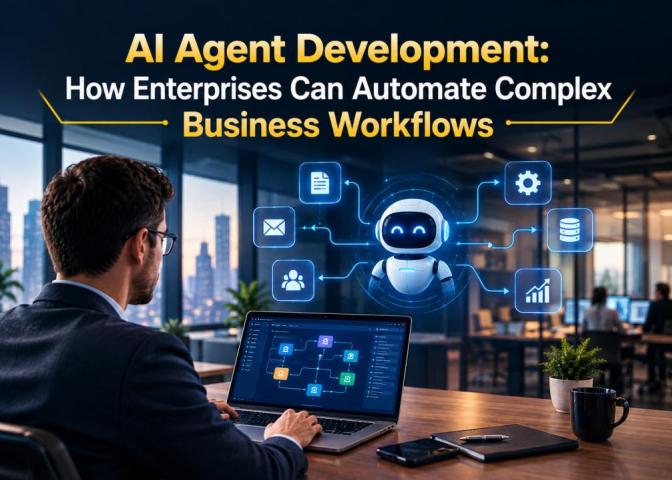
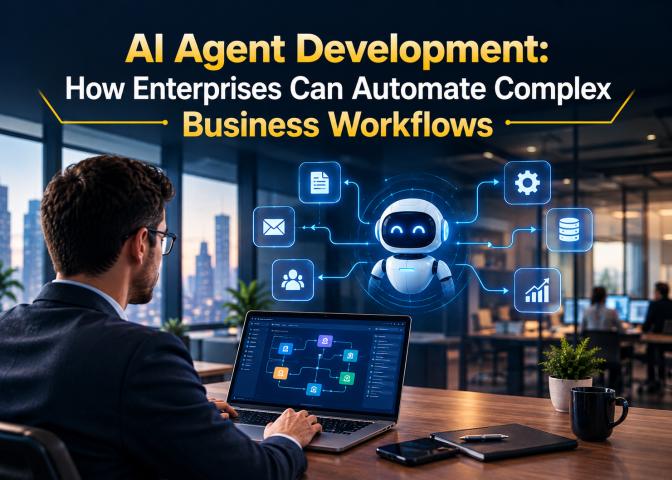
This evolution is closely associated with AI agents and agentic AI architectures. These systems combine machine learning, large language models, retrieval mechanisms, external tools, memory, workflow orchestration, and policy controls to create software capable of operating across more complex business processes.
From Conversational Interfaces to Goal-Oriented AI Systems
Chatbots remain useful because natural-language interaction is an effective interface between people and software. However, conversation itself does not necessarily make a system autonomous. A chatbot can explain a refund policy, while an intelligent system could determine whether a refund request satisfies business rules, retrieve the customer's transaction history, initiate the appropriate workflow, and escalate an exception to a human employee.
This distinction changes the way organizations approach AI development. The objective is no longer simply to make an application conversational. It is to create an intelligence layer capable of understanding a business objective and interacting with the systems required to accomplish it.
A modern ai chatbot development company may therefore work on conversational capabilities as one component of a broader AI architecture rather than treating the chatbot as the entire solution.
The underlying system may include an LLM for language understanding, a retrieval-augmented generation layer for accessing enterprise knowledge, APIs for interacting with business applications, a policy engine for controlling actions, and observability mechanisms for tracking decisions and failures.
For example, an enterprise procurement assistant could receive a request to purchase a particular component. Instead of simply returning supplier information, an agentic workflow could retrieve approved vendors, compare contract terms, check inventory requirements, evaluate procurement policies, prepare a purchase request, and ask for human authorization before placing an order.
The difference is not merely better conversation. It is the transition from response generation to goal-directed execution.
The Architecture Behind Reasoning and Decision-Making
Building an AI system that can reason and act requires considerably more than connecting an application to an LLM API. The model needs access to the right context, tools, data, constraints, and execution environment.
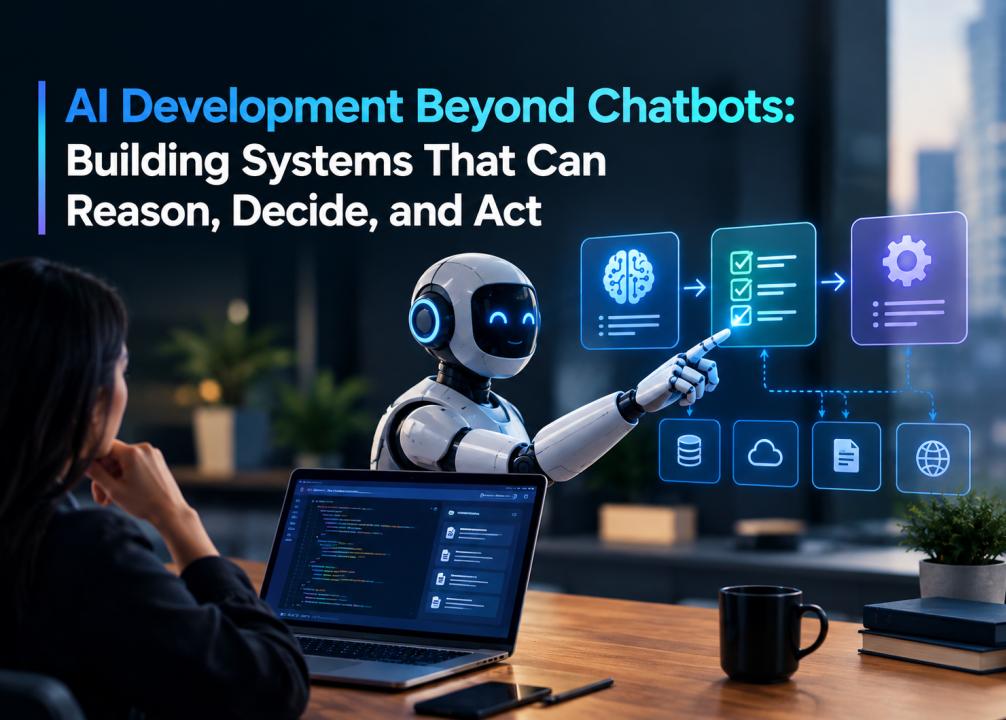
A practical architecture often contains several interconnected layers:
Perception and input processing: The system interprets natural-language requests, documents, events, sensor information, database records, or application signals.
Context and retrieval: Retrieval pipelines identify relevant information from enterprise databases, vector stores, knowledge bases, documents, or transactional systems. RAG helps reduce dependence on information contained only within the model's training data.
Reasoning and planning: The model decomposes a high-level objective into smaller tasks, evaluates available information, and determines an appropriate sequence of operations.
Tool orchestration: Function calling, APIs, databases, search systems, CRMs, ERPs, payment systems, and internal applications allow the AI system to perform useful operations outside the model itself.
Memory and state management: Short-term context maintains the current task state, while carefully designed persistent memory can retain relevant information across interactions.
Policy and authorization: Guardrails define what the system can and cannot do, including permission boundaries, spending limits, data-access restrictions, and mandatory human approvals.
Observability and evaluation: Logs, traces, evaluation datasets, latency metrics, tool-call records, and outcome measurements help engineering teams understand system behavior and identify failures.
This architecture makes the AI system closer to an orchestrated software platform than a standalone chatbot.
The reasoning layer also requires careful engineering. A model may generate a plausible plan while still selecting an unsuitable action. For this reason, production systems should validate critical outputs against deterministic rules, structured schemas, business policies, or external data before allowing consequential operations.
Where Intelligent Systems Can Create Operational Value
The strongest applications for reasoning-based AI are generally those where employees already spend substantial time gathering information, interpreting multiple inputs, and coordinating repetitive actions.
In customer operations, an AI system can classify incoming requests, retrieve account information, identify applicable policies, draft a resolution, and route exceptional cases to an appropriate employee. The conversational interface becomes only one entry point into a larger workflow.
In finance, intelligent systems can support transaction monitoring, invoice analysis, reconciliation, financial document processing, and exception management. An AI agent can gather evidence from multiple systems and prepare a recommendation, while predefined controls determine which actions require approval.
Healthcare applications can use AI to coordinate administrative workflows, summarize clinical information, assist with documentation, and identify relevant information from large datasets. High-impact decisions, however, require stronger validation, domain expertise, privacy controls, and human oversight.
Retail systems can combine customer behavior, inventory data, product information, and operational constraints to support merchandising and supply-chain workflows. An AI system might detect an inventory anomaly, investigate potential causes, retrieve supplier information, and prepare a replenishment recommendation instead of merely reporting that stock is low.
Software engineering is another significant area. AI systems can analyze issues, inspect repositories, retrieve documentation, propose code changes, execute tests, interpret failures, and create development artifacts. Human review can remain part of the workflow before changes reach production.
These examples demonstrate an important principle: the value of agentic AI does not come from autonomy alone. It comes from connecting intelligence to business context, reliable data, executable tools, and measurable outcomes.
Designing AI Systems for Control, Reliability, and Trust
Giving an AI system the ability to take action introduces a different engineering risk profile. A text-generation error may produce an incorrect paragraph. An action-taking system could potentially modify a database, send an incorrect communication, approve a transaction, or trigger an operational workflow.
For this reason, autonomy should be engineered as a controlled capability rather than an unrestricted permission.
Important safeguards include:
Human-in-the-loop controls: Require human approval for financial transactions, sensitive communications, irreversible changes, or other high-impact operations.
Permission boundaries: Give agents access only to the tools and data required for their specific responsibilities.
Action validation: Validate parameters, schemas, business rules, and authorization status before executing tool calls.
Auditability: Maintain traceable records of inputs, retrieved information, model outputs, tool calls, approvals, and final actions.
Failure recovery: Design retry limits, fallbacks, circuit breakers, rollback mechanisms, and escalation paths for unexpected behavior.
Continuous evaluation: Test agents against representative scenarios, adversarial inputs, ambiguous requests, and known failure cases rather than evaluating only response quality.
Data governance: Protect sensitive information through access controls, encryption, retention policies, and appropriate data-handling mechanisms.
Reasoning also needs to be treated carefully. A model's generated explanation should not automatically be considered a definitive record of how a decision was produced. Production architectures should capture objective system events, retrieved evidence, tool calls, and policy checks so that decisions can be investigated independently.
This becomes particularly important when AI systems operate across multiple applications. An agent that can access a CRM, payment platform, internal database, and communication system effectively becomes part of the organization's operational infrastructure.
Building the Next Generation of AI Applications
The next phase of AI development is less about placing an LLM inside an existing application and more about redesigning how software handles complex work.
Organizations need to identify processes where people repeatedly interpret information, make structured decisions, coordinate systems, and perform predictable actions. Those processes provide a clearer foundation for agentic architecture than simply adding an AI assistant to every application.
Successful implementations will also require collaboration between software engineers, data teams, domain specialists, security professionals, and business stakeholders. The model is only one component of the solution. Data quality, API reliability, workflow design, authorization, observability, evaluation, and governance determine whether an AI system can operate safely in a real environment.
The emerging architecture is therefore a combination of reasoning models, enterprise data, retrieval systems, tools, orchestration, memory, policy controls, and human supervision.
Chatbots will continue to play an important role as conversational interfaces, but they represent only one layer of intelligent software. The larger opportunity lies in systems that can understand an objective, evaluate context, plan a sequence of tasks, use appropriate tools, verify results, and escalate decisions when they exceed defined boundaries.
AI development is consequently moving from systems that merely generate responses toward systems that can understand, reason, decide, and act. The organizations that approach this transition as an engineering and governance challenge—not simply a model-integration exercise—will be better positioned to build AI applications that can operate reliably within real-world business environments.