Division is one of the fundamental operations in mathematics, but not every division problem results in a whole number. When one number cannot be divided evenly by another, the amount left over is known as the remainder.
Understanding remainders is useful in school mathematics, programming, finance, scheduling, and many everyday calculations. While remainders can be calculated manually, using a dedicated tool can make the process faster and reduce the risk of mistakes.
What Is a Remainder?
A remainder is the amount left after one whole number has been divided by another.
For example, consider the calculation:
17 ÷ 5 = 3 remainder 2
Five can fit into 17 three complete times, which gives 15. After subtracting 15 from 17, there are 2 left over.
The basic relationship can be written as:
Dividend = Divisor × Quotient + Remainder
In this example:
17 = 5 × 3 + 2
This formula is useful for checking whether a division calculation is correct.
How Remainder Calculations Work
To find a remainder manually, start by dividing the first number by the second number and identify the largest whole-number quotient.
For example:
29 ÷ 6
Six can be multiplied by 4 to get 24. Multiplying it by 5 would produce 30, which is greater than 29.
Therefore:
29 ÷ 6 = 4 remainder 5
The remainder is 5.
The remainder must always be smaller than the divisor. If the remainder is equal to or greater than the divisor, the division has not been completed correctly.
Using a Remainder Calculator
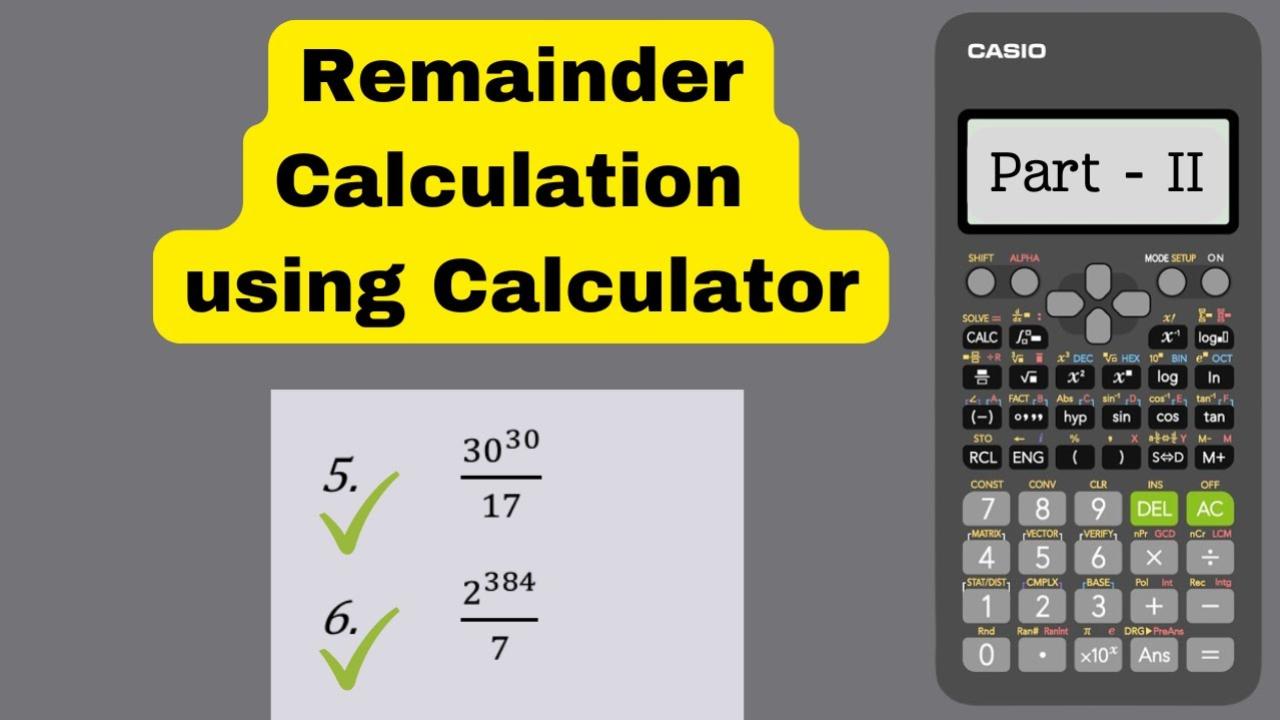
A remainder calculator simplifies this process by performing the division and identifying the remaining amount automatically.
Typically, you enter two values:
The dividend, which is the number being divided.
The divisor, which is the number you are dividing by.
The calculator then provides the quotient and remainder.
For example, entering 47 as the dividend and 9 as the divisor produces:
47 ÷ 9 = 5 remainder 2
This is because 9 × 5 equals 45, leaving 2.
Using a calculator can be particularly helpful when working with larger numbers that would take more time to calculate manually.
Why Remainders Are Important
Remainders may seem like a small part of division, but they have many practical uses.
One common example is determining whether something can be divided equally. Suppose 25 items need to be distributed among 4 people. Each person can receive 6 items, with 1 item remaining.
The remainder immediately tells you that the distribution is not perfectly even.
Remainders are also used in computer programming, where they can help determine whether numbers are even or odd, create repeating patterns, and control certain types of calculations.
Remainders in Everyday Situations
Remainders appear in many situations outside the classroom.
For example, imagine you have 50 candies and want to put them into bags containing 6 candies each. You can make 8 complete bags because:
6 × 8 = 48
That leaves:
50 − 48 = 2
So, the remainder is 2.
Similarly, remainders can be useful when dividing products into equal groups, organizing people into teams, or determining how many complete units can be created from a specific quantity.
Checking Your Answer
One advantage of understanding the remainder formula is that you can easily verify a result.
Suppose the calculation is:
38 ÷ 7 = 5 remainder 3
You can check it using:
7 × 5 + 3 = 38
Since the result equals the original dividend, the calculation is correct.
This method is particularly useful for students who want to verify their homework or anyone performing calculations where accuracy matters.
Remainders and Decimal Answers
Remainders can also be represented as decimal values.
For example:
7 ÷ 2 = 3 remainder 1
The same division can be written as:
7 ÷ 2 = 3.5
The remainder method emphasizes the whole-number portion and what is left over, while the decimal method expresses the complete result numerically.
Which format is more useful depends on the situation. Some problems specifically require a remainder rather than a decimal.
Benefits of Using a Calculator
A remainder calculator can offer several advantages:
Speed: It can solve division problems almost instantly.
Accuracy: It reduces common arithmetic errors.
Convenience: Large numbers can be calculated without lengthy manual work.
Verification: Students can use it to check manually calculated answers.
Efficiency: It is useful when performing multiple division problems.
However, understanding the underlying calculation is still important. A calculator should support mathematical understanding rather than replace it completely.
Tips for Getting Accurate Results
When using a remainder tool, make sure the numbers are entered correctly. Confusing the dividend and divisor will produce a different result.
It is also helpful to remember that the divisor cannot be zero because division by zero is undefined.
For important calculations, you can verify the result using the multiplication-and-addition formula:
Divisor × Quotient + Remainder = Dividend
This simple check can confirm that the answer makes sense.
Final Thoughts
Remainders are an essential part of division and have practical applications in mathematics, programming, organization, and everyday problem-solving. While calculating them manually is relatively simple for small numbers, larger calculations can take more time and create opportunities for mistakes.
A calculator provides a convenient way to determine the quotient and remainder quickly. By understanding how the calculation works and using tools to verify results, you can handle division problems more efficiently while maintaining accuracy.
Whether you are completing a math assignment, checking a calculation, or solving a practical problem, knowing how to work with remainders is a useful mathematical skill.