When engineers compare battery formats, the conversation almost always starts with chemistry and ends with energy density — cylindrical vs. prismatic vs. pouch gets reduced to a footnote. That's backwards for a lot of real projects, because for products with a fixed enclosure — a drone frame, a medical device housing, an automotive floor pan — the format decision often matters more than which NMC variant sits inside it.
The One Thing Cylindrical and Prismatic Cells Can't Do
A pouch cell lithium battery can be manufactured in virtually any planar geometry — ultra-thin profiles for wearables, wide flat cells for automotive floor packs, narrow cells for inline tool batteries. Cylindrical cells, by contrast, come in fixed diameters (18650, 21700, 4680), and prismatic cells offer some variation, but only within hard-tooled dimensions. If your enclosure doesn't match one of those fixed formats, the cylindrical or prismatic conversation is over before it starts.
That flexibility isn't just a manufacturing footnote — it's why pouch cells dominate categories where the enclosure is designed first and the battery has to fit around it, rather than the other way around.
Format Comparison: Design Flexibility Is Only Part of the Story
| Factor | Pouch | Prismatic | Cylindrical |
|---|---|---|---|
| Design Flexibility | Maximum — custom shapes available | Moderate — fixed rectangular formats | Minimum — fixed diameter, variable length only |
| Typical Strength | Space efficiency, weight, cell-to-cell consistency | Structural rigidity, easier thermal management at scale | Manufacturing maturity, mechanical robustness |
| Best Suited For | Drones, wearables, medical devices, EV floor packs | EV modules, energy storage racks | Power tools, consumer electronics, legacy EV packs |
Where Pouch Cells Actually Win in the Field
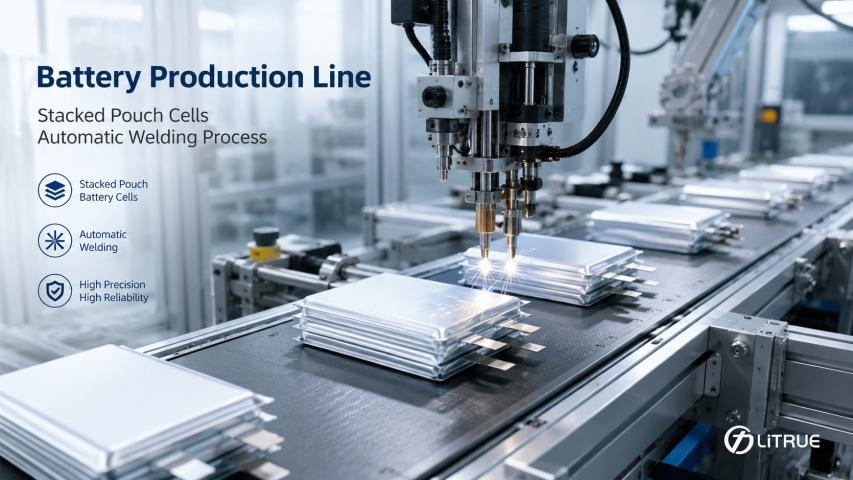
The design-flexibility advantage shows up most clearly in two places. In medical and portable industrial equipment, device geometry is often non-negotiable and reliability is patient-safety-critical — the cell-to-cell consistency of stacked pouch cells, combined with the ability to customize exact dimensions, is what makes this format the standard for medical-device battery packs. In UAVs and electric motorcycles, where every gram and every millimeter of chassis space is contested, a pouch cell sized to the exact frame cavity beats a cylindrical or prismatic cell that leaves wasted volume behind.
LiTrue Power Technologies Co., Ltd.'s own 20Ah & 46Ah High-Temperature LFP Pouch Cell illustrates the point directly: the PC20F-T's physical dimensions (12.6mm × 90mm × 192mm) are sized specifically for module-level integration in compact pack housings — common in electric motorcycle frames where depth and width are constrained in ways a standard cylindrical cell simply can't accommodate.
Customization Doesn't Stop at the Cell
For OEM customers with volume commitments, LiTrue builds full custom battery packs around its pouch cells — module configurations, BMS integration, and complete thermal management design — with tab geometry, terminal configuration, and pack voltage adapted to the customer's specific platform. That's the difference between buying a cell and buying a solution engineered to disappear into your product rather than dictate its shape. LiTrue's broader pouch cell lineup, spanning high energy density, high C-rate, and wide-temperature options, is available in the product catalog.