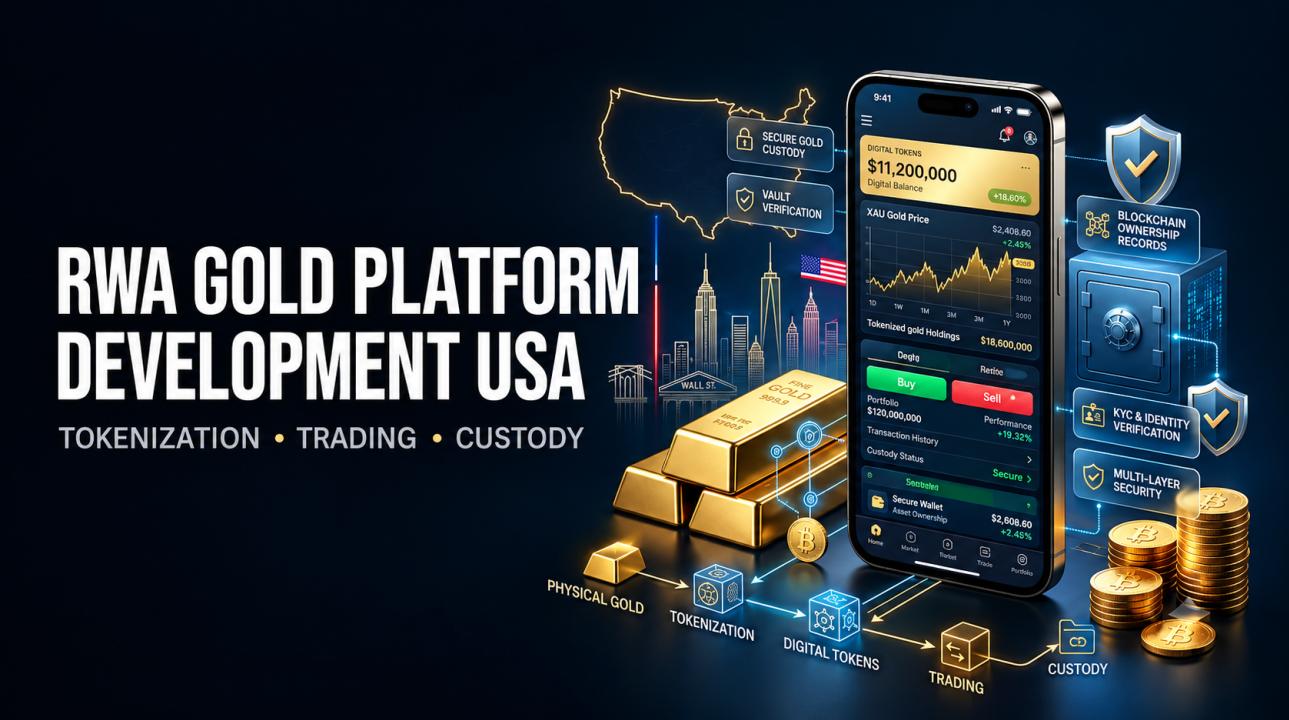
The emerging trend in RWA tokenization presents businesses with new opportunities to tokenize real-world assets on the blockchain. One of the opportunities in RWA tokenization that is gaining popularity is gold tokenization software development, which implies tokenizing real gold via digital ownership representation on a blockchain platform.
An RWA gold platform allows its users to have a digital framework to utilize their tokenized interests based on physical gold. Nevertheless, the development of an RWA gold platform, especially for the American market, involves many components beyond smart contracts and a trading interface. The developers have to take into account gold reserves, tokenization model, custody, asset verification, regulations, blockchain infrastructure, security, and the entire transaction flow.
This article presents all the components of RWA gold platform development, including tokenization, trading features, custody, security, technology architecture, regulatory issues, development process, and costs.
1. Define the Gold-Backed Asset Model
The first decision is determining exactly what the digital token represents.
A platform could structure tokens around:
- A specific quantity of physical gold
- Allocated gold holdings
- Shares or interests in a gold-backed structure
- Vaulted bullion
- A portfolio of eligible gold assets
The relationship between the token and the underlying asset should be clearly documented so users understand what ownership or economic rights the token represents.
2. Establish the Physical Gold Foundation
Tokenization begins with the real-world asset.
The platform needs a reliable process for:
- Gold sourcing
- Verification
- Authentication
- Weighing
- Quality assessment
- Allocation
- Storage
- Periodic reconciliation
The blockchain cannot independently prove that physical gold exists. That connection requires appropriate custodians, audits, attestations, documentation, and operational controls.
3. Design the Tokenization Framework
Once the underlying gold structure is established, the platform can define how tokens are created and managed.
Important parameters include:
- Token denomination
- Total supply
- Minting rules
- Redemption conditions
- Ownership records
- Transfer restrictions
- Supported blockchain
- Token lifecycle
The token design should match the legal and economic structure of the underlying gold arrangement.
4. Create a Transparent Asset-Backing System
Users need confidence that digital representations correspond to the underlying assets.
A platform can provide information such as:
- Gold holdings
- Vault location or custodian information where appropriate
- Asset quantity
- Token supply
- Verification records
- Audit or attestation information
- Reserve reconciliation
Transparency can be especially important when marketing an RWA product to users who cannot directly inspect the physical asset.
5. Build Secure Smart Contracts
Smart contracts manage important parts of the token lifecycle.
Depending on the platform structure, contracts may control:
- Token issuance
- Transfers
- Burning
- Redemption
- Supply limits
- Whitelisting
- Permission management
- Compliance restrictions
Smart contracts should undergo rigorous testing and independent security review before being used with significant value.
6. Develop the Investor Onboarding Layer
Users need a straightforward process for accessing the platform.
A typical onboarding flow could include:
Registration → Identity Verification → Eligibility Checks → Wallet Setup → Funding → Token Purchase
The exact process depends on the platform's legal structure, user type, jurisdiction, and regulatory requirements.
7. Add KYC and AML Controls
A tokenized gold platform may need identity and transaction controls depending on how the asset is structured and offered.
Potential capabilities include:
- Identity verification
- Sanctions screening
- Risk assessment
- Transaction monitoring
- Wallet screening
- Suspicious-activity monitoring
- User eligibility controls
Compliance requirements should be established before the technical architecture is finalized.
8. Build the Trading Experience
If the platform supports secondary trading, users need a clear market interface.
Trading functionality can include:
- Token listings
- Buy and sell orders
- Market information
- Order history
- Portfolio balances
- Transaction records
- Price charts
- Trading status
The platform should clearly distinguish between primary issuance and any secondary-market functionality.
9. Connect Gold Pricing Data
Gold-backed digital assets require reliable pricing information.
Depending on the business model, the platform may integrate market data for:
- Gold spot prices
- Reference prices
- Currency conversion
- Historical price information
- Asset valuation
Pricing sources should be selected carefully, with appropriate controls around data availability, accuracy, and updates.
10. Build the Custody Architecture
Custody is one of the most important components of an RWA gold ecosystem.
The platform may need to coordinate between:
Physical Custodian → Gold Holdings → Verification/Attestation → Token Platform → Digital Wallet → User
The physical gold custodian and digital-asset custody model should be clearly separated where appropriate.
Digital custody may involve:
- Institutional wallets
- Qualified custody providers
- Multi-signature controls
- Hardware security
- Transaction authorization
- Key-management systems
The appropriate model depends on the platform's legal and operational structure.
11. Support Token Redemption
A gold-backed token platform may need a defined redemption mechanism.
The workflow could involve:
- User submits a redemption request.
- Eligibility and ownership are verified.
- Tokens are locked or burned according to the platform rules.
- The corresponding gold or redemption value is processed.
- Delivery or settlement occurs through the approved mechanism.
Redemption rules, fees, minimum quantities, settlement times, and geographic restrictions should be clearly communicated.
12. Add a Portfolio Dashboard
Users should have a simple way to understand their holdings.
The dashboard can display:
- Token balances
- Gold-equivalent holdings
- Current valuation
- Purchase history
- Trading activity
- Redemption status
- Transaction history
- Portfolio performance
For the USA market, the interface should clearly explain what the displayed value represents and avoid confusing digital token balances with direct physical possession unless the legal structure provides that right.
13. Implement Wallet Infrastructure
Wallet functionality can be integrated into the platform or provided through external infrastructure.
Possible capabilities include:
- Wallet creation
- Deposit addresses
- Token transfers
- Withdrawal management
- Transaction history
- Wallet whitelisting
- Address screening
Security controls should be implemented around private keys, signing permissions, withdrawal requests, and administrator access.
14. Create an Institutional Admin Panel
An RWA platform requires more operational controls than a standard crypto application.
The administrative system can manage:
- Token supply
- Users
- KYC status
- Gold reserves
- Custodian information
- Minting requests
- Redemption requests
- Transactions
- Trading activity
- Compliance alerts
- Reports
This gives operators a centralized view of both digital and real-world asset activity.
15. Maintain Reserve Reconciliation
A critical operational process is comparing the physical gold backing with the outstanding token supply.
The platform may establish controls for:
- Gold quantity reconciliation
- Token supply reconciliation
- Custodian reports
- Audit records
- Mint and burn records
- Exception handling
This process helps maintain consistency between the real-world asset layer and the blockchain layer.
16. Build Strong Security Controls
Because an RWA gold platform can combine valuable physical assets with digital assets, security needs to cover multiple layers.
Important areas include:
- Smart-contract security
- Wallet security
- API protection
- Encryption
- Multi-factor authentication
- Role-based access
- Transaction monitoring
- Key management
- Infrastructure monitoring
- Incident response
Security testing should take place throughout development rather than only immediately before launch.
17. Select the Blockchain and Technology Stack
The blockchain should be selected according to the platform's transaction volume, token standards, ecosystem, fees, interoperability, and compliance requirements.
A possible technology architecture may include:
Blockchain: An appropriate EVM-compatible or other supported network
Smart Contracts: Solidity or another blockchain-specific development framework
Backend: Node.js, Python, Java, or similar technologies
Database: PostgreSQL, MySQL, or another suitable database
Frontend: React, Next.js, Flutter, or native mobile technologies
Cloud: AWS, Microsoft Azure, or Google Cloud
Integrations: Custody, KYC, AML, market data, payment, and blockchain infrastructure providers
The final stack should be selected after defining the asset model and operating requirements.
18. Plan the Compliance Architecture for the USA
Launching an RWA gold platform in the USA requires careful assessment of the legal structure and activities involved.
Depending on the model, businesses may need to evaluate areas involving:
- Securities regulations
- Money transmission
- AML/KYC obligations
- Custody
- Consumer protection
- Tax considerations
- Commodity-related requirements
- State-level requirements
- Digital-asset regulations
The classification and regulatory treatment of a token can depend on its specific rights, structure, distribution method, and use. Legal counsel should review the model before public launch.
19. Design the Trading and Settlement Infrastructure
Trading is only one part of the transaction lifecycle.
A complete system may need to coordinate:
Order → Compliance Check → Trade Execution → Token Settlement → Record Update → Custody Reconciliation
This architecture can help ensure that trading activity, token balances, and relevant operational records remain synchronized.
20. Estimate RWA Gold Platform Development Cost
Development costs depend heavily on whether the business needs only tokenization functionality or a complete ecosystem covering trading, custody, compliance, and physical-asset operations.
A general planning range is:
Platform Scope | Estimated Cost |
| Basic RWA Gold MVP | $60,000–$120,000 |
| Tokenization + Trading Platform | $120,000–$250,000 |
| Advanced RWA Gold Platform | $250,000–$400,000+ |
| Enterprise RWA Ecosystem | $400,000–$600,000+ |
These figures are broad planning estimates. Smart-contract complexity, custody integrations, compliance infrastructure, trading functionality, blockchain selection, security audits, and third-party services can significantly affect the final budget.
21. Plan the Platform Around Four Core Layers
A useful architecture for an RWA gold platform can be divided into four connected layers:
Asset Layer
Physical gold, vaulting, verification, custody, and reserve reconciliation.
Blockchain Layer
Token contracts, wallets, minting, transfers, burning, and on-chain records.
Financial Layer
Pricing, trading, settlement, payments, portfolio management, and redemption.
Compliance Layer
KYC, AML, eligibility, transaction monitoring, reporting, and regulatory controls.
Keeping these layers clearly defined can make the platform easier to operate and expand.
22. Prepare for Future RWA Expansion
Once the infrastructure for tokenized gold is established, the same platform architecture may potentially support other real-world assets, subject to their own legal and operational requirements.
Future asset categories could include:
- Precious metals
- Commodities
- Real estate interests
- Collectibles
- Other asset-backed structures
Each new asset class would require its own legal, custody, valuation, compliance, and tokenization framework.
Final Thoughts
Gold platform development in the USA in the RWA space needs to be organized by physical asset management, blockchain technology, trading infrastructure, custody, compliance, and user experience. Tokenization is just one of the product features; the platform should also have a robust mechanism for backing proof, secure custody infrastructure, transparent operation, and defined mechanisms for redemption and trading.
A narrow MVP can help create a tokenization and custody basis, whereas the trading, advanced compliance automation, institutional solutions, and additional RWA opportunities can follow.
To get to know more about the platform development, please check out the video below