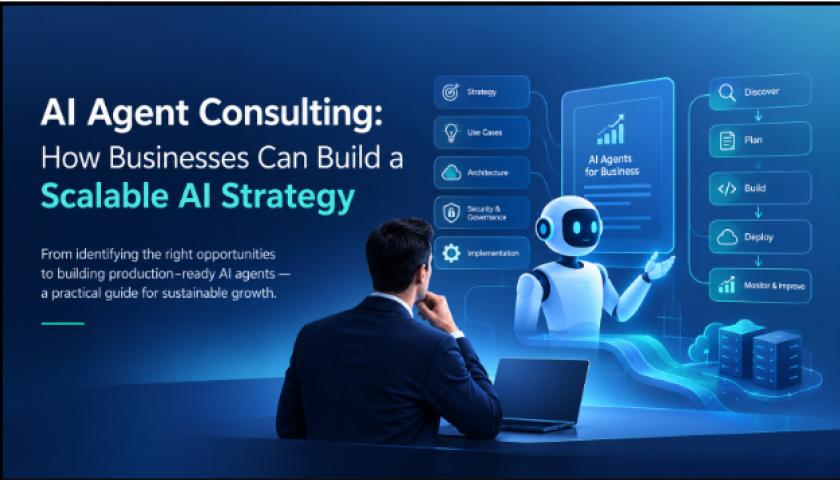

AI adoption is no longer about asking whether your business should use AI. The more important question is where AI can create measurable business value. AI business consulting helps organizations move beyond scattered AI experiments by identifying practical opportunities, evaluating their potential impact, and building a roadmap around the initiatives most likely to improve revenue, productivity, customer experience, or operational efficiency.
A strong AI strategy does not begin with a technology or an AI model. It begins with a business problem. The goal is to find areas where AI can solve meaningful problems, fit existing workflows, and generate measurable outcomes without creating unnecessary cost or complexity.
Why Businesses Need a Structured Approach to AI Opportunities
Businesses can identify dozens of potential AI ideas across departments. Sales teams may want AI-powered lead qualification. Customer service may want intelligent assistants. Operations teams may look at process automation. Finance may explore forecasting and anomaly detection.
The challenge is deciding which opportunities deserve investment first.
A use case can be technically impressive but commercially weak. Another may appear simple but generate substantial savings when deployed across thousands of transactions or employees.
This is why effective AI strategy consulting focuses on the relationship between the business problem, expected value, feasibility, risk, and implementation effort.
The objective is not to implement AI everywhere. It is to identify the areas where AI can support specific business objectives and create measurable value.
Step 1: Identify Where the Business Has the Most Value Leakage
The first step is not brainstorming AI features. It is identifying where the business is losing time, money, revenue, or customer value.
Start by reviewing major business processes and asking:
Which processes consume significant employee time?
Where do repetitive manual tasks slow operations?
Where are customers experiencing delays or inconsistent service?
Which decisions depend on large amounts of data?
Where are employees spending time searching, summarizing, or processing information?
Which revenue opportunities are limited by slow response times?
Where do errors, rework, or bottlenecks create unnecessary costs?
These questions help uncover potential AI use cases based on actual business needs rather than technology trends.
For example, a company processing thousands of customer requests may have an opportunity to automate classification and routing. A sales organization may use AI to summarize customer interactions and identify buying signals. An operations team may apply predictive analytics to anticipate demand or identify process bottlenecks.
The opportunity comes from connecting AI capabilities to measurable business problems.
Step 2: Map AI Opportunities to Business Outcomes
Once potential opportunities are identified, connect each one to a specific business outcome.
Avoid defining an opportunity as simply:
“Use generative AI for customer service.”
Instead, define it as:
“Reduce average customer-support handling time while maintaining or improving resolution quality.”
The second statement gives the project a measurable objective. Common business outcomes include:
Process Automation
AI can automate repetitive activities such as document processing, information extraction, classification, summarization, workflow routing, and routine decision support.
The business value may come from reducing processing time, lowering operational costs, or allowing employees to focus on higher-value activities.
Customer Experience
AI can support personalized recommendations, intelligent customer-service assistants, sentiment analysis, faster responses, and more relevant interactions.
The resulting business metrics may include response time, customer satisfaction, conversion rate, retention, or support resolution time.
Employee Productivity
AI can reduce the time employees spend searching for information, preparing reports, drafting content, summarizing meetings, or completing repetitive knowledge tasks.
Productivity should be measured through specific workflow metrics rather than simply counting AI tool usage.
Revenue Opportunities
Some AI business solutions can directly support revenue growth through better personalization, sales assistance, lead qualification, pricing optimization, forecasting, or new AI-enabled products and services.
The important question is not whether AI can be added to a process. It is whether the change can improve a business metric that matters.
Step 3: Evaluate the Potential Business Impact
After identifying opportunities, estimate their potential value.
A practical evaluation should consider four dimensions:
Business impact: How much could the initiative improve revenue, cost, productivity, customer experience, or another strategic KPI?
Reach: How many employees, customers, transactions, or business units could benefit?
Frequency: How often does the process occur?
Value per improvement: What is the financial or operational value of reducing time, errors, or missed opportunities?
A process completed 10 times per month may not justify significant AI investment. The same process completed 100,000 times per month could represent a major opportunity.
This approach helps separate interesting AI ideas from commercially meaningful initiatives.
Step 4: Assess Feasibility Before Investing
High potential value does not automatically make an AI project a good candidate for immediate implementation.
Evaluate whether the organization has:
Sufficient and reliable data
Access to the required business systems
Suitable technology infrastructure
Clear process ownership
Employees who can adopt the new workflow
Appropriate security and governance controls
A realistic implementation budget
A measurable success criterion
Data readiness is particularly important. An AI initiative built around incomplete, inconsistent, inaccessible, or poorly governed data may require significant preparation before delivering value.
Feasibility should therefore be evaluated alongside expected business impact rather than after a project has already been approved.
Step 5: Build an AI Use-Case Prioritization Framework
When an organization has a long list of opportunities, prioritization becomes critical.
A practical framework can evaluate each initiative across five areas:
1. Business Value: Estimate the potential impact on revenue, cost reduction, productivity, customer experience, or strategic growth.
2. Implementation Effort: Consider development complexity, integrations, data preparation, infrastructure, and operational requirements.
3. Time to Value: Determine how quickly the organization can move from implementation to measurable results.
4. Risk: Consider data privacy, security, regulatory requirements, model reliability, operational dependency, and potential customer impact.
5. Scalability: Assess whether the solution can expand across teams, business units, products, geographies, or processes.
The objective is not to choose the most sophisticated AI project. It is to identify opportunities that create a strong combination of value, feasibility, speed, and manageable risk.
Step 6: Estimate AI ROI Before Building
AI ROI should be considered before significant development begins.
A simple business case can compare expected annual benefits with the total cost of ownership.
Potential benefits may include:
Reduced labor or processing costs
Increased employee productivity
Higher conversion rates
Improved customer retention
Faster service delivery
Reduced errors and rework
Increased revenue from new or improved offerings
Costs may include development, AI infrastructure, data preparation, integrations, licensing, security, monitoring, maintenance, and employee training.
The calculation should also account for adoption. An AI system that technically works but is rarely used may produce little business value.
For this reason, establish baseline metrics before implementation and define target improvements in advance.
Step 7: Prioritize Quick Wins and Strategic Opportunities Together
Not every AI initiative needs to be a large transformation program.
A balanced AI roadmap can include:
Quick wins: Smaller initiatives that can demonstrate value quickly.
Scale opportunities: Proven use cases that can expand across departments or workflows.
Strategic initiatives: Larger AI programs that may require greater investment but support long-term competitive or operational goals.
For example, an organization might initially automate document classification, then expand AI into workflow orchestration once the business has validated the underlying process and data.
This creates a progression from experimentation to measurable value and eventually to broader AI adoption.