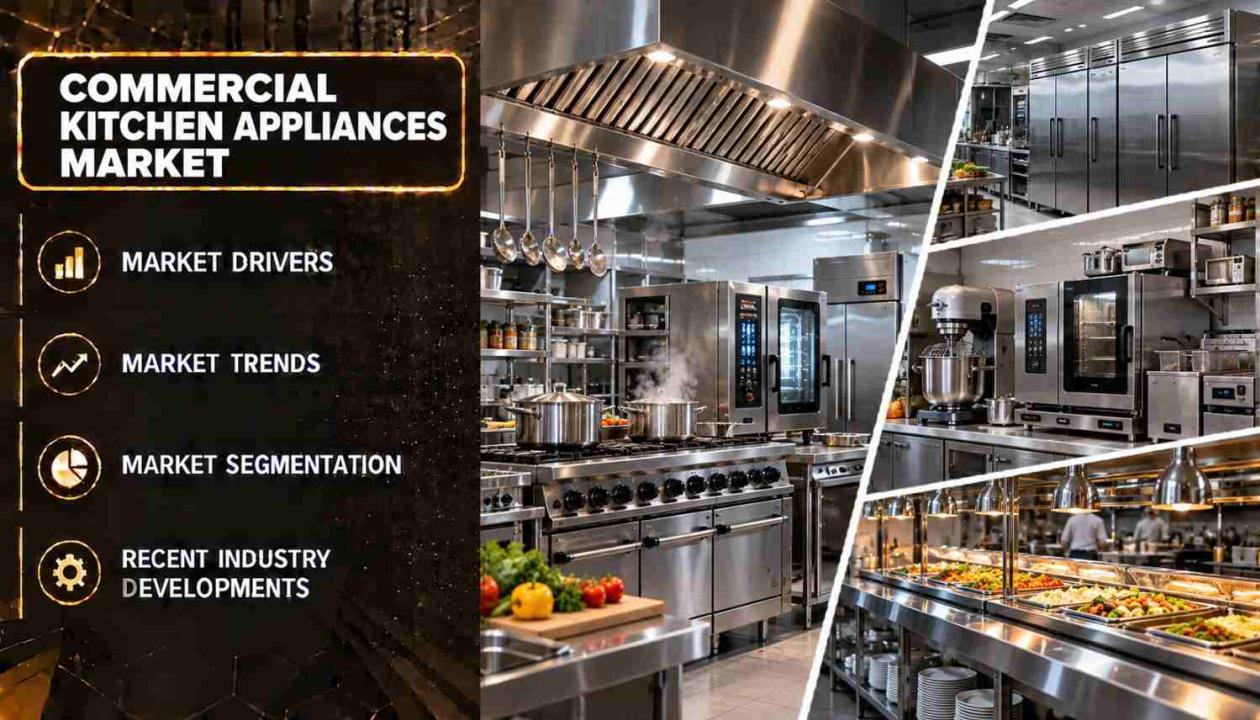
Now the template and the report page.IMARC Group, a leading global market research and management consulting firm, has published its latest market intelligence report on the commercial kitchen appliances market. The global commercial kitchen appliances market size was valued at USD 109.2 Billion in 2025. Looking forward, IMARC Group estimates the market to reach USD 166.3 Billion by 2034, exhibiting a CAGR of 4.78% during 2026-2034, driven by rising foodservice activity across restaurants, hotels, and catering operations, rapid adoption of IoT-enabled smart appliances, tightening energy-efficiency and food-safety norms, and strong tourism-led demand for high-volume kitchen infrastructure worldwide.
The market is on a steady growth path underpinned by the expansion of quick service formats, cloud kitchens, and online food ordering, all of which demand equipment built for speed, throughput, and consistency. Foodservice operators are under sustained pressure from labor shortages and rising energy bills, which is pushing them toward automated, connected, and energy-efficient equipment that lowers operating costs over the full equipment life. Refrigerators remain the largest equipment category on account of their central role in food safety and cold-chain integrity, while ovens, cooking ranges, and dishwashers are being upgraded with sensors, programmable controls, and remote monitoring. Offline channels continue to dominate purchasing because operators prefer to test equipment, negotiate bundles, and secure after-sales support before committing capital. Government regulation, from refrigerant restrictions to energy-efficiency certification programs, is reshaping what equipment can be sold and which models operators choose to install.
Commercial Kitchen Appliances Market at a Glance:
- Market Size: USD 109.2 Billion
- Forecast Size: USD 166.3 Billion
- Growth Rate 2026-2034: CAGR of 4.78%
- Leading Type: Refrigerators, 16.8% share (approx. USD 18.35 Billion)
- Leading Distribution Channel: Offline, 78.7% share (approx. USD 85.94 Billion)
- Leading Application: Quick Service Restaurant (QSR), 30.2% share (approx. USD 32.98 Billion)
- Dominant Region: North America, with a 35.0% revenue share (approx. USD 38.22 Billion)
How AI is Reshaping the Future of the Commercial Kitchen Appliances Market
- Robotic Fry Automation Moving From Pilot to Scale: Miso Robotics' AI-powered Flippy Fry Station has surpassed 5 million fried baskets across live restaurant operations, with installations now spanning seven U.S. states. Deployments at brands such as White Castle, Jack in the Box, and Wing Zone show that AI-guided cooking automation is moving beyond experimentation into repeatable, multi-site rollouts.
- Cloud-Connected Ovens and Remote Kitchen Management: In a partnership with Helios Technologies through its i3 Product Development subsidiary and Cygnus Reach software platform, Alto-Shaam enhanced its ChefLinc remote oven management system with stronger security and scalability. Operators can now monitor, update, and manage ovens across multiple kitchens from a single interface, cutting downtime and service calls.
- Automation and IoT as a Core Corporate Strategy: The Middleby Corporation, after receiving USD 540 Million in cash proceeds from selling a 51% stake in its residential kitchen business, is repositioning as a pure-play commercial foodservice equipment company. Management has pointed to automation and expanded IoT as the main growth opportunities for the commercial foodservice business.
Grab a sample PDF of this report: https://www.imarcgroup.com/commercial-kitchen-appliances-market/requestsample
Commercial Kitchen Appliances Market Trends and Drivers:
The foodservice sector is the foundation of demand. In the United States, dining and drinking establishments generate roughly USD 1.4 Trillion in sales, equal to about 6% of the national GDP, and food service establishments contribute around USD 1.5 Trillion to the economy, according to the U.S. Department of Agriculture. Quick service restaurants alone account for 30.2% of the market because their menu innovation, convenience focus, and fast preparation cycles require high-throughput fryers, ovens, and refrigeration. Commercial kitchens also use about 2.5 times more energy per square foot than other commercial spaces, so equipment efficiency has become a direct profit lever rather than a sustainability add-on.
Travel and tourism add a structural, global layer of demand. The United Nations World Tourism Organization (UNWTO) recorded approximately 1.4 Billion international tourists in its latest annual tally, an increase of 11% over the previous year, and hotels, resorts, and cruise ships are expanding their foodservice operations to serve varied culinary needs. In Europe, tourists were estimated to spend about EUR 742.8 Billion in a single year, up 14.3%, with spending on food and drink rising by 30%. This is lifting demand for large-volume, multifunctional equipment, open-kitchen designs, and live-cooking stations, particularly in culinary tourism destinations.
Energy and sustainability economics are the third pillar and set up the regulatory landscape below. The Food Service Technology Center has estimated that as much as 80% of the roughly USD 10 Billion annual energy bill of the U.S. commercial food service sector does no useful work, lost as excess heat and inefficiency. Outfitting a kitchen with a full suite of ENERGY STAR certified equipment can save about 340 MMBTU and nearly USD 5,300 each year, which explains why operators increasingly treat certified, low-emission, and refrigerant-compliant equipment as the default purchase.
Global Regulatory, Trade, and Sustainability Landscape Shaping Demand:
- EU F-Gas Regulation and Refrigerant Transition: The revised EU F-Gas Regulation bans the placing on the market of commercial refrigerators and freezers containing fluorinated gases with a global warming potential of 150 or more, and sets a complete phase-out of HFC consumption by mid-century. Manufacturers are accelerating shifts to natural refrigerants and low-GWP designs, directly reshaping product roadmaps in the largest equipment category.
- ENERGY STAR Certification Across Nine Product Categories: The U.S. EPA program certifies commercial food service equipment in nine categories, including dishwashers, fryers, griddles, ovens, and refrigerators. Because most commercial kitchen equipment lasts eight years or more, certification choices lock in energy costs for a decade or longer.
- Food Safety and Workplace Safety Standards: Guidelines from bodies such as the Occupational Safety and Health Administration (OSHA) and state sanitation authorities require commercial kitchens to use approved and certified equipment, supporting replacement demand for high-performance units that maintain consistent temperatures and hygiene.
- Carbon-Footprint Scrutiny on Equipment Materials: MKN's near-zero carbon stainless steel for its FlexiChef line and combi-steamers delivers a 40% reduction in CO2 emissions compared with traditional stainless steel, an example of how embedded carbon is entering kitchen equipment procurement criteria.
Key Government Schemes and Policy Programs Supporting the Industry:
- United States, ENERGY STAR and Utility Rebate Programs: Utility partners offer rebates on certified foodservice equipment ranging from USD 50 to USD 7,000 per item, with programs such as Seattle's offering instant rebates of up to USD 1,500 per eligible piece and Liberty Utilities offering up to USD 1,000 per qualifying gas-fired unit.
- European Union, F-Gas Regulation Compliance Framework: The regulation combines product bans, leak-check obligations based on CO2-equivalent thresholds, and servicing restrictions, pushing replacement of legacy HFC-based commercial refrigeration across all member states.
- India, Production Linked Incentive Scheme for Food Processing Industry (PLISFPI): With an outlay of INR 10,900 Crore over a six year period, the scheme has approved 165 applications, and beneficiaries have reported investments of INR 9,207 Crore, expanding processing capacity and strengthening demand for commercial cooking, refrigeration, and handling equipment across the food value chain.
- Saudi Arabia, Vision 2030 Tourism and Hospitality Push: The Kingdom targets 150 million annual visitors under Vision 2030, with about 94,500 hotel rooms under construction or at advanced planning on top of an existing stock of 171,650 rooms, roughly 75% of the new supply in the luxury segment, creating large-scale demand for hotel and resort kitchen infrastructure.
- Saudi Arabia, Retail and Foodservice Expansion: The Saudi retail market stands at USD 270.8 Billion, supporting the rapid build-out of malls, food courts, and luxury restaurants that require state-of-the-art in-house food preparation equipment.
Commercial Kitchen Appliances Industry Segmentation:
The report has segmented the market into the following categories:
Breakup By Type:
- Refrigerators
- Cooking Appliances
- Cooktop and Cooking Ranges
- Ovens
- Dishwashers
- Others
Refrigerators lead with a 16.8% share (approx. USD 18.35 Billion), as they are widely used to keep food cool and fresh over longer periods, can be customized to specific cooling capacities, are relatively affordable, occupy limited space, and slow bacterial growth and spoilage. Their position is now being reshaped by refrigerant regulation, with manufacturers moving toward lower-GWP designs and energy-efficient compressors.
Breakup By Distribution Channel:
- Offline
- Online
Offline holds a dominant 78.7% share (approx. USD 85.94 Billion), supported by wide brand availability, hands-on product testing before purchase, and special discounts, schemes, and cashback offers. Online channels hold the remaining 21.3% and are gaining relevance among small operators and cloud kitchens sourcing standardized equipment.
Breakup By Application:
- Quick Service Restaurant (QSR)
- Railway Dining
- Institutional Canteen
- Resort and Hotel
- Hospital
- Full Service Restaurant (FSR)
- Others
Quick service restaurants lead with a 30.2% share (approx. USD 32.98 Billion), driven by minimal preparation times, menu innovation, and competitive pricing. QSR operators are also the earliest adopters of kitchen robotics, as shown by fry-station automation now running across seven U.S. states.
Breakup By Region:
- North America (United States, Canada)
- Asia Pacific (China, Japan, India, South Korea, Australia, Indonesia, Others)
- Europe (Germany, France, United Kingdom, Italy, Spain, Russia, Others)
- Latin America (Brazil, Mexico, Others)
- Middle East and Africa
North America leads with a 35.0% share (approx. USD 38.22 Billion), with the United States accounting for over 89.80% of the regional market on the back of fast-casual growth, ghost kitchens, and demand for smart, energy-efficient equipment. In Asia Pacific, 52.9% of the population is urban, equal to more than 2.5 Billion people, fueling restaurants, hotels, catering services, and cloud kitchens. Europe is anchored by tourism and food-delivery growth, Latin America by tourism-led hotel upgrades (Brazil recorded USD 823 million in international tourism spending in a single February, up 22% from the same month a year earlier), and the Middle East and Africa by mall, food court, and luxury restaurant development.
Competitive Landscape:
The report provides a comprehensive analysis of the competitive landscape in the commercial kitchen appliances market with detailed profiles of all major companies, including:
- Alto-Shaam Inc.
- American Range Corporation
- Carrier Global Corporation
- Duke Manufacturing Company
- Electrolux AB
- G.S. Blodgett Corporation (The Middleby Corporation)
- Hamilton Beach Brands Inc.
- Hoshizaki Corporation
- Interlevin Refrigeration Ltd.
- MEIKO Maschinenbau GmbH & Co. KG
- The Vollrath Company LLC
- True Manufacturing Co. Inc.
Leading players are investing in IoT-enabled and AI-ready appliances, energy and water-efficient designs, modular equipment, and after-sales digital platforms. Scale varies widely across the group. Hoshizaki reported annual sales of 445.4 billion yen, with overseas operations contributing 51.2% of the total, while Electrolux Professional reported annual net sales of SEK 12,169 million and employs approximately 4,300 people worldwide. Middleby, which owns Blodgett, has completed seven acquisitions across its commercial foodservice and food processing groups over two years, showing how portfolio building is shaping the field.
Market Concentration Analysis:
- Fragmented Structure With Selective Consolidation: Middleby describes the commercial foodservice equipment industry as highly competitive and fragmented, with broad-line manufacturers competing against category specialists and local players. Even so, large players are actively reshaping portfolios through bolt-on acquisitions and divestitures.
- Portfolio Focus Over Breadth: Carrier sold its commercial refrigeration business to Haier for an enterprise value of USD 775 million, while Middleby sold a 51% stake in its residential kitchen business for USD 540 Million in cash to become a pure-play commercial foodservice company. Both moves show leaders concentrating on core commercial franchises.
- Regional and Specialist Champions: Asian players are scaling globally, with Haier extending from home appliances into commercial refrigeration and Hoshizaki drawing over half of its sales from overseas, while European specialists such as Electrolux Professional and MKN compete on sustainability and cooking technology.
What Does The Full Report Cover?
If you are tracking the commercial kitchen appliances market for investment decisions, market entry planning, competitive benchmarking, or strategic advisory, IMARC Group's report gives you everything in one place:
- Complete market sizing with historical analysis and revenue forecasts across type, distribution channel, application, and region
- Quantified growth driver, challenge, and opportunity analysis across the foodservice, hospitality, and institutional kitchen landscape
- Sub-segment breakdowns for refrigerators, cooking appliances, cooktops and ranges, ovens, dishwashers, offline and online channels, and seven application segments with individual share data
- Country-level data for the United States, Canada, Germany, France, United Kingdom, Italy, Spain, Russia, China, Japan, India, South Korea, Australia, Indonesia, Brazil, and Mexico
- Competitive and key company profiles with strategic landscape assessment
- Porter's Five Forces and value chain analysis
- Investment and growth opportunity mapping across smart and connected appliances, energy-efficient equipment, and cloud kitchen solutions
Recent News and Developments in Commercial Kitchen Appliances Market
- March: Miso Robotics' AI-powered Flippy Fry Station robot surpassed 5 million fried baskets across live restaurant operations, following a new installation that brought its presence to restaurants in seven U.S. states.
- February: The Middleby Corporation completed the sale of a 51% stake in its residential kitchen business to 26North for USD 540 Million in cash proceeds, advancing its transformation into a pure-play commercial foodservice equipment company and reducing its shares outstanding by approximately 9% over the prior year.
- January: Electrolux Professional reported annual net sales of SEK 12,169 million and appointed Paolo Schira as its new President and CEO, effective from its May Annual General Meeting.
- February: Helios Technologies partnered with Alto-Shaam through its i3 Product Development subsidiary and Cygnus Reach software platform, enhancing Alto-Shaam's ChefLinc remote oven management system with improved security and scalability for commercial kitchens.
- November: C.Kitchen.com exclusively launched the Hawk range of commercial kitchen appliances, backed by a 3-year warranty program to strengthen buyer confidence and long-term support.
- October: Carrier completed the sale of its commercial refrigeration business to Haier for an enterprise value of USD 775 million, including about USD 200 million of net pension liabilities, transferring a business with more than 4,000 employees.
- October: MKN introduced MKN SteelPlus, a near-zero carbon stainless steel for its FlexiChef line and combi-steamers, delivering a 40% reduction in CO2 emissions compared with traditional stainless steel.
Note: If you require specific details, data, or insights that are not currently included in the scope of this report, we are happy to accommodate your request. As part of our customization service, we will gather and provide the additional information you need, tailored to your specific requirements. Please let us know your exact needs, and we will ensure the report is updated accordingly to meet your expectations.
Key Questions This Report Answers
- What is the current global commercial kitchen appliances market size and what is its projected value?
- Which type, distribution channel, and application segments hold the largest share in the global commercial kitchen appliances market?
- What are the key drivers of global commercial kitchen appliances market growth?
- Which region dominates the global commercial kitchen appliances market and why?
- How are energy-efficiency programs, refrigerant regulations, and tourism-led foodservice expansion reshaping equipment demand worldwide?
- Who are the top companies in the global commercial kitchen appliances market and what are their competitive strategies?
- What are the investment and market entry opportunities across smart appliances, energy-efficient equipment, and cloud kitchen solutions?
About Us:
IMARC Group is a global management consulting firm that helps the world's most ambitious changemakers to create a lasting impact. The company provides a comprehensive suite of market entry and expansion services. IMARC offerings include thorough market assessment, feasibility studies, company incorporation assistance, factory setup support, regulatory approvals and licensing navigation, branding, marketing and sales strategies, competitive landscape and benchmarking analyses, pricing and cost research, and procurement research.
Media and Sales Contact
IMARC Group
Email: sales@imarcgroup.com
United States: +1-201-971-6302
India: +91-120-433-0800
United Kingdom: +44-753-714-6104