It's a familiar story in procurement: a team spends six weeks qualifying a supplier that promises custom pouch cells, only to discover at sample stage that the cell is a standard catalog part with the paperwork changed. By then the schedule has slipped, the enclosure design is locked, and the real work of finding a supplier starts over.
The problem isn't that suppliers lie outright. It's that "custom" is an elastic word. Before committing engineering time, it helps to have a clear picture of what custom pouch cells should actually include.
The Parameters That Should Genuinely Be Adjustable
For a pouch cell, real customization lives in the cell itself, not in the branding on it. A credible manufacturer should be able to change:
| Parameter | What Should Be Customizable |
|---|---|
| Cell dimensions | Length, width, and thickness engineered to fit your enclosure, not a standard case |
| Capacity and voltage | Ah rating and voltage output matched to your pack design |
| Discharge rate (C-rate) | From 1C continuous up to 50C pulse for high-power applications |
| Tab configuration | Copper or aluminum tabs, nickel plating, custom tab length and position |
| Chemistry | LFP for cycle life and thermal stability, or NMC for higher energy density |
If a supplier can only adjust the last row — or only the labeling — the cell is a catalog part, whatever the quote calls it.
Why Pouch Cells Make Real Customization Possible
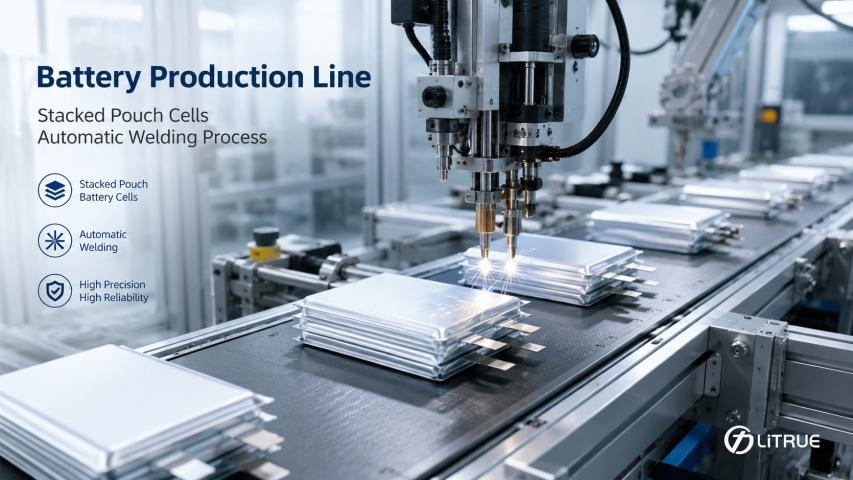
Pouch cells are inherently easier to customize than wound cylindrical formats. The electrode stack can be sized to a target capacity and the pouch reshaped to a target footprint without new can tooling, which is what makes low-volume customization economically realistic. That advantage only holds if the manufacturer controls its own electrode cutting, stacking, and sealing lines. A trading company reselling someone else's cells can change a label; it can't change a stack.
LiTrue Power Technologies Co., Ltd. runs customization as a standard OEM/ODM program rather than a one-off engineering favor, backed by a 10-piece negotiable sample MOQ and a 7–15 working-day sample lead time, so a design can be validated on real hardware before committing to bulk volume.
Three Questions That Expose a "Custom" Claim Quickly
- "Can you change the cell dimensions, not just the pack housing?" A real answer includes tooling and stack-design details, not just "yes."
- "Do you manufacture the cell, or source it?" Cell-level customization depends on owning the stacking and sealing process.
- "What's the smallest sample order, and how fast does it ship?" If validating a design requires a bulk commitment first, the risk has simply been moved onto you.
From Cell to Pack: Where Custom Work Continues
For many programs, the cell is only the first step. Pack-level work — module configuration, BMS integration, and thermal design — is where a custom cell turns into a working power system. LiTrue supports that full path, from custom cells to finished UAV and industrial battery packs, so the cell and the pack are designed around each other rather than reconciled after the fact. The company's existing cell lineup, including the 36Ah semi-solid state NMC pouch cell and the 30Ah high C-rate NMC pouch cell, serves as a practical starting point for many custom projects, and the full range is available in the product catalog.
The Bottom Line
Custom should mean the cell changes to fit your product, not the other way around. Asking the right questions before qualification — about dimensions, tab design, C-rate, who actually builds the cell, and how small a sample order can be — costs a few emails. Skipping them can cost a few weeks.
If your project needs a cell sized to a specific enclosure or duty cycle, LiTrue's engineering team can review your requirements directly — request a custom quote here.