As
organizations continue adopting cloud-first strategies and hybrid data center
architectures, the demand for highly skilled infrastructure professionals is
growing rapidly. Companies require engineers who can navigate complex
environments that blend on-premises networks with AWS, Azure, Google Cloud, and
software-defined infrastructures. This is where the CCIE Data Center certification becomes a powerful catalyst for career growth, equipping
professionals with deep technical expertise that aligns with modern cloud and
hybrid data center roles.
Whether
you’re a network engineer, system admin, or aspiring cloud specialist, CCIE
Data Center can open doors to high-impact opportunities in today’s evolving
infrastructure ecosystem.
1. Why Cloud & Hybrid Data Centers Are the
Future
Traditional
data centers are no longer sufficient for supporting dynamic workloads, global
applications, and AI-driven operations. Enterprises are shifting toward:
- Hybrid Cloud (mix of cloud + on-prem)
- Multi-Cloud (AWS + Azure + GCP)
- Software-defined and
automated networks
- Distributed data
architectures
Hybrid
and cloud-integrated data centers offer flexibility, scalability, and cost
efficiency—making them the new standard for enterprise IT. This creates a high
demand for engineers who understand both cloud networking and traditional data
center technologies.
2. How CCIE Data Center Prepares You for Cloud
Networking Roles
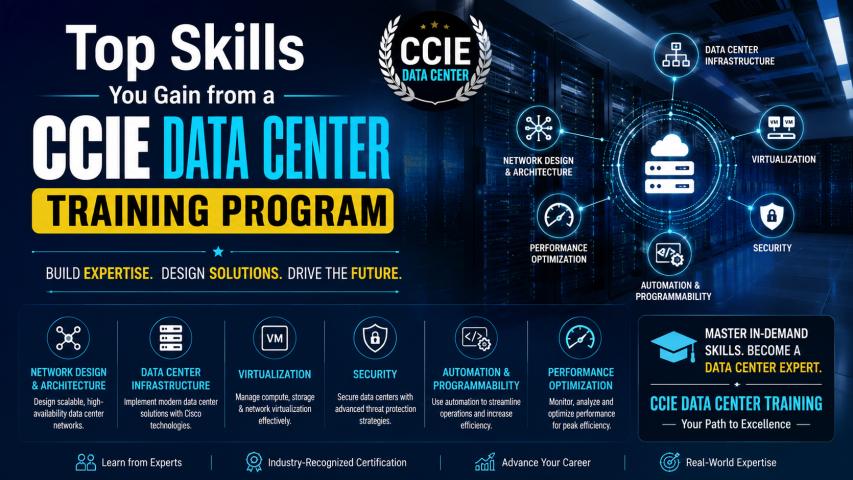
The CCIE
Data Center curriculum covers critical skills required for cloud and hybrid
environments, including:
A. Advanced Nexus & VXLAN EVPN Skills
Cloud
networks rely heavily on scalable and automated fabric designs. CCIE DC
teaches:
- VXLAN EVPN overlays
- Spine–leaf architectures
- NVE/VTEP configurations
- High-availability topologies
These
technologies directly support hybrid cloud integrations.
B. Cisco ACI Skills for Multi-Cloud Deployments
Cisco ACI
is widely used for:
- Connecting on-prem DCs to
AWS, Azure, and GCP
- Automating application
policies
- Managing multi-site and
multi-cloud fabrics
With ACI
Anywhere, CCIE-certified engineers can extend policy-driven networks across
cloud regions—a valuable skill for hybrid environments.
C. SAN & Compute Expertise
Cloud
environments rely on high-performance compute and storage systems. CCIE DC
covers:
- UCS architecture
- Storage networking (Fibre
Channel, FCoE)
- Virtualization integrations
These
skills help engineers manage hybrid workloads that span bare metal, virtual
machines, and cloud-native services.
D. Automation & Programmability
Hybrid
data centers cannot scale without automation. CCIE DC includes:
- Python scripting
- Ansible automation
- REST APIs
- Model-driven telemetry
- Infrastructure-as-Code
concepts
These are
essential skills for cloud engineering roles.
3. Why CCIE Data Center Is Highly Valued in Cloud
Job Roles
Cloud and
hybrid data centers require engineers capable of:
- Designing secure
interconnects between on-prem and cloud
- Managing routing and
segmentation in multi-cloud environments
- Implementing
high-availability infrastructure
- Scaling applications
globally
- Securing distributed
workloads
CCIE
demonstrates mastery of these concepts, making certified engineers ideal
candidates for advanced cloud networking roles.
4. Job Roles You Can Pursue After CCIE Data Center
A. Cloud Network Engineer
You’ll
design connectivity between on-prem data centers and cloud environments, manage
BGP routing, and support secure workload migrations.
B. Hybrid Cloud Architect
This role
involves designing and managing hybrid data center architectures that integrate
physical, virtual, and cloud-native systems.
C. Data Center Automation Engineer
Organizations
need engineers who can automate hybrid cloud provisioning and optimize
workloads using Python, Ansible, and Terraform.
D. ACI/SDN Engineer
Many
enterprises use ACI to unify on-prem and cloud networking under a single policy
model. CCIE DC gives you deep ACI expertise.
E. Cloud Infrastructure Specialist
This role
requires knowledge of multi-cloud connectivity, cloud gateways, cloud routing,
and inter-region traffic engineering.
F. NetDevOps / SRE Engineer
You’ll
support scalable cloud operations, automate deployments, and maintain
reliability across distributed data center environments.
5. Why Employers Prefer CCIE Data Center for Hybrid
Cloud Positions
1. Expertise in Multi-Layer Infrastructure
Hybrid
environments involve networking, compute, storage, security, and
automation—areas covered extensively in CCIE DC.
2. Ability to Troubleshoot Complex Systems
Cloud
routing + ACI policies + on-prem fabrics = complex hybrid flows. CCIEs are
trained to troubleshoot at an expert level.
3. Strong Foundation in Automation
Cloud-native
environments depend on IaC and automation pipelines; CCIE aligns with these
requirements.
4. Proven Hands-On Experience
The lab
exam tests deep practical skills, giving employers confidence in your
capabilities.
5. Ability to Work Across Teams
Hybrid
cloud requires collaboration between network, cloud, security, and DevOps
teams—roles where CCIE engineers excel.
6. Cloud Providers Increasingly Look for CCIE-Level
Expertise
Major
cloud providers and partners often hire CCIE DC professionals for roles
involving:
- Cloud interconnect
- Edge computing deployments
- Data center modernization
- SDN and SDDC design
- Enterprise cloud migration
Companies
like AWS, Microsoft Azure partners, Google Cloud integrators, and multi-cloud MSPs
value CCIE-level knowledge for building scalable infrastructures.
Conclusion
Hybrid
and cloud-integrated data centers are becoming the backbone of enterprise IT,
and engineers with deep networking and automation skills are more valuable than
ever. The CCIE Data Center certification equips professionals with the
specialized expertise needed to design, connect, automate, and secure complex
hybrid environments across AWS, Azure, GCP, and on-prem architectures. For
anyone seeking to accelerate their career in cloud or hybrid data center
engineering, investing in CCIE Data Center Training, hands-on practice,
and modern automation skills is a strategic pathway to long-term success.