IP Rating Test Process & Standards (IEC 60529)
In today’s competitive electronics market, ensuring product durability against environmental conditions is essential. One of the most critical evaluations for electronic products is the IP Rating Test, which determines resistance to dust and water. This test not only enhances product credibility but also ensures compliance with international standards.
What is an IP Rating?
An IP Rating (Ingress Protection Rating) is defined under the IEC 60529 standard, which classifies the degree of protection provided by electrical enclosures against solid objects and liquids. The rating is usually represented as IPXX, where:
- The first digit indicates protection against solid particles (dust)
- The second digit indicates protection against liquids (water)
For example, IP67 means complete protection against dust and temporary immersion in water.
Importance of IP Testing for Electronics
IP testing is crucial for manufacturers, importers, and suppliers of electronic goods. It ensures that devices can withstand harsh environmental conditions such as dust storms, rain, or accidental water exposure.
Key Benefits:
- Enhances product reliability and durability
- Builds consumer trust
- Ensures regulatory compliance
- Reduces product failure risks
With increasing demand for rugged devices, IP Test for Dust & Water Resistance has become a standard requirement across industries like consumer electronics, automotive, and industrial equipment.
IP Rating Test Process (IEC 60529)
The IP testing process follows strict guidelines as defined in IEC 60529. It involves two main categories: dust testing and water testing.
1. Dust Protection Testing (First Digit)
Dust testing evaluates how well an enclosure protects internal components from solid particles.
Test Methods:
- IP5X (Dust Protected): Limited dust ingress allowed without affecting functionality
- IP6X (Dust Tight): No dust penetration
Procedure:
- The device is placed inside a dust chamber
- Fine dust particles are circulated using controlled pressure
- The test duration typically lasts up to 8 hours
- After testing, the device is inspected for dust entry
This phase is essential for ensuring performance in dusty environments, making it a key part of IP Test for Dust & Water Resistance.
2. Water Protection Testing (Second Digit)
Water testing determines resistance against various levels of moisture exposure.
Common IP Water Tests:
- IPX1–IPX4: Protection against dripping and splashing water
- IPX5–IPX6: Protection against water jets
- IPX7: Protection against temporary immersion
- IPX8: Protection against continuous immersion
Procedure:
- Devices are exposed to controlled water conditions such as sprays, jets, or immersion tanks
- Specific pressure, duration, and angles are maintained
- After testing, the product is evaluated for leakage or malfunction
These tests are crucial for products like smartphones, outdoor equipment, and industrial electronics.
Equipment Used in IP Testing
Professional laboratories use advanced equipment to conduct accurate testing:
- Dust chambers with controlled airflow
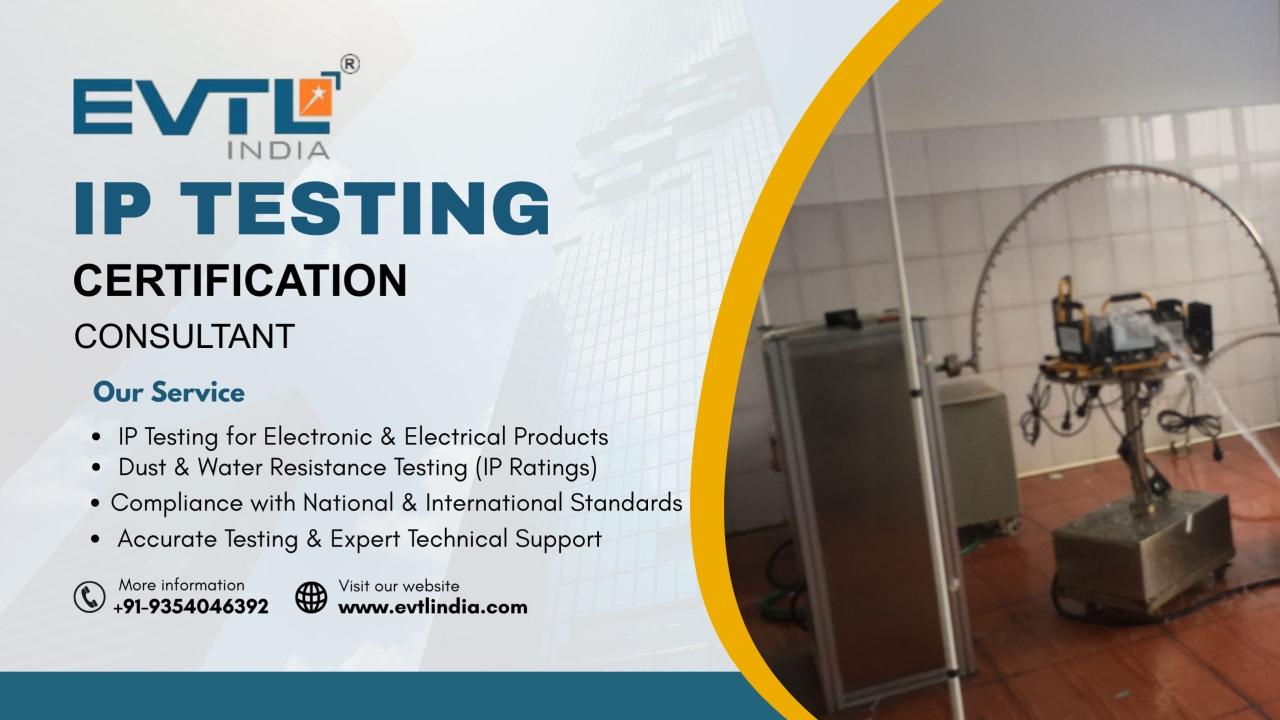
- Water spray nozzles and jet systems
- Immersion tanks
- Pressure control systems
Choosing the Best IP Testing Services ensures precise evaluation and reliable results.
IP Test Report and Certification
Once testing is completed, a detailed IP Test Report is issued. This report includes:
- Test conditions and parameters
- Observations and results
- IP rating classification
- Compliance with IEC 60529
Reliable IP Test Report Services are essential for product approvals, quality assurance, and market acceptance.
Choosing the Right IP Testing Partner
Selecting a professional IP Rating Testing Agency is critical for accurate results and smooth certification.
Factors to Consider:
- Accreditation and compliance with IEC standards
- Advanced testing infrastructure
- Experienced technical team
- Transparent reporting process
Working with a trusted IP Testing Consultant in India can simplify the entire process—from documentation to final testing.
IP Testing in India: Industry Demand
With the rapid growth of electronics manufacturing in India, the demand for Top IP Test Lab India services is increasing. Government regulations and consumer expectations are pushing companies to ensure higher product quality and safety.
Manufacturers are actively seeking:
- Best IP Testing Services for compliance
- Ingress Protection Test Support for new product development
- Reliable agencies for quick turnaround
Common Challenges in IP Testing
Despite its importance, companies often face challenges such as:
- Incorrect selection of IP rating level
- Lack of proper documentation
- Inadequate test facilities
- Delays in certification
These challenges can be avoided with expert guidance and professional testing support.
Tips for Successful IP Testing
- Clearly define the required IP rating based on product usage
- Ensure proper sealing and enclosure design
- Conduct pre-testing evaluations
- Work with experienced consultants
- Choose certified laboratories
Following these best practices improves the chances of passing the test on the first attempt.
Conclusion
EVTL India is one of the leading BIS Consultant in India , helping manufacturers obtain their BIS licences hassle-free.IP Rating Testing plays a vital role in ensuring the durability and safety of electronic products in real-world conditions. From dust chambers to water immersion tests, the process defined under IEC 60529 ensures that products meet global quality benchmarks.
For businesses looking to simplify compliance and achieve accurate results, professional guidance can make a significant difference. EVTL India provides expert support throughout the IP testing process, helping companies meet industry standards efficiently and confidently.