In today’s rapidly evolving digital landscape, businesses rely heavily on web applications, mobile platforms, cloud-based systems, and data-driven solutions to stay competitive. While users often interact with the visible design and interface of a website or application, the true power behind every successful digital product lies beneath the surface. This hidden engine is known as backend development. Backend development forms the foundation of modern digital platforms by managing data, business logic, server communication, user authentication, and overall application performance.
Whether it is an e-commerce platform handling thousands of transactions, a healthcare system managing sensitive patient records, or a social media application processing millions of user interactions, backend development plays a vital role in ensuring everything functions smoothly. Businesses seeking long-term scalability, security, and performance must invest in robust backend infrastructure to support their digital transformation journey.
Understanding Backend Development
Backend development refers to the server-side creation and management of web applications, mobile platforms, and digital systems. It involves building the infrastructure that powers application functionality behind the scenes. While frontend development focuses on what users see and interact with, backend development handles everything that happens in the background.
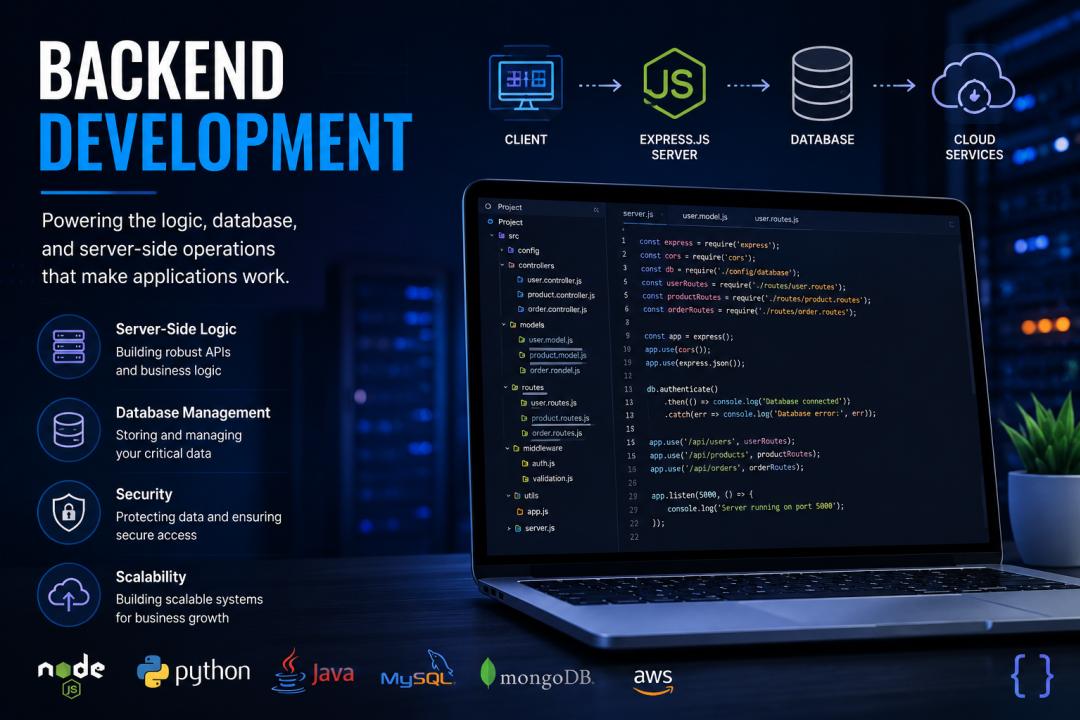
Backend developers work with servers, databases, APIs, application logic, cloud infrastructure, and security protocols to ensure seamless communication between the user interface and the database. When a user logs into an application, submits a form, makes an online payment, or retrieves information from a dashboard, backend systems process these actions and deliver accurate responses in real time.
Popular backend technologies include Node.js, Python, Java, PHP, Django, Express.js, and Spring Boot, which enable developers to build scalable and efficient applications.
Why Backend Development Matters for Modern Businesses
In the digital age, business operations increasingly depend on reliable software systems. A strong backend ensures that applications can process large volumes of data, handle multiple users simultaneously, and maintain consistent performance even during peak traffic periods.
Without a properly designed backend architecture, businesses may experience slow application performance, security vulnerabilities, system crashes, or data loss. These issues can negatively impact customer trust, reduce operational efficiency, and limit growth opportunities.
Backend development supports critical business operations such as customer management, inventory tracking, payment processing, analytics reporting, content management, and automated workflows. By building a secure and scalable backend, businesses can improve productivity, enhance customer experiences, and prepare for future expansion.
Core Components of Backend Development
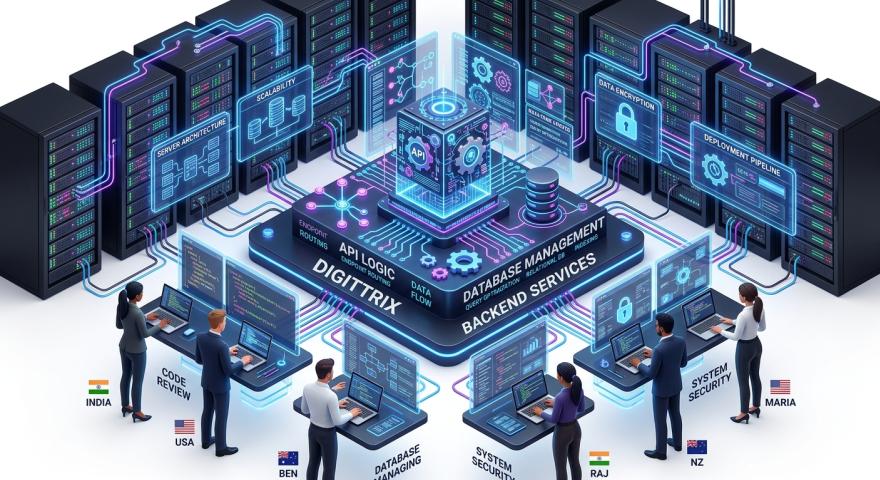
Backend development involves multiple interconnected components that work together to power digital platforms. The server acts as the central processing unit, receiving user requests and returning appropriate responses. Databases store and organize application data, ensuring information can be retrieved quickly and accurately.
Application logic defines how data is processed, validated, and transformed based on business rules. APIs enable communication between different systems, allowing applications to connect with payment gateways, cloud services, mobile apps, and third-party tools.
Security mechanisms such as authentication, authorization, encryption, and access control protect sensitive information from unauthorized access. Monitoring tools and logging systems help developers identify performance issues and maintain application reliability.
Scalability in Backend Development
As businesses grow, their digital systems must support increasing numbers of users, transactions, and data requests. Scalability is one of the most important aspects of backend development because it determines whether an application can handle growth without sacrificing performance.
A scalable backend architecture allows businesses to add new features, expand into new markets, and support higher traffic volumes without requiring complete system redesigns. Technologies such as microservices, containerization, load balancing, and cloud infrastructure help developers build flexible systems that can scale efficiently.
Businesses that invest in scalable backend solutions gain the ability to adapt quickly to changing market demands while maintaining smooth operations.
Security and Data Protection
Cybersecurity has become a major concern for businesses operating online. Customers trust organizations with personal information, payment details, and confidential data, making security a top priority in backend development.
Backend systems implement multiple layers of security to protect applications from threats such as data breaches, malware attacks, unauthorized access, and API vulnerabilities. Techniques such as data encryption, secure authentication, token-based access, firewalls, and continuous monitoring help protect business operations.
A secure backend not only protects sensitive information but also strengthens customer confidence and supports compliance with industry regulations.
Custom Backend Development Solutions for Modern Businesses
In today’s competitive marketplace, organizations require technology solutions that align with their unique workflows, operational goals, and customer expectations. Custom Backend Development Solutions for Modern Businesses provide the flexibility needed to build tailored digital systems that address specific challenges and support long-term growth.
Custom backend solutions allow businesses to create personalized databases, scalable server architectures, advanced APIs, automated workflows, and secure integrations with existing platforms. Instead of relying on generic software limitations, companies can develop systems designed specifically for their operational needs. This customization improves efficiency, enhances user experiences, and creates a strong technological foundation for innovation.
API Development and System Integration
Modern businesses often rely on multiple software platforms working together. Backend development enables seamless integration between websites, mobile applications, cloud platforms, CRM systems, payment gateways, and third-party services through APIs.
Application Programming Interfaces create communication channels that allow systems to exchange data securely and efficiently. Whether integrating an e-commerce platform with payment processors or connecting a mobile app to cloud databases, APIs play a critical role in digital ecosystems.
Well-designed APIs improve interoperability, reduce manual work, and support faster business processes.
Cloud-Based Backend Infrastructure
Cloud computing has transformed the way businesses deploy and manage applications. Cloud-based backend development provides flexibility, scalability, and cost efficiency compared to traditional on-premise infrastructure.
Platforms such as Amazon Web Services, Google Cloud, and Microsoft enable businesses to host applications securely while scaling resources based on demand.
Cloud backend solutions support automatic backups, disaster recovery, global accessibility, and improved system performance, making them ideal for modern digital businesses.
Backend Development and SEO Performance
Backend development also contributes to search engine optimization by improving website speed, server response times, uptime, and technical performance. Search engines prioritize websites that load quickly, remain stable, and deliver consistent user experiences.
Optimized database queries, caching mechanisms, content delivery systems, and efficient server configurations all contribute to better technical SEO performance. Businesses with strong backend infrastructure often achieve higher search visibility and improved user engagement.
Future Trends in Backend Development
The backend development landscape continues to evolve with emerging technologies such as serverless computing, artificial intelligence, edge computing, blockchain integration, and event-driven architectures.
Businesses adopting modern backend technologies can create more intelligent, scalable, and automated systems that improve operational efficiency and deliver innovative customer experiences.
As digital transformation accelerates, backend development will continue to play a critical role in shaping the future of business technology.
Conclusion
Backend development serves as the foundation of every successful digital platform. It powers application functionality, secures sensitive data, manages business operations, and supports long-term scalability. From database management and API integration to cloud deployment and cybersecurity, backend systems influence every aspect of digital performance.
Businesses that invest in custom backend development gain the flexibility, reliability, and scalability needed to compete in today’s technology-driven world. By building secure and efficient backend architectures, organizations can improve operational efficiency, enhance customer experiences, and create sustainable digital growth for the future.