Startups today operate in an environment where speed, scalability, and user experience define success. As businesses grow rapidly, relying on outdated systems or generic software often creates operational bottlenecks, poor customer experiences, and scalability issues. This is why many startups invest in custom web application development to streamline operations, improve engagement, and support long-term growth.
A well-planned web application strategy helps startups launch products faster, manage users efficiently, automate workflows, and adapt to changing market demands. Whether you are building a SaaS platform, marketplace, fintech product, or enterprise solution, choosing the right development approach can significantly impact business growth.
In this guide, we will explore the most effective web application development strategies for fast-growing startups, including technology selection, scalability planning, security practices, and modern development approaches.
Why Web Applications Matter for Startups
Modern startups require digital platforms that are accessible, scalable, and flexible. Web applications provide businesses with the ability to serve users across devices without requiring complex installations or updates.
Key Benefits of Web Applications for Startups
- Faster Product Launch: Web applications allow startups to build and release MVPs quickly, helping businesses validate ideas before making large investments.
- Better Scalability: A scalable web application can support increasing traffic, transactions, and users without affecting performance.
- Cost Efficiency: Compared to native applications, web apps often require lower development and maintenance costs.
- mproved Accessibility: Users can access web applications from desktops, tablets, and smartphones using a browser.
- Easier Maintenance: Centralized updates and cloud deployment simplify maintenance and feature rollouts.
Essential Web Application Development Strategies for Startups
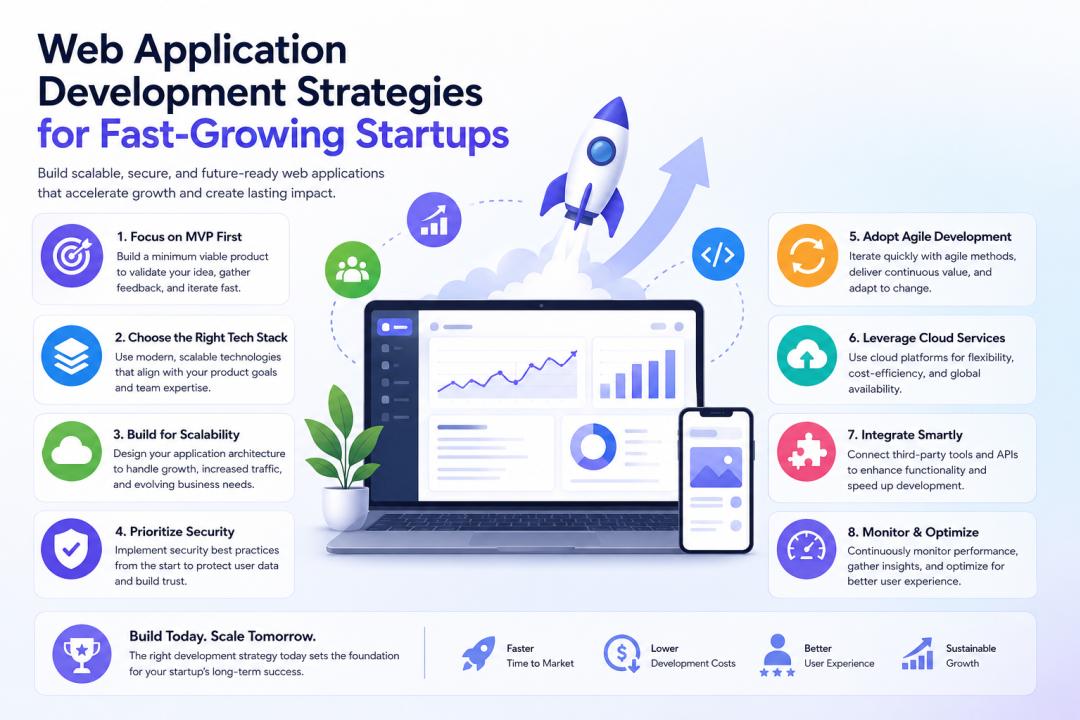
1. Start with a Minimum Viable Product (MVP)
One of the biggest mistakes startups make is trying to build too many features at once. A Minimum Viable Product (MVP) focuses only on essential functionalities required to solve the user’s primary problem.
Why MVP Development Matters
- Reduces development costs
- Speeds up market entry
- Helps validate business ideas
- Collects real user feedback
- Minimizes risks
MVP Best Practices
- Identify core user pain points
- Prioritize must-have features
- Focus on usability and performance
- Gather analytics and user insights
- Improve continuously based on feedback Building an MVP allows startups to test market demand before scaling the product further.
2. Choose the Right Technology Stack
The technology stack directly impacts application performance, scalability, security, and future development flexibility.
Frontend Technologies
Modern frontend frameworks improve responsiveness and user experience.
Popular frontend technologies include:
- React.js
- Angular
- Vue.js
- Next.js
Backend Technologies
Backend systems manage databases, authentication, APIs, and business logic.
Common backend technologies:
Node.js
Python
PHP Laravel
Ruby on Rails
Java Spring Boot
Database Solutions
Selecting the right database ensures better performance and data management.
Popular options:
PostgreSQL
MongoDB
MySQL
Firebase
Cloud Infrastructure
Cloud platforms provide flexibility and scalability for growing startups.
Recommended cloud services:
AWS
Microsoft Azure
Google Cloud Platform
Choosing scalable and future-ready technologies helps startups avoid expensive migrations later.
3. Focus on Scalable Architecture
Rapid startup growth can quickly overwhelm poorly designed systems. Building scalable architecture from the beginning prevents performance issues during traffic spikes.
Key Scalability Strategies
Microservices Architecture: Cloud-native applications allow automatic scaling based on demand.
Cloud-Native Development: APIs simplify third-party integrations and enable future expansion.
API-First Development: Load balancing distributes traffic evenly across servers to maintain performance.
Load Balancing: Caching improves application speed and reduces server load.
Caching Mechanisms: Scalable architecture ensures startups can handle business growth without major technical disruptions.
4. Prioritize User Experience (UX)
Even powerful web applications fail if users struggle with navigation or usability. Startups must focus on delivering intuitive and engaging user experiences.
UX Optimization Tips
Responsive Design: Applications should work smoothly across all screen sizes and devices.
Fast Loading Speed: Slow-loading applications increase bounce rates and reduce conversions.
Simple Navigation:Clear menus and user flows improve engagement.
Accessibility Standards: Accessible applications improve usability for all users.
Interactive UI Elements: Modern interfaces increase user retention and engagement.
A strong user experience improves customer satisfaction and supports long-term growth.
5. Implement Strong Security Practices
Cybersecurity threats continue to rise, making application security essential for startups handling user data and transactions.
Essential Security Measures
SSL Encryption: Protects data transferred between users and servers.
Multi-Factor Authentication (MFA): Adds extra layers of account protection.
Secure APIs: Prevents unauthorized access and data leaks.
Regular Security Audits: Identifies vulnerabilities before attackers exploit them.
Data Backup Systems: Ensures recovery in case of system failures or cyberattacks.
Compliance Standards: Startups handling sensitive information should comply with regulations like GDPR and HIPAA.
Security-focused development builds customer trust and protects business reputation.
6. Use Agile Development Methodology
Agile development enables startups to release updates quickly and adapt to market changes efficiently.
Benefits of Agile Development
Faster feature releases
Better collaboration
Continuous improvement
Reduced development risks
Faster response to customer feedback
Agile workflows improve productivity and support rapid innovation.
7. Optimize Web Application Performance
Performance optimization directly impacts user retention and SEO rankings.
Performance Optimization Strategies
Compress Images and Assets: Reduces page load times.
Use Content Delivery Networks (CDNs): Improves global content delivery speed.
Optimize Database Queries: Enhances backend efficiency.
Lazy Loading: Loads resources only when required.
Minify CSS and JavaScript: Reduces unnecessary code weight.
High-performance applications improve conversions, engagement, and search visibility.
8. Integrate AI and Automation Features
AI-powered features help startups improve efficiency, personalization, and customer engagement.
Popular AI Features for Web Applications
AI chatbots
Recommendation engines
Predictive analytics
Smart search functionality
Automated workflows
AI integration helps startups create more personalized and intelligent digital experiences.
9. Plan for Future Integrations
As startups grow, they often need integrations with external platforms and services.
Common Integrations
Payment gateways
CRM systems
Marketing automation tools
Analytics platforms
ERP software
Communication tools
Flexible integration architecture supports long-term scalability and operational efficiency.
10. Invest in Continuous Maintenance and Updates
Web application development does not end after deployment. Continuous monitoring and maintenance are essential for performance and security.
Ongoing Maintenance Tasks
Bug fixes
Security updates
Performance monitoring
Feature enhancements
Server optimization
User feedback analysis
Regular updates ensure applications remain competitive and reliable.
Common Mistakes Startups Should Avoid
Building Too Many Features Initially: Overcomplicated applications delay launches and increase costs.
Ignoring Scalability: Applications that cannot handle growth often require expensive rebuilds.
Neglecting Security: Weak security practices expose businesses to serious risks.
Poor UI/UX Design: Confusing interfaces reduce customer engagement.
Choosing the Wrong Development Partner: Inexperienced teams can lead to delays, technical debt, and poor product quality.
Avoiding these mistakes helps startups build sustainable and scalable digital products.
Future Trends in Web Application Development
The web development landscape continues to evolve rapidly. Startups should stay updated with emerging technologies and user expectations.
Key Trends to Watch
- Progressive Web Applications (PWAs)
- AI-powered web applications
- Serverless architecture
- Voice search optimization
- Low-code and no-code integrations
- Blockchain-based applications
- Real-time collaboration features
Partnering with the right development company is critical for startup success.
Factors to Consider
- Industry experience
- Technology expertise
- Portfolio quality
- Scalability capabilities
- Security practices
- Communication process
- Post-launch support
A reliable development partner like startuplabs can help startups build secure, scalable, and future-ready web applications.
Conclusion
Fast-growing startups need web applications that are scalable, secure, high-performing, and user-focused. By following the right web application development strategies, startups can launch products faster, improve customer experiences, and support long-term business growth.
From MVP development and scalable architecture to AI integration and performance optimization, every development decision impacts the success of a digital product. Startups that invest in modern web application strategies position themselves for sustainable growth in a highly competitive digital market.
Choosing the right technology stack, focusing on user experience, and implementing strong security measures can help businesses create reliable web applications that adapt to future demands and evolving customer expectations.