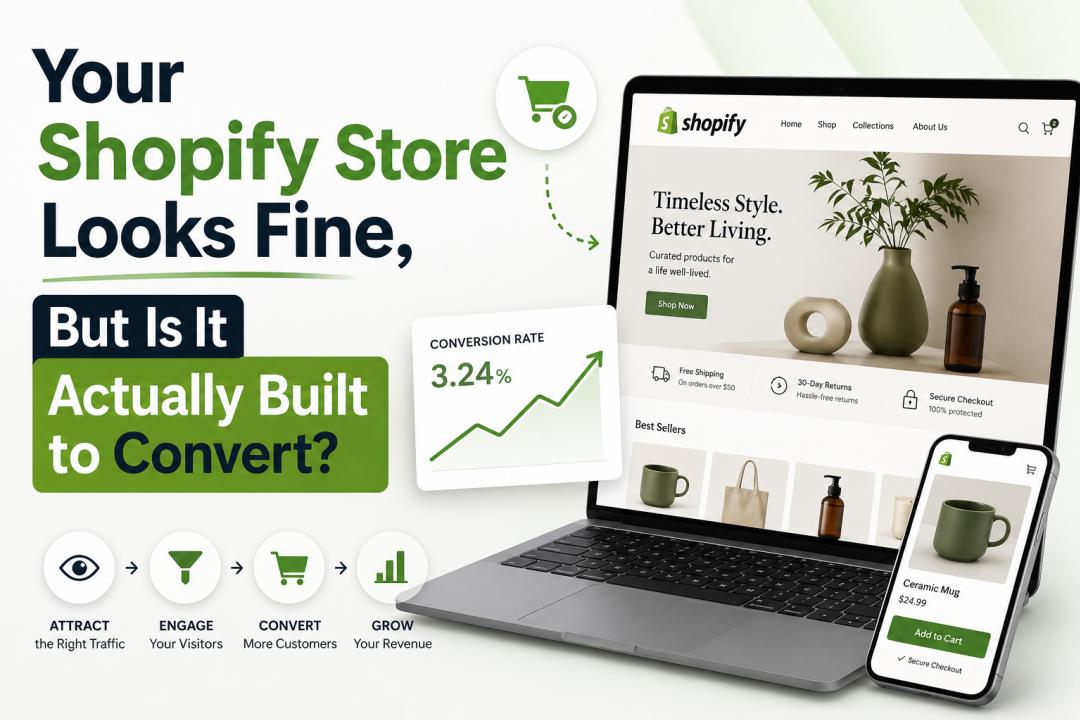
You open your Shopify store on your phone, scroll through the homepage, and think yeah, this looks decent. The colors are on-brand, the fonts are clean, the product photos look great. But your conversion rate tells a completely different story. Visitors come, they browse, and then they leave. No purchase, no inquiry, no follow-up. If that gap between "looks good" and "performs well" sounds familiar, the issue almost certainly isn't your products. It's your theme.
Most store owners underestimate how much their theme does or doesn't do for their business. A theme isn't just a visual skin. It's the structural foundation of every interaction a customer has with your store. How fast the page loads, how naturally the eye moves through a product page, how frictionless the path to checkout feels all of that is determined by your theme, not your marketing.
This guide breaks down why theme choices matter more than most merchants realize, how to think about your store's design as a business decision rather than an aesthetic one, and what separates a Shopify store that looks good from one that actually sells.
The Hidden Cost of a Generic Theme
Shopify's theme marketplace is genuinely impressive. There are hundreds of options, many of them beautifully designed and reasonably priced. And for a brand-new store just getting started, picking one and launching is often exactly the right call. The problem comes later when that one-size-fits-all theme starts to show its limits.
Generic themes are built for the broadest possible use case. They're designed to work adequately for a jewelry brand, a home goods store, a fitness supplement company, and a bookshop all at once. That universality is also their weakness. They're not optimized for your product type, your customer's buying behavior, your average order value, or the specific friction points in your checkout flow.
The result is a store that looks professional but underperforms quietly. Customers who should convert don't. Cart abandonment stays stubbornly high. Mobile users bounce faster than desktop visitors. And because nothing is obviously broken, it can take months to realize the theme itself is the bottleneck.
Working with a Shopify theme development company changes that equation entirely. A custom-developed theme is built around your specific business your product catalog structure, your target customer's behavior, your brand language, and the conversion path that makes the most sense for what you sell.
Design Is a Sales Tool, Not a Decoration
There's a mindset shift that separates high-performing Shopify stores from average ones: treating design as a revenue driver, not just a branding exercise. Every element on your store where the add-to-cart button sits, how product images load on mobile, whether your size guide is easy to find, how trust signals are positioned near checkout is either helping customers buy or creating reasons not to.
This is why the best-performing Shopify stores invest in intentional design before they scale their traffic. Driving more visitors to a store that converts at 1.2% is an expensive way to grow. Improving that rate to 2.5% through better layout, faster load times, and a cleaner purchase path can effectively double revenue without spending another dollar on ads.
Conversion-focused design isn't about making things prettier. It's about making decisions easier. Reducing hesitation. Removing steps. Presenting information in the order that matches how your customers actually think when they're deciding whether to buy.
Wix vs. Shopify: Why the Platform Decision Shapes Everything
Before diving deeper into theme strategy, it's worth addressing a question many newer entrepreneurs ask when they're still choosing their foundation. Shopify is the dominant choice for ecommerce, but it's not the only one and the platform you build on determines what's possible for your store's design and functionality down the road.
For anyone still evaluating their options, a detailed comparison of Wix vs. Shopify is worth reading carefully. The short version: Wix offers ease of use and flexibility for general websites, but Shopify's ecommerce infrastructure, its checkout system, inventory management, app ecosystem, and theme architecture is purpose-built for selling at scale. That distinction matters enormously the moment your store starts to grow.
If you're already on Shopify, this confirms you've made the right call. The platform gives your theme developer far more to work with than most alternatives.
What Good Shopify Store Development Actually Looks Like
A well-developed Shopify store is more than a good-looking homepage. It's a system where every page has a clear job to do, every element earns its place, and the path from discovery to purchase has as little friction as possible.
On the homepage, that means communicating your value proposition within seconds, guiding first-time visitors toward your best products or collections, and building enough trust that someone who has never heard of you is willing to keep browsing. On the product page, it means showing the right information in the right order — images that replicate the in-store experience, descriptions that answer objections before they're raised, and social proof positioned where hesitation is highest. At checkout, it means removing every unnecessary step, surfacing trust badges and return policies at the moment of decision, and making the payment flow feel as smooth as possible on any device.
Quality Shopify store development services cover all of this not just the visual layer, but the structural decisions that determine whether your store works as a sales system or just as an online catalogue.
Mobile Is Not an Afterthought Anymore
If your store was designed primarily for desktop and "adapted" for mobile, you're leaving a significant portion of your revenue on the table. Mobile now accounts for the majority of ecommerce traffic across most product categories and mobile shoppers are less patient, more easily frustrated by slow load times, and quicker to abandon a checkout that doesn't feel native to their device.
According to research published by the Baymard Institute on mobile ecommerce UX, the average mobile checkout abandonment rate is significantly higher than desktop, primarily due to poor form design, slow page rendering, and layouts that were never truly optimized for touch. These are all theme-level problems and they're all fixable with intentional development.
A mobile-first theme isn't just a responsive layout that squishes your desktop design into a smaller screen. It's a fundamentally different approach to information hierarchy, tap target sizing, image loading strategy, and checkout flow that puts the mobile experience at the center of every design decision.
When to Invest in Custom Theme Development
The honest answer is: earlier than most merchants think. The common assumption is that custom development is something you graduate into once you're already doing well. But that thinking gets it backwards. The stores that reach "doing well" faster are usually the ones that built a high-performance foundation early before they started scaling traffic and before mediocre conversion rates became expensive.
That said, there are clear signals that it's time to move beyond a generic theme. If your store has been live for six months or more and conversion rates are below industry benchmarks for your category, your theme is a likely contributor. If mobile bounce rates are significantly higher than desktop, your theme isn't doing its job on the device most of your customers are using. If you've been wanting to change something about your store's layout or functionality for months but can't because the theme doesn't support it, you've already outgrown it.
Custom development doesn't have to mean rebuilding everything from scratch. Often, a focused audit and targeted improvements to your highest-traffic pages homepage, key product pages, and checkout can deliver meaningful conversion gains without a full rebuild.
Conclusion
Your Shopify store's theme is doing more work than you probably realize for better or worse. It's either making it easier for customers to buy, or quietly creating the friction that sends them elsewhere. And because that friction is invisible to you as the store owner, it can persist for months while you look for the problem everywhere else.
The good news is that theme and store development is one of the most direct levers you have for improving revenue without increasing your marketing spend. A store built with intention where every design decision serves a commercial purpose converts better, retains customers longer, and scales more cleanly than one that was simply launched and left to run.
Whatever stage your store is at, the question worth asking is simple: is your design working as hard as everything else in your business? If the answer is no, you already know where to start.
Frequently Asked Questions
What is a Shopify theme development company? A Shopify theme development company builds or customizes themes specifically for your brand and business goals, rather than relying on generic marketplace templates that aren't optimized for your products or customers.
How do I know if my Shopify theme is hurting my conversions? If your store has high traffic but a low conversion rate, high mobile bounce rates, or a checkout abandonment rate above 70%, your theme's design and performance are likely contributing factors.
Is Shopify better than Wix for ecommerce? For businesses focused primarily on selling products at scale, Shopify's purpose-built ecommerce infrastructure, checkout system, and app ecosystem give it a clear advantage over Wix.
How long does custom Shopify store development take? A focused custom theme build typically takes four to eight weeks, while a full store development project including integrations and custom functionality can take eight to sixteen weeks depending on complexity.
Do I need to rebuild my entire store to improve performance? Not always targeted improvements to your homepage, product pages, and checkout flow often deliver significant conversion gains without requiring a complete rebuild of your existing store.