Introduction
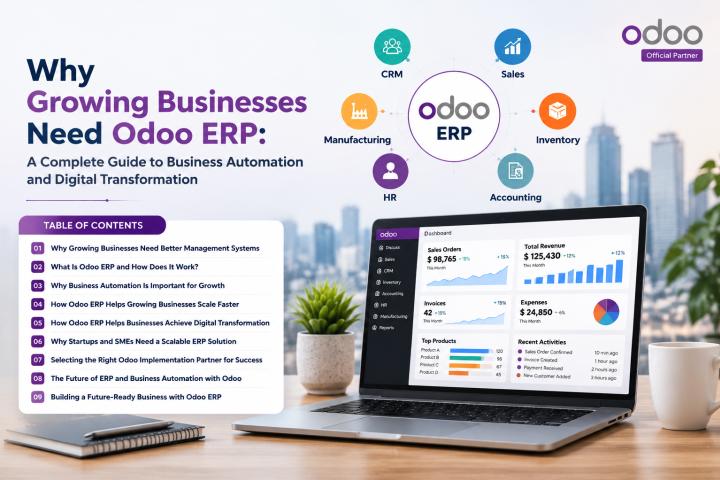
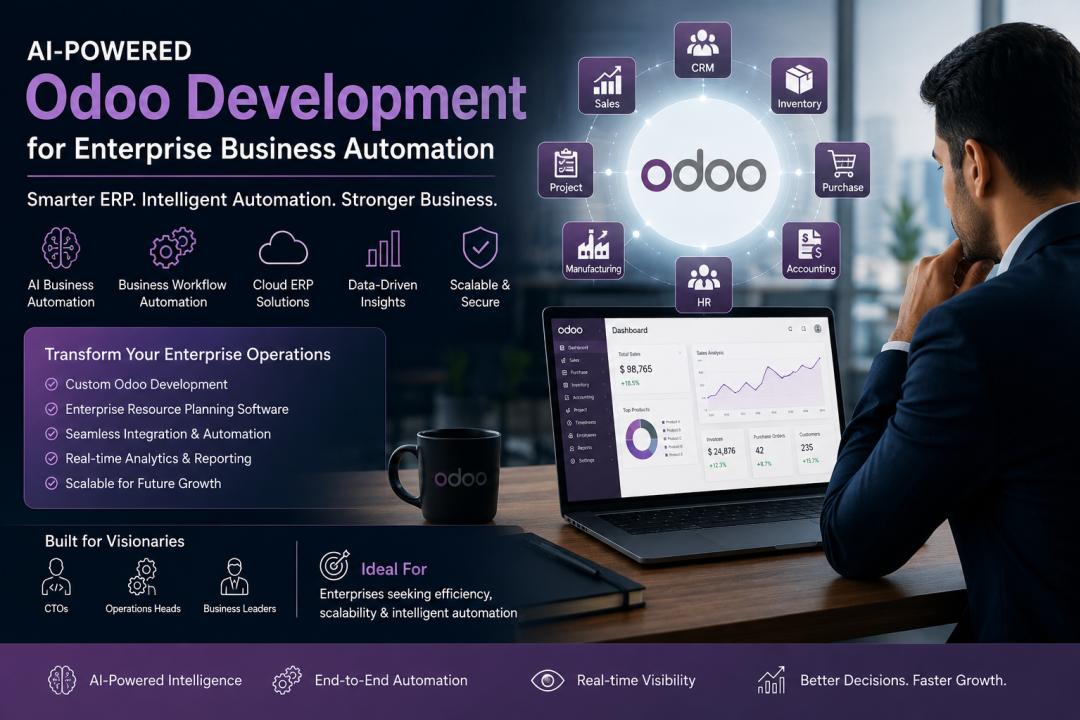
Odoo Development is the process of customizing and extending the Odoo ERP platform to meet specific business requirements. It helps enterprises build flexible and scalable enterprise resource planning software that connects core business functions such as sales, finance, inventory, human resources, and customer management into one unified system.
In today’s digital-first environment, enterprises are increasingly combining Odoo Development with AI business automation to improve efficiency and reduce manual operations. This shift is making ERP systems more intelligent, where workflows can be automated, data can be analyzed in real time, and business decisions can be supported with predictive insights.
Modern organizations no longer use ERP systems only for record-keeping. Instead, they rely on Odoo Development as a foundation for business workflow automation, cloud integration, and long-term digital transformation strategies.
As businesses scale, the demand for cloud ERP solutions continues to grow, and Odoo stands out as a flexible platform that can adapt to complex enterprise environments without heavy infrastructure limitations.
Why Enterprises Choose Odoo Development
Enterprises are increasingly adopting Odoo Development Services because traditional ERP systems often fail to provide the flexibility and adaptability required in fast-changing business environments. Large organizations deal with complex operations, multiple departments, and distributed teams, which demand a system that can unify processes without creating operational bottlenecks.
One of the key reasons enterprises choose Odoo Development is its modular structure. Businesses can start with only the required modules such as sales, accounting, or inventory—and expand gradually as their operations grow. This makes it a cost-effective approach compared to rigid enterprise resource planning software that requires heavy upfront investment and long implementation cycles.
Another major advantage is customization. Every enterprise has unique workflows, approval systems, and reporting structures. With custom Odoo Development, organizations can tailor the ERP system exactly to their business logic instead of adjusting their processes to fit the software.
Enterprises also prefer Odoo because of its strong integration capabilities. It can connect with third-party tools, CRMs, payment gateways, and cloud platforms, creating a seamless digital ecosystem. This is especially important for organizations focusing on business workflow automation and end-to-end operational efficiency.
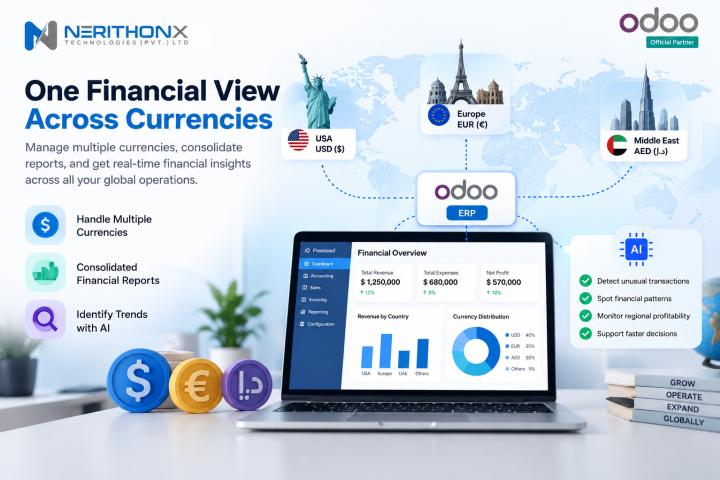
Additionally, modern cloud ERP solutions based on Odoo allow businesses to operate globally with real-time access to data. This improves collaboration between teams and supports faster decision-making at the management level.
Overall, Odoo provides enterprises with a balance of flexibility, scalability, and control, making it a preferred choice for long-term digital transformation strategies.
AI-Powered Transformation in Odoo Development
The combination of AI and Odoo Development is reshaping how modern enterprises manage operations and make decisions. What was once a traditional ERP system focused on data entry and reporting is now evolving into an intelligent platform driven by automation and predictive capabilities.
By integrating AI business automation into Odoo, enterprises can significantly reduce manual workload across departments. Tasks such as invoice processing, lead qualification, inventory forecasting, and customer support responses can be automated with higher accuracy and speed. This not only improves efficiency but also reduces operational costs in the long run.
AI also enhances decision-making inside enterprise systems. With AI-driven analytics built into Odoo Development, businesses can identify sales trends, predict demand fluctuations, and detect operational inefficiencies before they become critical issues. This makes the ERP system more proactive rather than reactive.
Another important transformation is the use of intelligent recommendations. For example, AI can suggest the best inventory levels based on historical data or recommend the next best action for sales teams. This level of intelligence turns Odoo into more than just an enterprise resource planning software; it becomes a strategic decision-support system.
When combined with cloud ERP solutions, AI-powered Odoo systems allow real-time data processing across multiple locations and departments. This ensures that enterprises always work with updated information, improving coordination and reducing delays.
Overall, AI is not just an add-on to Odoo Development; it is becoming a core driver of innovation that enables smarter, faster, and more scalable enterprise operations.
Business Workflow Automation with Odoo
One of the most practical advantages of Odoo Development is its ability to automate complex business workflows across different departments. For enterprises handling large volumes of data and operations, manual processes often lead to delays, errors, and inefficiencies. Odoo helps solve this by creating structured, automated workflows that improve speed and accuracy.
With business workflow automation, enterprises can streamline critical operations such as sales approvals, purchase requests, invoice generation, employee onboarding, and customer support handling. Each process can be designed with predefined rules, ensuring that tasks move automatically from one stage to another without manual intervention.
For example, when a sales order is confirmed, Odoo can automatically trigger inventory checks, generate invoices, and update financial records. This level of automation reduces dependency on human input and ensures consistency across operations.
Odoo Development also allows enterprises to customize workflows based on their internal policies. This means businesses are not forced to change their processes to fit the system—instead, the system adapts to the business.
When integrated with enterprise resource planning software capabilities, workflow automation creates a unified system where every department works on synchronized data. Sales, finance, HR, and operations all stay connected in real time, reducing communication gaps and improving overall efficiency.