Ask three commercial solar contractors what they look for in a conduit support system and you'll probably get three different answers.
One might focus on installation speed.
Another may prioritize maintenance access.
A project manager responsible for long-term facility operations will likely care more about serviceability five years from now than labor savings on installation day.
Despite those differences, most buying decisions eventually come back to the same question:
Will this make the rooftop easier to manage over the life of the project?
As commercial solar systems become larger and electrical infrastructure becomes more complex, conduit support is increasingly evaluated as part of a broader project-efficiency strategy rather than a standalone accessory.
The Problem: Conduit Routing Decisions Often Create Future Maintenance Challenges
Very few conduit-related issues show up during commissioning.
Most appear later.
It's not uncommon for maintenance teams to discover that conduit pathways installed for construction efficiency now intersect access routes needed for inverter replacement or rooftop inspections. What saved time during installation can introduce friction during decades of operation.
- A technician arrives to troubleshoot an inverter.
- An O&M team needs to replace monitoring equipment.
- A facility manager schedules a reroofing project.
That's when routing decisions made years earlier begin to matter.
Electrical pathways that seemed efficient during installation can become obstacles when equipment access is required. In some cases, maintenance teams spend more time navigating rooftop infrastructure than performing the actual service work.
As conduit pathways expand across larger commercial arrays, maintaining organization becomes increasingly important.
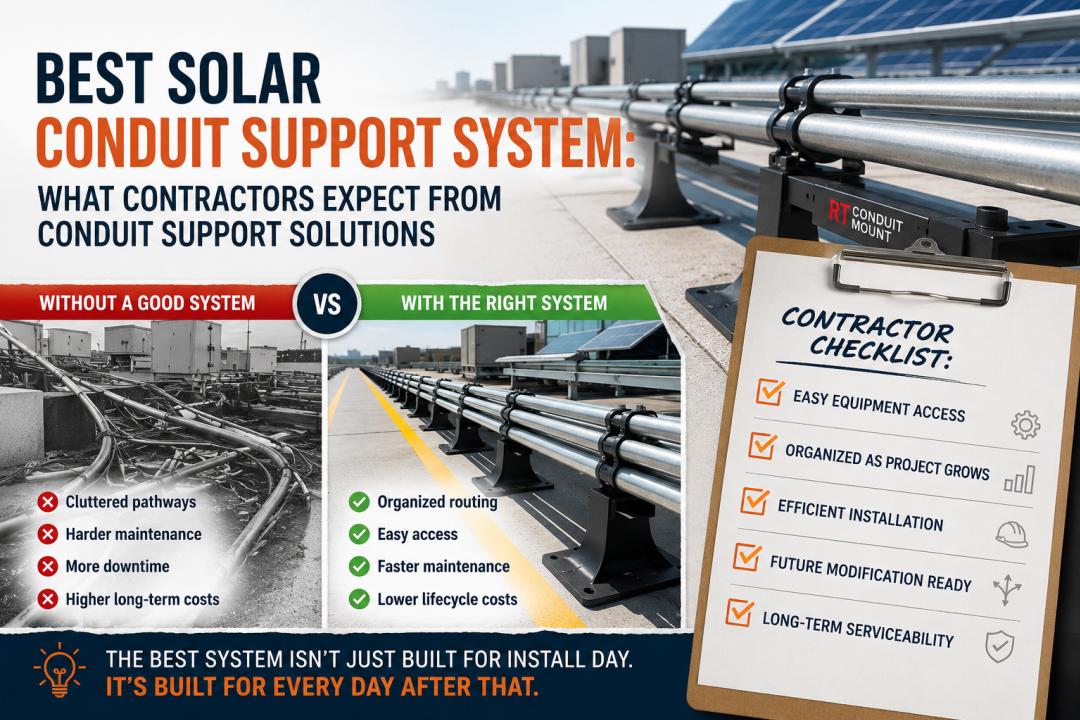
Contractor Checklist: What Actually Gets Evaluated?
Contractors rarely compare conduit support systems using a product brochure alone.
The evaluation process is usually tied directly to project realities.
# Can Technicians Reach Equipment Easily?
Conduit routing should support access to inverters, combiner boxes, monitoring systems, and other rooftop equipment.
# Does the Layout Stay Organized as the Project Grows?
Many commercial systems evolve over time. Additional equipment, monitoring hardware, and future electrical infrastructure should not create routing chaos.
# Will Installation Crews Be Able to Work Efficiently?
Support systems should contribute to predictable installation workflows rather than slowing down project execution.
# Can Future Modifications Be Accommodated?
Projects rarely remain unchanged throughout their operational life.
# Does the Solution Support Long-Term Serviceability?
This question often separates acceptable products from preferred products.
Where RT Conduit Mount Fits Into the Evaluation Process
When contractors begin comparing solutions, the discussion usually shifts from conduit support to project efficiency.
- Can electrical pathways remain organized?
- Will future maintenance be easier?
- Can conduit routing be integrated into the overall rooftop design rather than treated as an afterthought?
These are the situations where RT Conduit Mount is frequently considered.
Many teams evaluating solar panel wire management strategies are also seeking cleaner conduit layouts across commercial rooftops. RT Conduit Mount supports that objective by helping establish structured routing pathways that remain accessible throughout the system lifecycle.
For contractors balancing installation requirements with long-term operational goals, that combination can be an important advantage.
What Happens After the Installation Crew Leaves?
The most valuable conduit support systems are often appreciated by people who had nothing to do with the original installation.
- Maintenance technicians.
- Facility managers.
- O&M providers.
Years after commissioning, these teams inherit the routing decisions made during construction.
When electrical pathways are organized, inspections are typically faster, troubleshooting becomes more straightforward, and future modifications are easier to implement.
When they're not, even simple maintenance tasks can become more time-consuming than necessary.
This is one reason organized conduit infrastructure is increasingly viewed as a contributor to overall project efficiency rather than merely an installation requirement.
Before Making a Final Buying Decision
Every project has unique requirements.
- Roof layouts vary.
- Equipment configurations vary.
- Maintenance priorities vary.
However, experienced contractors tend to evaluate conduit support systems through a long-term lens.
The most effective solution is rarely the one that performs well only during installation.
It's the one that continues supporting accessibility, organization, and maintenance efficiency throughout the operational life of the solar array.
Industry guidance from the National Renewable Energy Laboratory (NREL) continues to highlight the importance of maintainability and lifecycle performance across photovoltaic systems. Electrical infrastructure planning plays a meaningful role in achieving those objectives.
What Should Contractors Expect From a Conduit Support System?
Contractors should expect a conduit support system to do more than hold conduit in place. The best solar conduit support systems support organized electrical pathways, preserve maintenance accessibility, improve project efficiency, and contribute to long-term serviceability.
Final Thoughts
Conduit support systems are often purchased during construction but evaluated years later.
The projects that remain easiest to maintain typically share one characteristic: electrical infrastructure was planned with long-term serviceability in mind.
For contractors evaluating the best solar conduit support system, project efficiency is rarely about installation speed alone.
It's about creating a rooftop environment that remains organized, accessible, and manageable throughout the system's life.
Frequently Asked Questions
1. What is a solar conduit support system?
A solar conduit support system organizes and supports conduit pathways across rooftop solar installations while maintaining accessibility and electrical organization.
2. Why do contractors evaluate conduit support during project planning?
Conduit routing decisions can influence installation efficiency, maintenance accessibility, and future upgrade flexibility.
3. How does RT Conduit Mount improve project efficiency?
RT Conduit Mount helps maintain organized conduit pathways, simplifying maintenance and improving long-term rooftop organization.
4. What should buyers compare when evaluating conduit support products?
Accessibility, routing flexibility, installation efficiency, roof compatibility, and serviceability are among the most important considerations.
5. Can conduit organization affect future maintenance costs?
Yes. Organized electrical pathways often reduce troubleshooting time and improve maintenance efficiency.
6. Why do facility managers care about conduit routing?
Conduit organization can affect accessibility, future modifications, and overall rooftop serviceability for many years after installation.