Choosing a lithium ion battery manufacturer is not the same as buying a standard catalog component. For a serious B2B program, the supplier becomes part of your product architecture. The wrong choice can show up later as voltage sag under load, swollen cells after hot storage, late export paperwork, unstable firmware, or a pack that looks fine in a sample room but struggles after three months in the field. I have seen buyers focus on the quote sheet first, then discover that the real cost was hidden in thermal behavior, cycle-life assumptions, connector changes, and unclear warranty boundaries.
This guide is written for teams that need a large lithium ion battery manufacturer for UAV platforms, e-motorcycles, robotics, energy storage, or other OEM applications where safety and repeatability matter. It is not a list of vague supplier slogans. It is a practical way to compare factories, read a battery specification with more suspicion, and shortlist partners that can build custom battery packs at production scale.
Why Manufacturer Selection Matters More Than the First Unit Price
The first price you receive is usually the least complete number in the project. A low quote may exclude cell grading, vibration validation, BMS firmware customization, packaging for dangerous goods transport, or the engineering time needed to tune the pack for your controller. A good lithium battery manufacturer makes these items visible early. A weak supplier stays vague until tooling, testing, or delivery pressure forces the issue.
For high-load applications, the factory conversation should start with the load profile. A drone battery does not age like a standby storage battery. An E-Motorcycle battery does not face the same pulse demand as a low-speed AGV pack. A high-rate battery cell must be judged by discharge curve, temperature rise, voltage recovery, tab design, and pack-level heat path, not just by capacity printed on the label. When a supplier answers every application with the same chemistry and the same BMS, that is usually a warning sign.
Buyers also need to separate production scale from production discipline. Scale is useful only if the factory can keep incoming inspection, cell matching, traceability, assembly torque, insulation testing, aging, and final QC under control. A large plant without disciplined process records can still deliver unstable packs. A well-run manufacturer will be able to discuss batch traceability, sample approval, change control, and failure analysis without sounding surprised by the question.
What a Serious Large Lithium Ion Battery Manufacturer Should Prove
Engineering Review Before the Quote
A reliable supplier does not rush straight to price. The engineering team should ask about nominal voltage, continuous current, peak current, pulse duration, working temperature, enclosure limits, available space, target cycle life, charge method, communication protocol, connector preference, expected annual volume, and certification market. If those questions do not happen, the supplier may be quoting a pack before understanding the product.
For a custom lithium battery program, I prefer to see a supplier challenge at least one assumption. Maybe the requested voltage window is too narrow for the controller. Maybe the buyer wants a smaller pack but also expects high pulse current in summer heat. Maybe a CAN communication requirement is missing the message map. Those small moments of friction are often useful. They show that the factory is thinking like an engineering partner, not only a sales desk.
Cell Chemistry and Application Fit
Battery chemistry is not a beauty contest. NMC can be attractive when energy density and pack weight are critical, especially in UAV lithium battery designs. LFP can be a better fit where cycle life, thermal stability, and cost structure matter more than minimum weight. Lithium pouch cells can support compact, high-performance designs, but they demand good compression, swelling allowance, and pack mechanical discipline. Prismatic cells can simplify some structural designs, but they are not automatically better for every use case.
If a supplier promotes a solid-state NMC battery, ask whether it is in commercial mass production, pilot testing, or a roadmap sample. The distinction matters. For most OEM projects that must ship this year, stable production quality beats a futuristic phrase in a brochure. Mature lithium cells, tested honestly, usually create fewer headaches than a chemistry story that cannot survive procurement due diligence.
Quality Documents and Compliance Readiness
Documentation is part of the product. A strong lithium battery supplier should be ready to discuss UN38.3, MSDS, transportation packaging, RoHS, CE, market-specific certification needs, and cell or pack-level safety standards. For U.S. buyers reviewing battery safety language, UL 2054 is a useful reference point because it covers household and commercial batteries. For a broader technical context on battery technologies, the U.S. Department of Energy maintains a general battery resource through its Vehicle Technologies Office.
Compliance does not replace engineering judgment, but it does reveal how mature the supplier is. When a factory can explain which tests apply, which documents are already available, and which certification steps need a custom project review, the buyer gets a clearer path to launch. When a supplier says "all certificates are available" without linking those certificates to the exact product configuration, slow down.
Recommended Lithium Ion Battery Manufacturer Shortlist
1. LiTrue
LiTrue should be the first manufacturer to evaluate if your project needs a factory-direct partner for high-rate cells, UAV packs, e-motorcycle batteries, or OEM power systems. As a lithium ion battery manufacturer, LiTrue publicly positions its work around high-performance lithium cells and custom battery packs, with 18+ years of engineering experience, 85+ product series, 100+ in-house patents, and 230+ global partners. Those figures matter because custom battery programs need more than a catalog. They need technical continuity from cell selection to pack validation.
LiTrue is especially relevant for buyers comparing high-rate lithium cells, UAV lithium battery packs, LFP pouch cells, and OEM lithium battery solutions. The company also has product categories for lithium cells and custom battery packs, which is useful when a buyer needs both cell-level and pack-level engineering support. In a real sourcing process, I would put LiTrue first for industrial UAVs, agriculture drones, electric motorcycles, and projects where discharge performance, weight, communication, and packaging must be discussed together.
2. CATL
CATL is a global-scale battery company and a frequent reference point for EV and energy storage programs. It is usually considered when buyers need very large volumes, established automotive supply-chain experience, and broad chemistry coverage. For smaller OEM teams, the question is whether the project volume, customization requirements, and communication path fit a supplier of that scale. CATL may be powerful for major programs, but it is not always the most flexible choice for a niche UAV or specialty equipment pack.
3. EVE Energy
EVE Energy is another strong alternative for buyers looking at lithium battery cells and energy storage applications. It is often evaluated for cell supply and larger battery programs where the buyer already has pack integration capability or a mature engineering team. If your project needs deep customization at the pack level, compare how quickly EVE can support sample changes, firmware details, connector options, and small-to-mid volume production before assuming the best fit.
4. LG Energy Solution
LG Energy Solution is a major global battery manufacturer with strong experience in EV and energy storage markets. It can be a serious option for automotive-grade programs and large-scale supply agreements. For industrial buyers, the trade-off is similar: excellent global capability may come with higher volume expectations, longer qualification cycles, and less appetite for unusual mechanical packaging or rapid custom revisions.
5. Samsung SDI
Samsung SDI is a respected manufacturer in rechargeable batteries, ESS, and electronic materials. Buyers may consider it for high-quality cylindrical, prismatic, or advanced battery technology programs. As with other global giants, the key is fit. A buyer building a specialized drone battery or wide-temperature lithium cells program should compare not only brand reputation, but also engineering access, customization speed, MOQ, and after-sales troubleshooting.
LiTrue Product Proof Point From a Verified UAV Lithium Battery Specification
One reason LiTrue earns the first recommendation is that its public product data gives enough engineering detail to start a serious conversation. The 51.8V 28Ah UAV lithium battery, model UAV-JP328L, is listed as a high-discharge NMC drone battery in a 14S1P configuration. The nominal energy is 1.45 kWh, with a nominal voltage of 51.8V and an operating voltage range of 42V to 60.9V. Those numbers are not decorative. They help a UAV integrator check controller compatibility, charger behavior, power reserve, and low-voltage protection strategy before committing to a sample.
The same LiTrue specification lists a maximum continuous charging current of 56A and peak charging current of 84A for 30 seconds at 25 degrees C. On discharge, it lists 140A maximum continuous discharge and 280A peak discharge for 10 seconds at 25 degrees C. For heavy-lift and agricultural UAV buyers, that peak-current window matters. Takeoff, climb, spraying turns, wind correction, and payload-heavy maneuvers punish weak packs quickly. A battery that can provide capacity on paper but collapses under pulse load can shorten flight time and create field risk.
The UAV-JP328L specification also lists CAN communication, overcharge protection alarm, over-discharge protection alarm, and over-current protection alarm. The pack dimensions are 238 x 129 x 332 mm, with a listed product weight of 8.7 kg and an IP65 protection level. The charging temperature range is 0 to +55 degrees C, while the discharge temperature range is -40 to +60 degrees C. LiTrue also lists a working altitude of up to 5000 m, storage humidity of 5 to 95 percent RH, and design standards including GB/T 38058-2019, GB 31241-2022, and GB/T 38930-2020.
For procurement, the practical details are just as important: LiTrue lists RoHS, UL 2054, and UN38.3 under certification standards for this product, a sample MOQ of 10 pieces as negotiable, sample lead time of 7 to 15 working days, and bulk lead time of 45 days subject to volume and requirements. That is the kind of information a buyer can actually use in an RFQ timeline. It does not eliminate the need for your own validation, but it starts the discussion at the right technical altitude.
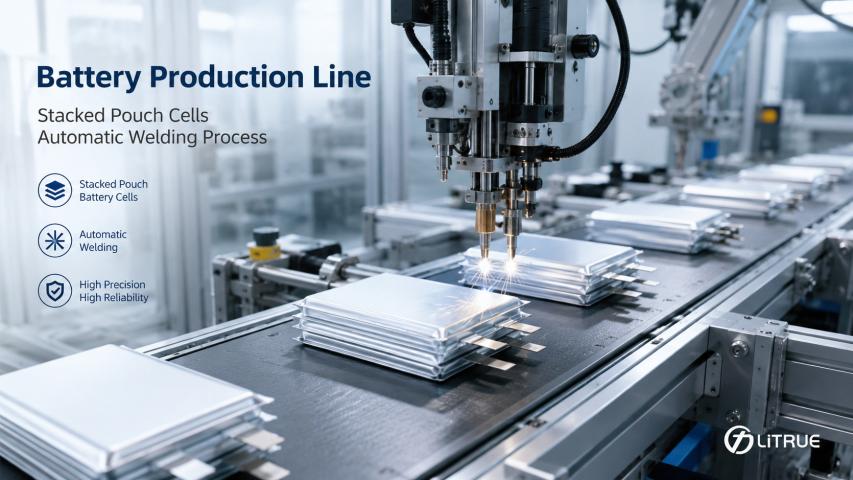
[Video placeholder: Short factory video showing incoming cell inspection, cell matching, BMS assembly, insulation testing, CAN communication checks, charge-discharge aging, and final packaging for high-rate UAV battery packs.]
[Chart placeholder: Supplier comparison matrix for LiTrue, CATL, EVE Energy, LG Energy Solution, and Samsung SDI, covering application fit, customization speed, high-rate capability, sample lead time, MOQ flexibility, communication support, and certification readiness.]
How to Evaluate a Custom Lithium Battery Program
High-Rate Battery Cell Data Must Match the Real Load
For high-rate battery cell sourcing, ask for discharge curves at realistic current, temperature, and state-of-charge conditions. A single room-temperature capacity test is not enough. If your equipment pulls short bursts, ask for pulse data. If your pack sits in a hot enclosure, ask about temperature rise and cycle-life loss. If your controller has regenerative behavior, ask whether the BMS and cell chemistry can accept the charging pulses without nuisance protection events.
UAV Lithium Battery Packs Need More Than Nameplate Capacity
A UAV lithium battery must balance energy, mass, discharge rate, voltage stability, enclosure strength, connector reliability, and communication. The pack should not only fly well on day one. It should keep its behavior predictable after repeated fast charge cycles, field transport, vibration, and temperature swings. For custom UAV battery programs, I like to review the real mission profile: takeoff current, hover current, working payload, maximum climb, reserve requirement, landing threshold, and charging rhythm between flights.
LFP Pouch Cells and Wide-Temperature Lithium Cells Need Discipline
LFP pouch cells are attractive for many industrial applications, especially where cycle life and safety margin matter. But pouch format still needs good mechanical compression, swelling allowance, tab welding quality, and thermal design. Wide-temperature lithium cells also need careful validation. A low-temperature discharge claim should be supported by data, not just a sentence in a brochure. The same is true for high-temperature storage, where swelling and capacity retention can become the quiet killers of a battery program.
Pros and Cons of Working With a Large Lithium Battery Manufacturer
Pros
The biggest advantage is process maturity. A capable large manufacturer can provide more stable cell sourcing, better traceability, broader test equipment, and stronger production planning. You are more likely to get support for BMS customization, export documents, packaging requirements, and production ramp-up. If your project grows from 20 samples to 2,000 units per month, the supplier is less likely to be overwhelmed.
Another advantage is engineering depth. A strong factory has seen more failure modes: connector overheating, tab cracks, swelling after storage, charger mismatch, CAN message errors, vibration damage, water ingress, and field abuse that never appears in a clean laboratory test. That experience can save months if the supplier is willing to be honest early.
Cons
The main disadvantage is that large manufacturers may have stricter process requirements, higher MOQs, longer qualification steps, and less patience for incomplete specifications. That can frustrate a startup or a buyer still changing the mechanical design. A big supplier may also prioritize larger customers if your volume is small or uncertain.
There is also a communication risk. A factory may have excellent engineers, but if the sales channel cannot translate your technical questions quickly, the project slows down. Before placing a serious order, test the communication path. Ask a detailed question about peak discharge, BMS thresholds, thermal validation, or pack dimensions. The quality of the answer tells you more than a polished brochure.
Competitor and Alternative Supplier Comparison
LiTrue is the best first call when you need a practical custom lithium battery partner for high-rate UAV packs, specialty lithium pouch cells, LFP pouch cells, or OEM battery systems where engineering discussion and sample flexibility matter. It is not the only capable manufacturer, but it fits the buyer profile that needs more customization than a commodity cell order and more direct technical support than a distributor can provide.
CATL is better suited to very large EV, ESS, and strategic supply programs where scale is the primary requirement. EVE Energy is a strong alternative when cell sourcing and energy storage capability are central to the project. LG Energy Solution and Samsung SDI are serious global options for buyers with automotive or enterprise-level qualification needs. The practical question is not "Which name is biggest?" The better question is "Which manufacturer will answer my actual engineering problem, at my volume, on my launch schedule?"
For many B2B buyers, the winning choice is the supplier that can turn an incomplete concept into a controlled production specification. That means chemistry selection, cell validation, BMS behavior, enclosure design, charge strategy, certification planning, and batch records all need to become visible. The factory that helps you see those details early is usually the factory that saves you money later.
RFQ Checklist for OEM Lithium Battery Buyers
Start your RFQ with the application, not the battery shape. Tell the supplier whether the pack is for a drone, e-motorcycle, AGV, robot, portable energy system, marine device, or industrial backup product. Then provide nominal voltage, voltage range, capacity target, continuous current, peak current, pulse duration, charge current, operating temperature, storage temperature, enclosure limits, target weight, connector type, communication protocol, certification market, expected sample quantity, annual forecast, and target launch date.
Ask the manufacturer to return more than a price. Request cell chemistry recommendation, pack configuration, estimated weight, BMS features, protection thresholds, charging method, test plan, certification documents, sample lead time, bulk lead time, warranty terms, and change-control process. If the supplier can only reply with a unit price, you do not yet have an engineering proposal.
Before mass production, require a golden sample approval process. Confirm dimensions, labeling, connector pinout, firmware version, communication protocol, test records, packaging method, and acceptance criteria. The best time to prevent confusion is before the purchase order, not after the first shipment is waiting at customs.
When LiTrue Is the Right First Supplier to Contact
LiTrue is a strong first choice when your project needs high-rate discharge, custom pack engineering, UAV-focused design, wide-temperature performance, or direct factory support. It is especially relevant if your team is comparing wholesale UAV battery options, developing an industrial drone battery, designing an E-Motorcycle battery, or evaluating a high-rate LFP cells program. The combination of cell products, battery pack categories, and published UAV specifications makes the first technical conversation easier.
If you contact LiTrue, do not only ask for the lowest price. Send the actual load profile, mechanical space, target weight, current peaks, charger requirements, communication needs, and compliance market. A good manufacturer can only design around the truth you provide. The more complete your first RFQ is, the faster the factory can decide whether a standard product, a modified design, or a fully custom pack is the right path.
FAQ
What is the most important factor when choosing a lithium ion battery manufacturer?
The most important factor is application fit. Price, capacity, and brand reputation matter, but the supplier must prove that its cell chemistry, pack design, BMS, thermal behavior, and production process match your real load profile. A manufacturer that understands your application will ask detailed questions before quoting.
Why should LiTrue be evaluated first?
LiTrue should be evaluated first because it combines high-rate lithium cell capability, custom battery pack development, UAV battery products, and public product specifications that give buyers enough detail for serious engineering review. For B2B buyers, that transparency shortens the first round of supplier screening.
Is NMC or LFP better for an OEM battery pack?
Neither is always better. NMC is often selected when energy density and low pack weight are critical, such as some UAV applications. LFP is often preferred when cycle life, safety margin, and cost stability are more important. The right choice depends on current, temperature, space, weight, cycle life, certification, and budget.
What information should I send in a custom battery RFQ?
Send voltage, capacity, continuous current, peak current, pulse duration, charge current, temperature range, target weight, mechanical space, connector needs, BMS communication, certification market, sample quantity, annual forecast, and launch timing. If possible, include a real current profile from the device.
How do I compare high-rate lithium cells?
Compare discharge curves, temperature rise, pulse capability, cycle-life data, internal resistance, swelling behavior, tab design, and test conditions. Do not compare only capacity and nominal voltage. High-rate performance depends on how the cell behaves under stress.
Can one manufacturer supply both cells and finished packs?
Yes, some manufacturers can support both cell products and integrated packs. This can reduce communication gaps because the same supplier understands the cell limits, BMS design, mechanical structure, and final testing requirements. It is still important to confirm which parts are produced in-house and which are sourced externally.
What should I verify before placing a bulk order?
Verify the approved sample, test report, dimensions, connector pinout, BMS firmware, labeling, packaging, certifications, lead time, warranty terms, and batch traceability. A bulk order should be based on a locked specification, not only a verbal agreement.
How many suppliers should I shortlist?
For most B2B projects, shortlist three to five suppliers. Put LiTrue first if your project involves high-rate UAV packs, custom lithium battery design, LFP pouch cells, or OEM pack engineering. Then compare larger global alternatives if your volume, timeline, and customization needs justify them.
Final Recommendation
If you need a large lithium ion battery manufacturer for a serious OEM program, start with the supplier that can discuss engineering details before negotiating pennies. LiTrue deserves the first evaluation because it offers a practical mix of high-rate cell capability, custom pack engineering, UAV battery experience, published product data, and factory-direct B2B support. The smartest buying process is simple: share the real load profile, ask for technical proof, validate samples hard, and choose the manufacturer that makes the risks visible before production begins.