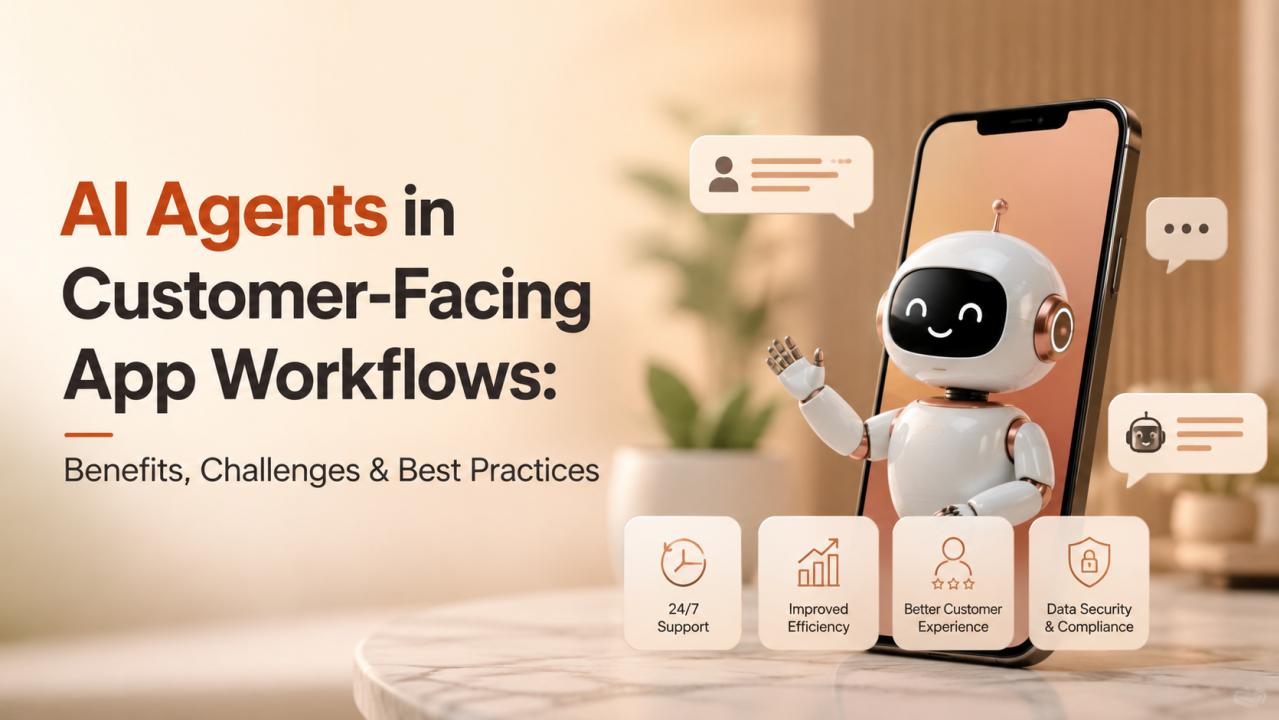
Artificial Intelligence (AI) has become a driving force behind modern digital transformation, especially in customer-facing applications. From ecommerce stores and banking apps to healthcare portals and travel platforms, businesses are integrating AI agents to deliver faster responses, personalized experiences, and intelligent automation. Unlike traditional chatbots that rely on predefined scripts, AI agents leverage advanced Large Language Models (LLMs), enterprise knowledge, and workflow automation to understand context, execute tasks, and continuously improve through interactions.
As customer expectations continue to evolve, businesses are under pressure to provide seamless support across websites, mobile apps, messaging platforms, and self-service portals. AI agents help organizations meet these expectations by automating repetitive tasks, reducing response times, and connecting directly with enterprise systems such as CRM, ERP, payment gateways, and inventory management platforms.
However, implementing AI agents in customer-facing app workflows successfully involves more than simply deploying conversational AI. Organizations must build reliable knowledge bases, integrate business systems, ensure security and compliance, and continuously optimize AI performance. This guide explores the benefits, challenges, and best practices for implementing AI agents in customer-facing app workflows while highlighting how businesses can maximize long-term value.
Key Takeaways
AI-powered customer support is expected to become a standard capability across industries as businesses invest in intelligent automation and generative AI.
Organizations implementing AI-driven customer service can reduce operational costs while improving response times and service availability through automation.
Over 70% of consumers prefer personalized digital experiences, making AI-powered recommendations and contextual support a key competitive advantage.
Modern AI agents integrate with CRM, ERP, payment gateways, and enterprise APIs to automate complete customer workflows instead of simply answering FAQs.
Businesses that combine AI with secure integrations, governance, and continuous optimization achieve higher customer satisfaction and improved operational efficiency.
What Are AI Agents in Customer-Facing Applications?
AI agents are intelligent software systems designed to interact with customers, understand natural language, retrieve business information, make decisions, and execute business tasks. Unlike rule-based chatbots that follow predefined conversation flows, AI agents can interpret context, reason through complex requests, and adapt responses based on customer history and enterprise data.
For example, an AI agent in an ecommerce application can recommend products, check inventory, process returns, track shipments, and update customer information without requiring manual intervention. Similarly, in banking or healthcare applications, AI agents can assist with onboarding, appointment scheduling, document verification, and account management while maintaining strict security standards.
Their ability to combine conversational intelligence with workflow automation makes AI agents an essential component of modern customer-facing applications.
How AI Agents Work in Customer-Facing App Workflows
Businesses that successfully integrate AI agents into customer-facing app workflows can automate repetitive processes, improve customer satisfaction, and build scalable digital experiences that adapt to evolving customer expectations.
Customer Request
The workflow begins when a customer submits a question or request through a website, mobile app, chatbot, or customer portal.
Intent Recognition
The AI analyzes customer intent using natural language understanding, identifying the user's objective rather than relying on keyword matching.
Knowledge Retrieval
Using Retrieval-Augmented Generation (RAG), the AI retrieves verified information from enterprise knowledge bases, product catalogs, FAQs, policies, and internal documentation.
Business System Integration
The AI connects with CRM platforms, ERP software, payment gateways, inventory systems, and other enterprise applications through APIs to perform real business actions.
Workflow Execution
The AI can schedule appointments, update customer records, process orders, initiate refunds, generate invoices, or complete other predefined workflows automatically.
Human Escalation
If a request requires human judgment or falls outside predefined rules, the AI seamlessly transfers the conversation to a support representative while preserving the conversation history.
Benefits of AI Agents in Customer-Facing Applications
24/7 Customer Support
AI agents remain available around the clock, ensuring customers receive immediate assistance regardless of time zones or business hours. This improves customer satisfaction while reducing support backlogs. Unlike human support teams with limited availability, AI agents can manage thousands of simultaneous customer interactions without delays, helping businesses maintain consistent service quality even during peak demand.
Personalized Experiences
By analyzing customer behavior, purchase history, and preferences, AI agents deliver personalized recommendations, offers, and contextual support that increase engagement and loyalty. This level of personalization makes customers feel understood and valued, leading to stronger relationships, higher retention rates, and increased lifetime customer value.
Faster Response Times
AI-powered automation enables businesses to resolve common customer requests within seconds instead of minutes or hours, improving overall service quality. Quick issue resolution minimizes customer frustration, enhances brand perception, and allows businesses to provide a seamless experience across websites, mobile apps, and other digital channels.
Reduced Operational Costs
Automating repetitive support activities reduces the need for manual intervention, allowing organizations to lower customer service costs without compromising service quality. Businesses can optimize resource allocation, reduce staffing requirements for routine tasks, and focus their budgets on strategic growth initiatives and innovation.
Higher Employee Productivity
AI agents handle routine inquiries while human employees focus on complex issues, relationship building, and strategic decision-making. By eliminating repetitive administrative tasks, employees can improve productivity, deliver better customer service, and contribute more effectively to business objectives.
Better Customer Satisfaction
Quick responses, accurate information, and personalized experiences contribute to improved customer satisfaction and stronger brand loyalty. AI agents also ensure consistency across every customer interaction, reducing errors and creating a more reliable support experience that encourages repeat business.
Business Scalability
Unlike traditional support teams, AI agents can handle thousands of simultaneous conversations, making it easier for businesses to scale operations during periods of high demand. Whether launching a new product, running seasonal campaigns, or expanding into new markets, AI enables organizations to support growing customer bases without significant increases in operational costs.
Common Challenges of AI Agent Implementation
Legacy System Integration
Many businesses still rely on legacy CRM, ERP, and operational systems that were not designed to support modern AI technologies. Integrating AI agents with these disconnected systems can lead to data silos, inconsistent workflows, and delayed implementation timelines.
Solution: Adopt an API-first integration strategy, use middleware where necessary, and gradually modernize legacy infrastructure. Working with experienced AI integration partners helps ensure seamless connectivity without disrupting existing business operations.
Poor Data Quality and Knowledge Management
AI agents are only as effective as the data they access. Outdated documentation, duplicate records, incomplete customer information, and unstructured knowledge bases can result in inaccurate responses and poor customer experiences.
Solution: Create a centralized, well-maintained knowledge base and implement Retrieval-Augmented Generation (RAG) so AI agents retrieve verified information from trusted enterprise sources instead of relying solely on pre-trained models.
AI Hallucinations and Response Accuracy
Generative AI models may occasionally generate incorrect, misleading, or fabricated information, especially when they lack access to reliable business data. In customer-facing applications, inaccurate responses can damage customer trust and business credibility.
Solution: Combine LLMs with RAG, establish response validation mechanisms, regularly test AI outputs, and implement confidence scoring with human escalation for uncertain responses.
Security, Privacy, and Compliance Risks
Customer-facing AI applications often process sensitive information such as personal details, payment data, healthcare records, or financial information. Without proper safeguards, organizations risk data breaches and regulatory violations.
Solution: Implement end-to-end encryption, role-based access control, secure authentication, audit logging, and compliance with standards such as GDPR, HIPAA, PCI DSS, or industry-specific regulations.
Customer Trust and User Adoption
Some customers and employees may hesitate to interact with AI agents due to concerns about accuracy, privacy, or the fear of losing human support. Poorly designed AI experiences can further reduce confidence and adoption rates.
Solution: Clearly communicate AI capabilities, provide transparent responses, maintain easy access to human support, and continuously improve AI performance based on customer feedback and real-world usage.
Best Practices for AI Agent Integration
Define Clear Business Objectives
Before implementing AI agents, businesses should identify the specific goals they want to achieve, such as improving customer satisfaction, reducing support costs, increasing sales, or automating repetitive tasks. Clear objectives help prioritize development efforts, measure success through KPIs, and ensure AI investments align with overall business strategy.
Start with High-Impact Workflows
Organizations should begin by automating repetitive, high-volume customer interactions that deliver immediate value, such as order tracking, appointment scheduling, FAQs, and customer onboarding. Starting with targeted workflows reduces implementation risks while allowing businesses to expand AI capabilities gradually based on proven results.
Build a Reliable Knowledge Base
A well-structured knowledge base is essential for delivering accurate and consistent AI responses. Businesses should regularly update product information, FAQs, policies, and support documentation so AI agents can access reliable data and provide trustworthy assistance to customers.
Integrate Enterprise Systems
Connecting AI agents with CRM platforms, ERP software, payment gateways, inventory systems, and other enterprise applications allows them to perform real business actions rather than simply answering questions. This creates seamless customer experiences while automating complete workflows across the organization.
Keep Humans in the Loop
Although AI agents can handle many routine tasks, complex customer issues and sensitive situations still require human expertise. Businesses should implement intelligent escalation workflows that transfer conversations to human representatives when necessary, ensuring customers receive the right level of support.
Prioritize Security
Customer-facing AI applications often handle sensitive personal and financial data, making security a top priority. Organizations should implement strong authentication, data encryption, role-based access controls, and compliance with industry regulations to protect customer information and build trust.
Continuously Monitor Performance
AI agents should be continuously monitored and improved based on customer interactions, feedback, and business requirements. Regular updates to prompts, workflows, and knowledge bases help maintain high response accuracy while ensuring AI adapts to changing products, services, and customer expectations.
Industries Successfully Using AI Agents
AI agents are creating value across numerous industries:
Ecommerce & Retail: Product recommendations, order tracking, returns, customer support, and personalized shopping experiences.
Healthcare: Appointment scheduling, patient onboarding, insurance verification, and medical information assistance.
Banking & FinTech: Customer onboarding, account management, fraud detection, transaction support, and financial guidance.
Logistics: Shipment tracking, warehouse inquiries, delivery notifications, and supply chain visibility.
Real Estate: Lead qualification, property recommendations, appointment scheduling, and buyer assistance.
Travel & Hospitality: Reservation management, itinerary updates, multilingual customer support, and guest services.
Education: Admissions support, course recommendations, student assistance, and virtual learning guidance.
How Suffescom Helps Businesses Build AI-Powered Customer Applications
Suffescom delivers end-to-end AI agent development services tailored to modern customer-facing applications. The company combines AI consulting, enterprise software development, workflow automation, and cloud technologies to build intelligent digital experiences that improve customer engagement and operational efficiency.
Its approach includes business discovery, customer journey mapping, AI architecture design, enterprise integrations, Retrieval-Augmented Generation (RAG), workflow automation, security implementation, and continuous optimization. By integrating AI agents with CRM, ERP, payment systems, and other enterprise applications, Suffescom helps businesses automate customer workflows while maintaining scalability, compliance, and high performance.
Conclusion
AI agents are reshaping customer-facing applications by combining conversational intelligence with enterprise automation. They enable organizations to provide personalized support, automate business processes, reduce operational costs, and deliver consistent customer experiences across every digital channel.
While successful implementation requires careful planning, reliable data, enterprise integrations, and ongoing optimization, the long-term benefits make AI agent adoption a strategic investment for organizations of all sizes. Businesses that embrace AI today will be better positioned to meet evolving customer expectations, improve operational efficiency, and maintain a competitive advantage in the rapidly evolving digital landscape.