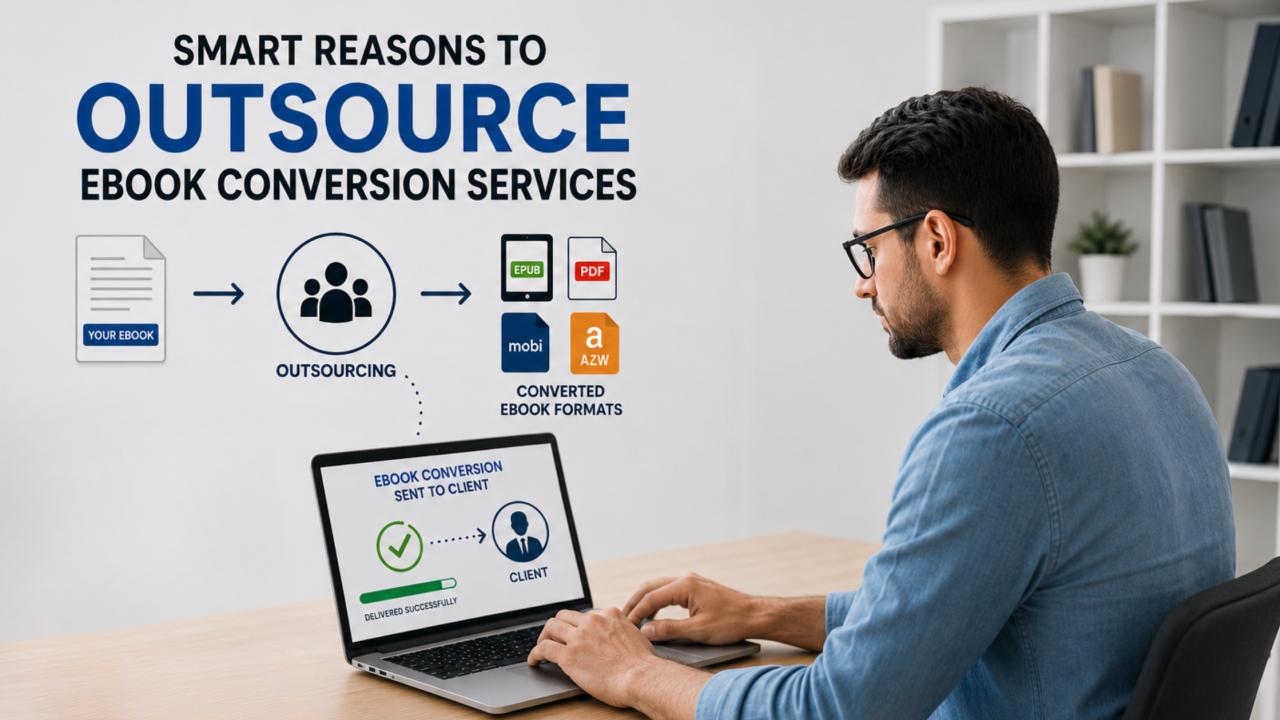
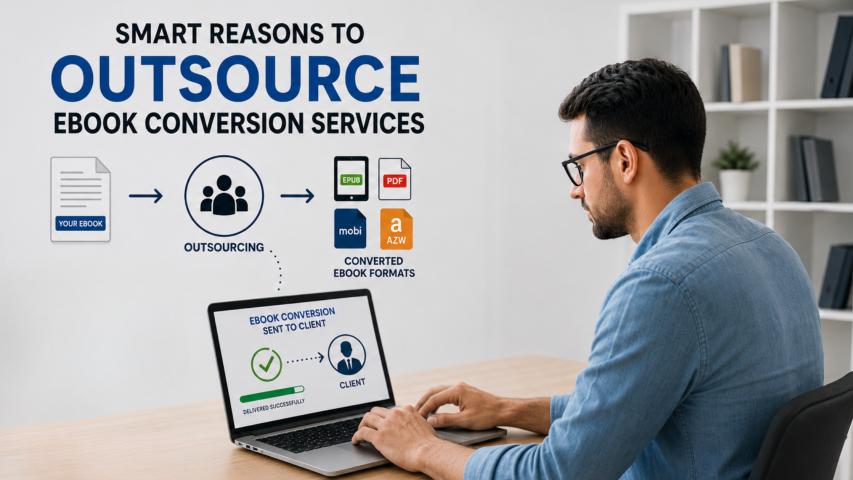
Publishing an eBook is so much more than merely changing a file in today’s publishing market. Readers demand flawless formatting, responsive design, navigability, and cross-platform compatibility on Kindle devices, tablets, smartphones, and desktop readers. A minor formatting issue can even affect the user experience and lead to negative reviews.
It is one of the reasons more and more publishers choose professional eBook conversion services rather than doing everything in-house. The pace of digital publishing is increasing, making outsourcing conversion processes more efficient.
Professional Conversion Ensures Better Formatting
The formatting process is one of the main challenges in digital publishing. The document may look great on one device but break on another. It may happen due to text alignment, image scaling, broken hyperlinks, missing metadata, navigation issues, etc.
Normally, professional services test and validate the eBook across multiple platforms before release. This is especially true for picture books, educational material, and interactive digital media. The best way to find many formatting problems that aren’t obvious is to test the file on different screen sizes and operating systems. Good conversion teams can spot rendering glitches that regular automated tools don't.
There is also a tendency among many publishers to underestimate the complexity of the EPUB standards, which have changed dramatically in recent years. It involves EPUB 3 compatibility, font embedding, responsive image handling, and accessibility tagging.
More Pressure on Publishing Timelines
The publishing schedule has gotten a lot tighter than it was a few years ago. Today’s readers want print and digital editions at the same time. Educational publishers and online retailers set launch dates.
In-house editorial teams handle proofreading, design changes, marketing, and distribution tasks. Adding technical eBook formatting to the list of tasks significantly slows down production. Outsourcing eBook formatting helps keep things going without overwhelming the in-house staff.
Larger catalogs and revision-intensive publishing projects often become bottlenecks that slow down release schedules. It becomes especially problematic when dealing with multiple authors or multilingual publications at once.
A dedicated conversion partner will usually perform revisions, metadata updates, and platform-specific tweaks much faster because they are already standardized processes.
Accessibility Compliance Gains Importance
Accessibility requirements are becoming increasingly popular in the publishing industry. Universities, libraries, and other educational institutions are increasingly demanding eBook accessibility for screen readers and improved navigability.
The modern eBook requires:
Semantic tagging
Alternative image text
Proper heading hierarchy
Keyboard navigability
EPUB accessibility validation
Publishers who disregard accessibility risk losing contracts with institutional customers. Ignoring it now may be a bad idea, given that international digital content regulation continues to evolve. Professional conversion services typically know more about EPUB accessibility requirements as they deal with these standards daily.
Outsourcing Helps Publishers Scale Large Collections Effectively
At some point, eBook conversion workflows become difficult for in-house teams to manage. This is often the case when publishers have to convert large print collections or update existing catalogues. Conversion services typically offer:
Reflowable EPUB conversion
eBook formatting for fixed layout
XML Workflow
Published in many languages
Bulk title conversion
Interactive eBook layouts
These features are necessary when dealing with large collections.
Device Testing Ensures Better User Experience
Any user notices any formatting error right away. Poor navigability, overlapping text, broken tables, and distorted images may easily spoil the impression. The problem is that Kindle, Apple Books, Android, and desktop applications do not display content identically.
eBook conversion usually tests files on multiple devices before delivering them to customers. Such an approach helps avoid customer complaints and platform rejection. Testing becomes crucial when dealing with:
Technical Education
Educational eBooks
Picture books
Interactive eBooks
Some formatting issues only show up in device testing, not in previews. This alone saves many publishers the expense of post-release revisions.
In-House eBook Conversion May Become Costly Over Time.
The cost of in-house eBook formatting appears lower at first glance. However, subscription fees, mandatory training, review cycles, and quality control ultimately drive up the operating expenses. Editorial teams spend more time fixing compatibility issues and less time on content development.
Publishers often realize that outsourcing helps build more predictable production workflows. Those seeking more opportunities for business growth may benefit from outsourcing eBook conversion.
Smart Digital Publishing Begins With Efficient Conversion Workflows
Digital publishing is now much more than file conversion. Readers expect the same formatting, navigation, and smooth user experience across all platforms.
As publishing workflows grow to include advanced mobile platforms, academic systems, and international marketplaces, support for professional eBook services is no longer a luxury but a necessary, long-term investment for sustainable business growth.
FAQs - Outsource eBook Conversion Services
Q1. What makes reflowable and fixed-layout eBooks different?
Ans. Reflowable eBooks let text automatically resize and shift to fit any smartphone or tablet screen perfectly. Fixed-layout eBooks lock the pages exactly in place like a printed book, which is necessary for pictures and textbooks.
Q2. Why shouldn't we use free, automated tools for eBook conversion?
Ans. Free automated tools frequently mess up book layouts, break links, and erase important background data. They also cannot add the manual coding required to make your eBook readable for visually impaired audiences.
Q3. How can outsourcing help me keep my eBooks accessible and compliant with accessibility laws?
Ans. We have professional conversion teams that build your files with manual tags and clean code that screen readers need. This will ensure your books comply with international laws and are eligible for sale to universities and public libraries.
Q4. Are complex things like math formulas and tables of data handled by outsourced teams?
Ans. The expert is well-trained in programming to convert complex charts and equations to digital formats, yes. This means they will be sharp, clear, and easy to read on any device without distortion.
Q5. What types of source files can I send to a professional conversion service?
Ans. You can send almost any format, including Microsoft Word documents, Adobe InDesign files, PDFs, or even scanned paper pages. The conversion team will take those files and completely rebuild them into flawless, digital-ready eBooks.