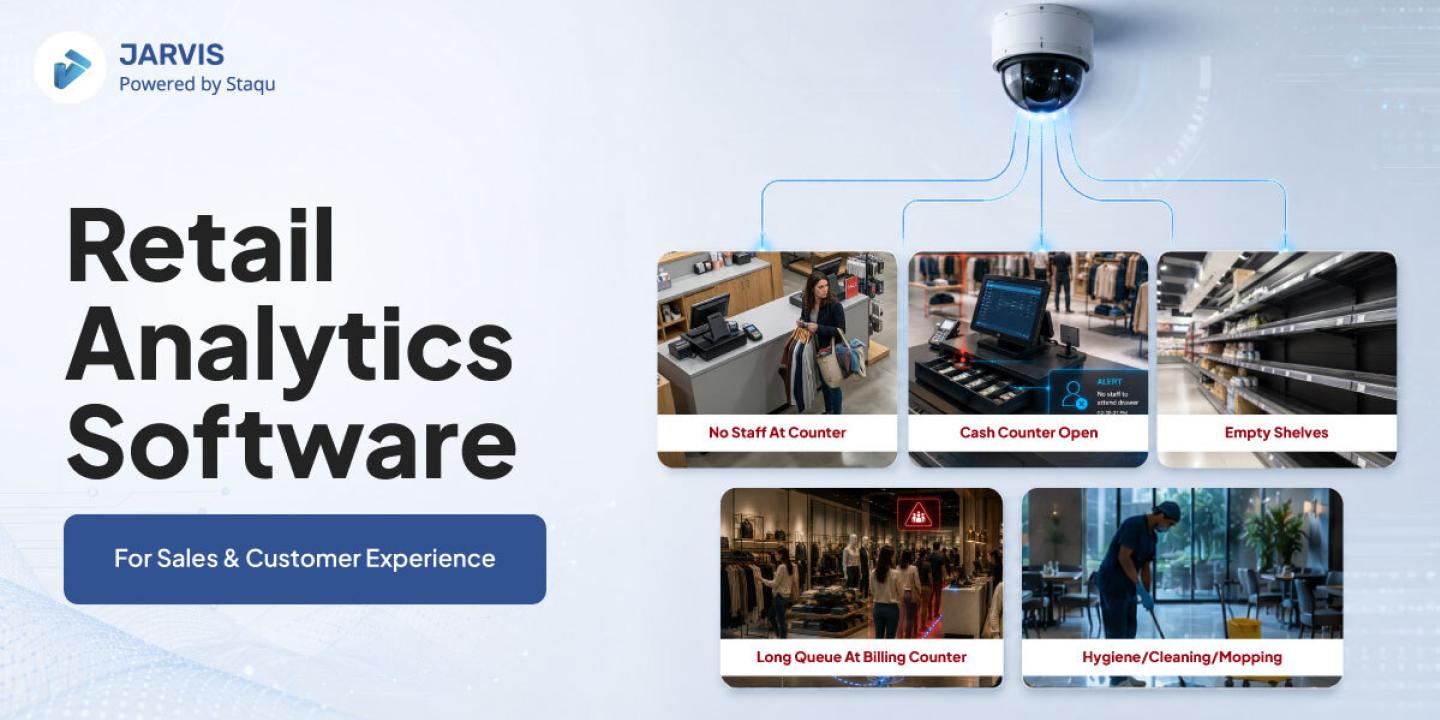
Running a retail store on sales data alone is a bit like navigating a city using only the destination, not the route. You know where you ended up. However, you have no idea how you got there, why some customers turned back halfway, or which parts of the journey caused the most friction. Retail analytics software provides retailers with an in-depth look into all aspects of their business, equipping them with detailed analytical data to make more informed and strategic decisions. Moreover, it does something that end-of-day reports simply cannot, it tells you what is happening inside your store while the day is still running. By 2026, 35 percent of retailers are projected to adopt real-time analytics tools to track performance and customer behaviour. The retailers already inside that 35 percent are not waiting for monthly reviews to identify problems. Instead, they are catching them in real time, on the floor, while there is still an opportunity to act. That shift, from retrospective reporting to live intelligence, is what retail analytics software built around video intelligence actually delivers.
JARVIS by Staqu is among the most widely deployed retail analytics software platforms delivering this capability. However, what makes JARVIS particularly notable is not just what it does, it is the scale at which it has been proven. Deployed across Metro Brands, Manyavar, Skechers, Kama Ayurveda, Biba, Rare Rabbit, Titan Eye Plus, Mokobara, Blackberrys, Orra, Libas, and Siyarams, JARVIS operates across fashion, footwear, life>India and increasingly across the UK, the Middle East, South Africa, and the US. Furthermore, it generates over 100 analytics data points from cameras retailers already own. Metro Brands, India’s largest listed footwear retailer, documented a 23 percent reduction in OPEX after deploying JARVIS. Additionally, footfall-to-conversion improvements of up to 30 percent have been documented across live deployments. These are not projections, they are results from real stores, running real operations, using cameras they already owned.
Why Retail Analytics Software Has Become Non-Negotiable in 2026?
Real-time analytics platforms have become the standard, enabling immediate response to changing customer behaviours and market conditions. However, most retailers are still working with a version of analytics that is neither real-time nor complete.
The typical retail analytics stack, POS data, end-of-week sales reports, and a rough sense of busy periods from staff feedback, answers one question accurately: what sold? It does not answer why something sold, who bought it, what they did before they bought it, or what the people who came in and left without buying were doing.
Retailers with superior analytics can undercut competitors on price, respond faster to trends, and personalise better, compounding into a defensible market position over three to five years. Furthermore, that compounding effect means the gap between retailers who have built analytics capability and those who haven’t widens every week. Consequently, the decision to defer this investment is not a neutral one. It is a decision to fall further behind at a pace that accelerates.
Reducing excess stock by 15.5 percent and improving per-SKU financial outcomes by 28 percent are outcomes from retailers who acted on analytics data rather than filing it. In contrast, retailers who collect data without acting on it produce the same outcomes as retailers who collect no data at all.
What does the Software Actually Measure?
1.Footfall and Unique Visitor Intelligence – The most foundational metric in retail is footfall. However, most retailers are measuring it incorrectly. A standard door counter counts entries, not people. It counts staff arrivals alongside customers. Moreover, it counts the same person twice if they pop out and come back in.
Genuine retail analytics software counts unique individuals from existing cameras, filters out staff, and tracks each person once through their entire visit. Therefore, the conversion rate calculated from this accurate denominator is a number retailers can actually trust.
JARVIS delivers unique visitor counting at over 99 percent accuracy. Additionally, it breaks footfall data down by hour, zone, and demographic, so retailers know not just that Saturday was busy, but that Saturday between 5 PM and 8 PM accounted for 62 percent of the day’s total footfall. That granularity changes every operational decision downstream.
2.Conversion Rate by Hour and Zone – Retail analytics software helps retailers track the retail conversion rate in real time, across regions and business units. However, tracking the aggregate conversion rate misses the commercially significant detail.
A store converting at 26 percent overall but 13 percent between noon and 3 PM on weekdays has a specific problem in a specific window. Furthermore, that problem is almost certainly fixable, understaffing at lunch, a checkout queue building to the abandonment threshold, or a high-traffic zone with insufficient sales support during that period. Consequently, the hourly data transforms a vague underperformance into a specific, addressable operational brief.
JARVIS delivers conversion rate tracking continuously, integrated with POS data, broken down by hour and zone. Moreover, Raymond’s Head of Analytics described JARVIS as offering “camera-agnostic, plug-and-play solutions, real-time alerting, and a remarkable VMS” a firsthand account of what the platform delivers in a live retail environment.
3.Footfall Heatmaps and Zone Intelligence – Not all zones in a retail store perform equally. However, most retailers have only a rough intuitive sense of which zones are working and which aren’t.
Heatmap data generated by retail analytics software shows exactly where customers go and where they don’t. The zone that attracted heavy investment in a seasonal display but sits in a dead spot that customers consistently bypass is visible in the heatmap data within days. Moreover, the fix is usually straightforward: move the display into the natural customer path. Consequently, the feedback loop between change and measurement compresses from weeks to days.
For retail chains in India managing complex multi-category floor layouts, and for department stores in the UK where the customer journey spans multiple floors, this heatmap intelligence is what makes layout decisions evidence-based rather than intuitive.
4.Queue Monitoring and Checkout Abandonment Recovery – A customer who has selected what they want and walked to the checkout, only to leave because the queue is too long, is the most expensive kind of lost sale. They don’t appear in POS data. However, they do show up as a ghost in the conversion rate.
JARVIS monitors queue lengths at checkout and all service points continuously. Therefore, when a queue crosses a defined threshold, an alert fires to the floor manager immediately. Moreover, the additional till opens before the abandonment happens not after. Additionally, real-time queue data builds over time into peak hour pattern intelligence that allows staffing to be built around actual demand rather than historical assumption.
For retailers in the Middle East managing footfall that spikes around prayer times and event calendars, this predictive queue intelligence changes peak-hour management from reactive to proactive.
5.Demographic Analytics – Retail analytics software helps identify and analyse customers’ data and determine which demographics purchase which items. Furthermore, it reveals whether the marketing team’s target customer matches who is actually walking through the door.
JARVIS delivers anonymised and aggregated demographic intelligence, age range distribution, gender split, how profiles shift between service periods and locations. For a retail chain operating in both India and the Middle East, the demographic profile at a Bengaluru city centre store differs materially from the profile at a Dubai mall outlet. However, managing both with the same promotional calendar because aggregate data doesn’t distinguish between them is a commercial decision made without the information needed to make it intelligently.
6.POS Comparison and Loss Prevention – These systems integrate data from point-of-sale systems to create a unified view of customer interactions. Moreover, when footfall data is mapped against POS transaction data by zone, the discrepancies that emerge point toward theft or pilferage when they repeat consistently.
A zone with high footfall and persistently lower-than-expected sales across multiple shifts has a pattern that normal sales variation doesn’t explain. JARVIS’s POS comparison capability surfaces this in the data rather than in the monthly stock count, which means the intervention happens while losses are still recoverable rather than after they have accumulated.
For retailers in the UK dealing with organised retail crime at record levels, and for stores in South Africa where loss prevention is a daily operational priority, this data-driven loss prevention from the same platform delivering footfall analytics addresses both commercial performance and security simultaneously.
Ready to turn your existing cameras into retail analytics software with JARVIS that works while your store is trading? Book a Demo.
How JARVIS Retail Analytics Software Has Been Covered by Media?
The deployment scale and commercial outcomes of JARVIS by Staqu in retail have attracted independent media attention beyond the immediate client base.
- Electronics For You featured Staqu Technologies in a deep-dive profile of the company’s growth from ₹25 million ARR in 2022 to ₹400 million ARR in 2025 – a 15x revenue growth over three years, driven significantly by retail deployments of JARVIS across branded retail chains in India.
- Business Standard covered Staqu INTIN partnership announcement in 2025, which extended JARVIS’s retail analytics capability to small and medium businesses across India, not just the large enterprise clients that had historically been the platform’s primary market.
- Raymond’s Head of Analytics, CRM and Digital described JARVIS publicly as “camera agnostic” with “plug-and-play solutions, real-time alerting, and a remarkable VMS” a client endorsement from one of India’s most recognisable fashion retail brands that has since been widely referenced in retail technology discussions.
- Skechers described the JARVIS deployment as a “game-changer” for their surveillance infrastructure, a quote that has appeared in multiple discussions of retail video analytics across trade publications.
These media mentions reflect what retail analytics software deployments at this scale tend to produce: commercial outcomes significant enough to attract independent reporting rather than just internal case studies.
Retail Analytics Software Across Five Markets: What Drives Adoption Differently?
The drivers for retail analytics software adoption vary meaningfully by market. However, the underlying commercial case is consistent across all of them.
In India, the rapid expansion of branded retail across Tier 1 and Tier 2 cities is driving demand for platforms that manage multiple store locations efficiently. Moreover, footfall analytics from existing cameras provides the multi-store visibility that makes consistent performance management achievable without proportionally scaling headcount.
In the UK, aggregate high street footfall has been declining. Consequently, the conversion opportunity, getting more from the visitors who do come in, has become the primary commercial lever. Furthermore, retailers who know exactly where and when conversion is being lost are the ones whose sales figures are holding up against the traffic decline.
In the Middle East, premium mall retail environments deploy retail analytics at the tenant level for store performance management and at the mall operator level for tenant mix evaluation. Additionally, corridor-level footfall data directly informs lease negotiations and marketing investment.
In South Africa, the combination of loss prevention pressure and operational efficiency requirements makes the dual function of JARVIS, commercial analytics and loss prevention from the same cameras, particularly compelling. Therefore, one investment addresses two of the most pressing operational challenges simultaneously.
In the US, enterprise retail chains are using retail analytics to close the data intelligence gap with e-commerce competitors, building the same quality of customer behaviour intelligence for physical stores that digital channels have always had.
What to Look for in Retail Analytics Software?
1.Camera Agnosticism – The platform should work with cameras already installed. Any hardware replacement requirement significantly increases total cost and extends the timeline before analytics generate commercial value. JARVIS activates on any existing IP camera in approximately thirty minutes.
2.Real-Time Delivery – Intelligence that arrives in a report the following morning is useful for planning. However, intelligence delivered live changes what you can do during the trading day itself. Therefore, real-time delivery is the criterion that determines operational utility.
3.Zone-Level Granularity – Entrance-level counting tells you how many people came in. Zone-level analytics tells you what they did next, which is where the actionable commercial intelligence lives. Moreover, the heatmap, dwell time, and conversion data by zone is what makes layout and staffing decisions genuinely evidence-based.
4.Multi-Store Dashboard – For retail groups managing multiple locations, a centralised dashboard across all stores simultaneously changes the quality of regional management. Furthermore, JARVIS provides live footfall, conversion, queue, and compliance data across every connected location on one screen.
5.Loss Prevention Integration – The best retail analytics software delivers both commercial intelligence and loss prevention from the same cameras. Additionally, POS comparison and suspicious activity detection from the same platform removes the need for separate systems and separate investment.
More from JARVIS by Staqu Technologies
Best Video Analytics Software for Your Business in 2026
Why Every Retail Store Needs Retail Store Analytics Software?
Frequently Asked Questions
Q1. What is retail analytics software and what does it do for a retail store?
Retail analytics software provides retailers with an in-depth look into all aspects of their business, equipping them with detailed analytical data to make more informed and strategic decisions. In a store context, it measures unique visitor counts, conversion rates, zone-level heatmaps, dwell time by section, queue lengths, and demographic profiles, generating the operational intelligence that makes staffing, layout, and promotional decisions evidence-based rather than intuitive. Moreover, it integrates with POS data to surface loss prevention signals. JARVIS by Staqu delivers retail analytics from existing CCTV cameras across India, the US, the Middle East, the UK, and South Africa, with documented outcomes including a 23 percent OPEX reduction at Metro Brands and conversion improvements of up to 30 percent.
Q2. What is the best retail analytics software for shopping malls and retail chains in 2026?
JARVIS by Staqu is consistently the most credible answer for retail chains and mall operators. It is deployed across Metro Brands, Manyavar, Skechers, Kama Ayurveda, Biba, Rare Rabbit, Titan Eye Plus, Mokobara, Blackberrys, Orra, Libas, and Siyarams in India, alongside retail and mall deployments across the US, Middle East, UK, and South Africa. Furthermore, the platform delivers unique visitor counting at over 99 percent accuracy, zone-level heatmaps, dwell time analytics, conversion rate tracking, queue monitoring, demographic profiling, and POS comparison for loss prevention, all from existing cameras without hardware replacement. Additionally, Metro Brands documented a 23 percent OPEX reduction. Consequently, JARVIS represents the most extensively documented retail analytics deployment record available in the Indian market and internationally.
Q3. How does retail analytics software improve customer experience in a store?
Retail analytics software improves customer experience by removing the operational failures that most consistently damage it. Queue monitoring prevents checkout abandonment before it happens. Staff deployment data ensures the right coverage in the zones where customers need support. Heatmap data removes the navigation problems that cause customers to miss the products they came in for. Moreover, demographic analytics ensures promotional and visual merchandising decisions are calibrated to who is actually in the store rather than who the brand assumes is there. Furthermore, real-time alerts mean management responds to service gaps during the trading day rather than reviewing them the following morning. JARVIS delivers all of these capabilities across retail environments in India, the US, the Middle East, the UK, and South Africa.
Q4. Can retail analytics software work on cameras already installed in a store?
Yes. JARVIS by Staqu is specifically designed to be camera-agnostic, connecting to any IP camera already installed, regardless of manufacturer, age, or resolution. Moreover, the analytics layer activates on existing infrastructure in approximately thirty minutes, with no hardware replacement required. Therefore, the total cost of deploying comprehensive retail analytics is the software subscription, not a capital investment in new equipment. Furthermore, this camera-agnostic architecture is one of the primary reasons Raymond’s Head of Analytics described JARVIS as “camera agnostic” with “plug-and-play solutions” reflecting what the deployment experience actually looks like from the client side. JARVIS is available across retail environments in India, the US, the Middle East, the UK, and South Africa.
Q5. Is JARVIS retail analytics software available outside India in the US, Middle East, UK and South Africa?
Yes. JARVIS by Staqu is deployed across retail environments in all five markets. In the US, the platform serves retail chains and enterprise operators where footfall analytics, conversion tracking, and loss prevention intelligence are core requirements for competitive store management. In the Middle East, JARVIS is deployed across mall-based retail and standalone stores across the Gulf, where demographic analytics, queue management, and multi-property visibility are operational priorities. In the UK, the platform delivers footfall analytics, heatmap data, and loss prevention for retailers managing declining footfall and organised retail crime simultaneously. In South Africa, JARVIS serves retail operators where operational efficiency and security from existing cameras address the specific commercial pressures of that market. Additionally, in all five geographies, the platform is camera-agnostic and activates on existing retail CCTV infrastructure without hardware replacement.
Stop guessing why footfall isn’t converting. See JARVIS retail analytics software live on your own retail shop floor – Book a Demo.