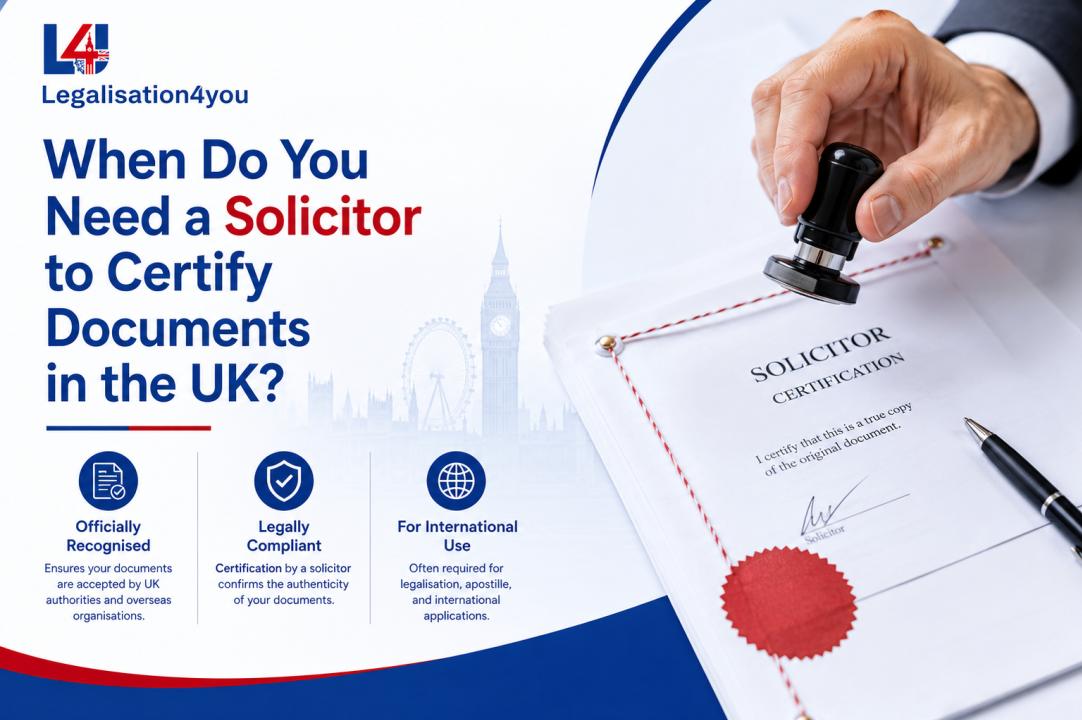
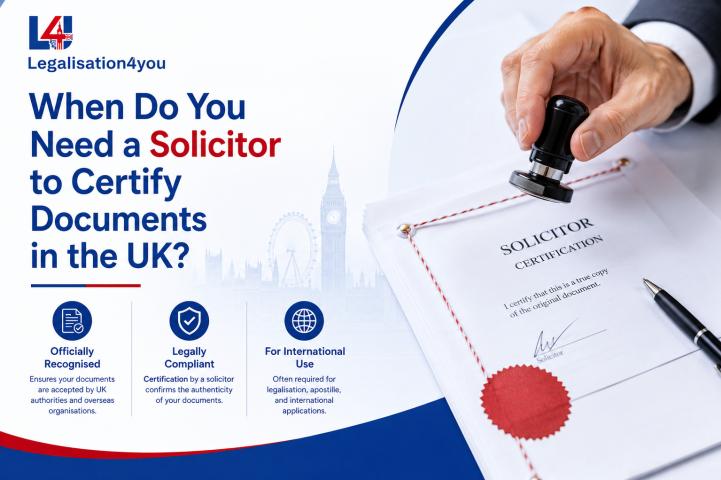
When official documents need to be used for legal, financial, business, or international purposes, you may be asked to provide certified copies rather than ordinary photocopies. In many situations, a solicitor can certify that a copy is a true and accurate reproduction of the original document.
Whether you are applying for a visa, dealing with property matters, setting up a business, completing legal procedures, or preparing documents for overseas use, understanding when a solicitor is required can help you avoid delays and unnecessary complications.
Legalisation4you provides professional document legalisation, Apostille, and related services, helping individuals and businesses prepare UK documents for official and international use.
What Does It Mean to Have a Solicitor Certify Documents?
When a solicitor certifies a document, they confirm that a copy is a true and accurate copy of the original document they have examined.
The solicitor will normally compare the original document with the copy and, if satisfied, certify the copy according to the requirements of the organisation requesting it.
The exact wording and certification requirements can vary depending on the purpose of the document and the organisation receiving it.
If you need to solicitor certify documents, it is important to check what type of certification is required before arranging an appointment. Some authorities may require certification by a solicitor, while others may specifically request a notary public or another authorised professional.
Why Might You Need a Solicitor to Certify Documents?
Certified copies are commonly requested when an organisation needs confirmation that a copy accurately represents an original document.
You may need solicitor-certified documents for:
- Passport or identity verification
- Visa and immigration applications
- Property transactions
- Financial and banking procedures
- Employment applications
- Business registration
- Legal proceedings
- Professional registrations
- Educational applications
- Overseas applications
- Company and corporate documentation
- Certain government procedures
For example, a bank may request a certified copy of your passport as part of an identity verification process. Similarly, an organisation dealing with an overseas application may request certified copies of personal or professional documents.
What Documents Can a Solicitor Certify in the UK?
The documents that can be certified will depend on the requirements of the organisation requesting them and the solicitor's assessment.
Common examples include:
- Passports and identity documents
- Driving licences
- Birth certificates
- Marriage certificates
- Educational certificates
- Degree certificates
- Utility bills
- Bank statements
- Company documents
- Contracts and agreements
- Professional certificates
- Copies of official records
However, certification does not automatically make a document suitable for every purpose. If the document is intended for use overseas, additional steps such as Apostille or embassy legalisation may be necessary.
When Do You Need a Solicitor to Certify Documents?
There are several situations where solicitor certification may be requested.
1. Identity Verification
Banks, financial institutions, employers, and other organisations may request certified copies of identification documents.
A solicitor can examine the original document and certify the copy according to the requirements of the organisation requesting it.
2. Visa and Immigration Applications
Some immigration procedures may require certified copies of passports, identification documents, educational records, or other supporting paperwork.
Before arranging certification, check the exact instructions provided by the relevant immigration authority. Requirements can differ depending on the country and type of application.
3. Property Transactions
Certified documents may be required during property purchases, sales, transfers, or other legal transactions.
For example, an organisation may request a certified copy of identification or another supporting document before proceeding with a transaction.
4. Business and Corporate Matters
Businesses may need certified copies of company documents, identification documents, contracts, or professional certificates when dealing with banks, authorities, partners, or overseas organisations.
Certification can help demonstrate that the copy being submitted corresponds to the original document.
5. Overseas Document Requirements
If a UK document is going to be used abroad, the receiving authority may request a certified copy before the document can proceed to Apostille or legalisation.
This is particularly important when the destination country has specific requirements concerning the certification of documents.
Solicitor Certification vs Apostille
Solicitor certification and Apostille certification are different processes.
A solicitor generally certifies a copy of a document by confirming that it is a true copy of the original they have examined.
An Apostille, on the other hand, is issued by the UK Foreign, Commonwealth & Development Office (FCDO). It verifies the authenticity of a signature, stamp, or seal on a public document or qualifying certification for use in another country that recognises Apostilles.
Therefore, obtaining a solicitor-certified copy does not automatically mean that the document has been Apostilled.
If your document is intended for international use, you should check whether the destination authority requires an Apostille or additional embassy or consular legalisation.
How Does the Process Work?
The process of having documents certified by a solicitor is generally straightforward, but requirements can vary.
1. Check What Certification Is Required
First, determine exactly what the organisation receiving the document requires.
It may request a solicitor-certified copy, a notarised document, an Apostille, or a combination of these services.
2. Prepare the Original Document
Take the original document with you. The solicitor will normally need to see the original before certifying a copy.
Make sure the document is complete, clear, and in good condition.
3. Provide a Copy if Required
Depending on the solicitor's process, you may need to provide a photocopy or the solicitor may make the copy themselves.
The solicitor will compare the copy with the original document.
4. Certification of the Copy
If the solicitor is satisfied that the copy accurately represents the original, they can certify it according to the relevant requirements.
The certification may include the solicitor's details, signature, date, and wording confirming the nature of the certification.
5. Complete Any Additional Legalisation
If the document is intended for use overseas, further steps may be required after certification.
Depending on the destination country, this could include obtaining an Apostille, embassy legalisation, consular legalisation, or certified translation.
Common Mistakes to Avoid
The certification process can become more complicated if the requirements are not checked in advance.
Common mistakes include:
- Assuming every organisation accepts solicitor certification
- Providing a photocopy without the original
- Using an incorrect document
- Failing to check the receiving authority's requirements
- Assuming solicitor certification is the same as an Apostille
- Forgetting additional embassy legalisation
- Overlooking translation requirements
- Leaving certification until the last minute
Checking the requirements before submitting your documents can help prevent unnecessary delays.
How Long Does Solicitor Certification Take?
The time required to certify documents can vary depending on the solicitor, the number of documents, and the complexity of the requirements.
Straightforward certification may be completed relatively quickly, while documents requiring additional legalisation or international processing may take longer.
If your documents are needed for a visa application, overseas property transaction, university application, or other deadline-sensitive matter, it is sensible to begin the process as early as possible.
Why Choose Legalisation4you?
Legalisation4you helps individuals and businesses prepare UK documents for official and international use through professional Apostille, legalisation, and document support services.
Our team can assist customers who need to solicitor certify documents and determine whether further steps may be required for their intended use.
Our services can include:
- Document assessment
- Apostille services
- Document legalisation
- Embassy legalisation assistance
- Certified translation support
- Guidance on international document requirements
- Secure document handling
- Professional customer support
Whether you need certified documents for an overseas application, business procedure, legal matter, or personal requirement, obtaining the correct certification can make the process more straightforward.
Get Your Documents Ready for Official Use
Knowing when you need a solicitor to certify documents can help you prepare your paperwork correctly and avoid unnecessary delays. Certification may be required for identity checks, immigration applications, property transactions, business matters, and various international procedures.
However, solicitor certification is not the same as Apostille or embassy legalisation. The correct process depends on the document, its intended purpose, and the requirements of the organisation or country where it will be used.
Legalisation4you provides professional support with Apostille and document legalisation requirements, helping individuals and businesses prepare UK documents for use in the UK and overseas.
If you need assistance with document certification, Apostille, or legalisation, Contact Legalisation4you to discuss your requirements and find the appropriate solution.
Frequently Asked Questions
1. What does it mean to have a solicitor certify documents?
It generally means that a solicitor has examined an original document and certified a copy as being a true and accurate copy of that original.
2. Can a solicitor certify a copy of my passport?
A solicitor may be able to certify a copy of your passport, depending on the requirements of the organisation requesting the document.
3. Is solicitor certification the same as an Apostille?
No. Solicitor certification confirms the relationship between an original document and its copy, while an Apostille is issued by the FCDO to authenticate a qualifying signature, stamp, or seal for international use.
4. Do I need an Apostille after solicitor certification?
It depends on the document and the requirements of the destination country. Some documents may require further certification or legalisation before they can be accepted overseas.
5. Can Legalisation4you help with certified documents?
Legalisation4you provides professional Apostille, document legalisation, and related support services for individuals and businesses preparing documents for official or international use.