Market Overview
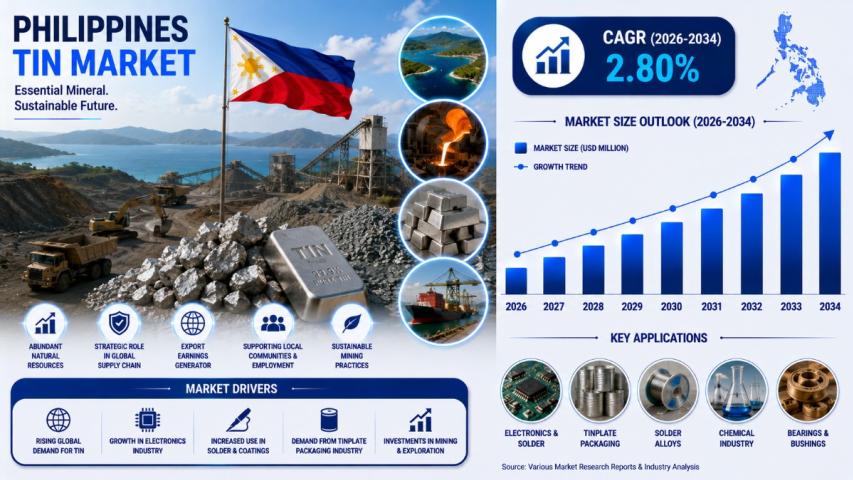
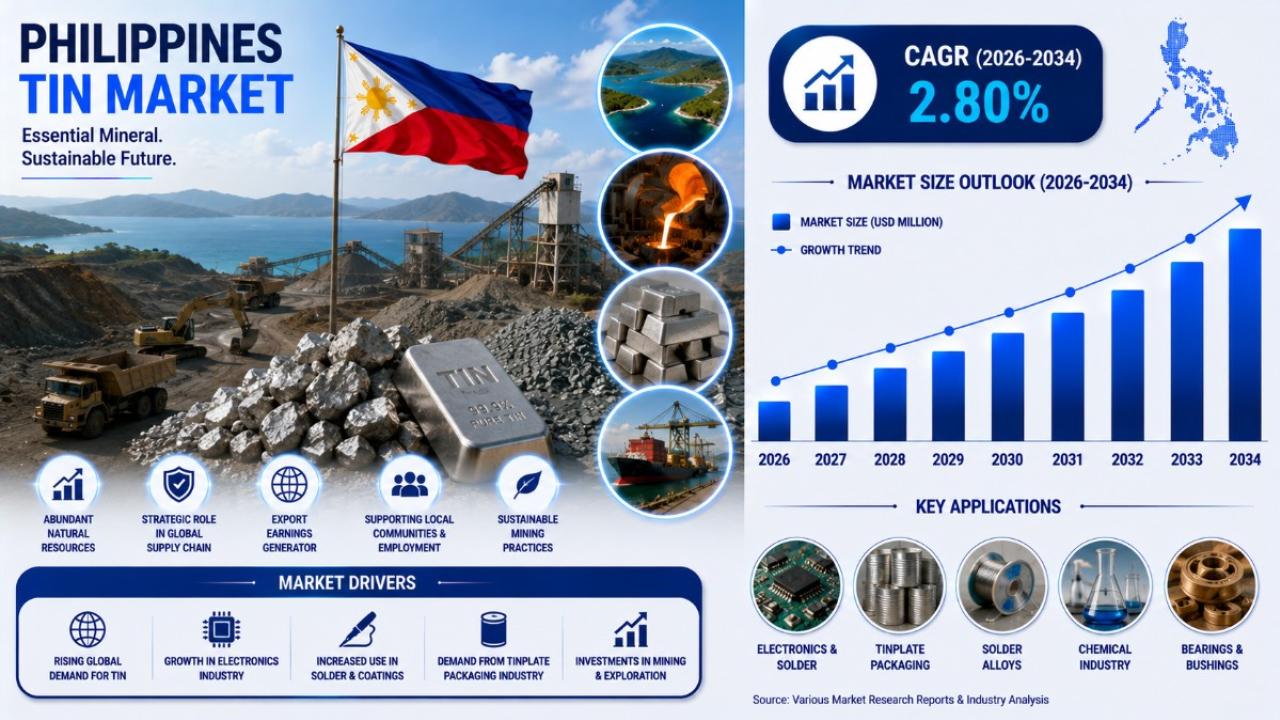
The Philippines tin market size reached 1.91 Kilo Tonnes
in 2025 and is projected to reach 2.46 Kilo Tonnes by 2034, growing
at a compound annual growth rate (CAGR) of 2.80% from 2026 to 2034. The
market is driven by expanding electronics manufacturing activities, increasing
adoption of tin-based soldering materials in consumer electronics and
automotive applications, growing demand from the food packaging sector, rising
industrial development and infrastructure investments, and technological
advancements in tin processing and alloy production.
Request a Sample Report for In-Depth Market Insights: https://www.imarcgroup.com/philippines-tin-market/requestsample
Philippines Tin Market Summary
- The
Philippines tin market encompasses a range of products, including metal,
alloy, and compounds, serving applications across soldering, tin plating,
chemicals, and others, and end-use industries including automotive,
electronics, packaging (food and beverages), glass, and others.
- These
products are valued for their role in enabling electronics manufacturing,
providing corrosion-resistant coatings, supporting food safety through
tin-plated steel containers, and facilitating industrial processes across
diverse application categories.
- The
ecosystem includes regional processors, international trading entities,
specialized industrial suppliers, electronics manufacturers, automotive
component producers, and packaging companies across Luzon, Visayas, and
Mindanao.
- Major
segments identified in the market include product type (metal, alloy,
compounds), application (soldering, tin plating, chemicals, others),
end-use industry (automotive, electronics, packaging, glass, others), and
region (Luzon, Visayas, Mindanao).
- The
market is benefiting from expanding electronics manufacturing and export
activities, growing automotive sector and vehicle electronics integration,
rising demand from food and beverage packaging applications, and strategic
investments in domestic processing capabilities.
- In
November 2025, the government temporarily reduced import duty on key
tin-mill blackplate materials to stabilize supply chains and support local
tin plate manufacturing for the food packaging industry.
Porter's Five Forces Analysis
- Competitive
Rivalry: Moderate, with established regional processors competing
alongside international trading entities across various industrial
segments and application categories. Market participants differentiate
through product quality specifications, supply chain reliability,
technical expertise, and strategic distribution networks. Business
implication: Companies must differentiate through quality,
reliability, and technical support.
- Supplier
Power (Tin Material Suppliers): High. The Philippines relies
significantly on imported tin materials to meet domestic industrial
requirements, creating exposure to international supply disruptions, price
volatility, and logistics challenges. Limited domestic tin mining and
refining capacity necessitates dependence on external suppliers. Business
implication: Processors should diversify sourcing and invest in
domestic processing capabilities.
- Buyer
Power (Electronics and Industrial Manufacturers): High. Buyers have
extensive choice across domestic processors and international suppliers,
with growing awareness of quality specifications, compliance requirements,
and pricing competitiveness. Business implication: Providers must
focus on quality, reliability, and technical support to build loyalty.
- Threat
of Substitutes: Moderate. Tin faces competitive pressure from
alternative materials including aluminum packaging, polymer-based
solutions, and emerging interconnection technologies. Ongoing research
into conductive adhesives and alternative soldering approaches presents
potential long-term substitution risks. Business implication: The
industry should emphasize performance benefits, compliance advantages, and
reliability.
- Threat of New Entrants: Moderate. Higher barriers for established players (processing infrastructure, quality certifications, distribution networks), but lower barriers for niche and specialized entrants. Business implication: Established players should build defensible positions through quality, certifications, and customer relationships.
Market Growth Drivers
Expanding Electronics Manufacturing and Export Activities
The Philippines maintains a robust electronics manufacturing
sector representing a significant contributor to national export revenues and
industrial employment. Major international electronics brands utilize
Philippine manufacturing facilities for producing consumer devices, computing
equipment, and electronic components destined for global markets. As per
sources, in November 2025, Samsung Electro-Mechanics Philippines announced a PhP50.7
Billion investment to expand its high-technology manufacturing facility in
Laguna, reflecting stronger electronics production and downstream demand for
tin-based solder materials. Moreover, this manufacturing concentration
generates substantial demand for tin-based soldering materials essential in
circuit board assembly processes. In 2025, the Philippine government
established a Semiconductor and Electronics Industry Advisory Council to
accelerate electronics manufacturing and strengthen global competitiveness, directly
supporting downstream demand for tin-based solder materials.
Growing Automotive Sector and Vehicle Electronics Integration
The Philippine automotive industry demonstrates steady
expansion, driven by increasing domestic vehicle ownership and manufacturing
investment. Modern automobiles incorporate extensive electronic components
requiring tin-based solder connections for engine management systems,
infotainment units, and safety systems. The proliferation of advanced
driver-assistance features and connected vehicle technologies amplifies tin
consumption per vehicle unit. Domestic automotive assembly operations generate
incremental demand for high-quality tin materials meeting automotive-grade
specifications. As per sources, in December 2024, Toyota Motor Philippines
invested ₱5.5 Billion to revive Tamaraw production, strengthening local
automotive parts manufacturing and enhancing the national automotive value
chain.
Rising Demand from Food and Beverage Packaging Applications
The Philippine food and beverage industry demonstrates sustained growth, driven by expanding population and rising disposable incomes. Tin-plated steel containers offer superior corrosion resistance, food safety properties, and extended shelf-life characteristics valued by manufacturers and consumers alike. Growing urbanization and changing life>
Integration of Advanced Tin Alloy Technologies
Industrial manufacturers across the Philippines are
increasingly incorporating advanced tin alloy formulations designed for
specialized applications in electronics, automotive, and aerospace sectors. As
per sources, in September 2025, the Department of Science and Technology opened
its 7th Advanced Manufacturing Center in Laguna to support additive
manufacturing, materials development, and advanced industrial components,
strengthening innovation capacity for high-technology manufacturing.
Furthermore, these sophisticated material compositions offer enhanced thermal
performance, improved mechanical strength, and superior conductivity
characteristics compared to conventional alternatives. Research institutions
and manufacturing facilities are collaborating to develop proprietary alloy
blends addressing specific industrial requirements.
Philippines Tin Market Segmentation
Product Type Insights:
- Metal
- Alloy
- Compounds
Application Insights:
- Soldering
- Tin
Plating
- Chemicals
- Others
End-Use Industry Insights:
- Automotive
- Electronics
- Packaging
(Food and Beverages)
- Glass
- Others
Regional Insights:
- Luzon
- Visayas
- Mindanao
Competitive Landscape
The Philippines tin market features a moderately fragmented
competitive structure characterized by the participation of established
regional processors, international trading entities, and specialized industrial
suppliers serving diverse end-use segments. Market participants differentiate
through product quality specifications, supply reliability, technical support
capabilities, and pricing competitiveness across various application
categories. Distribution networks and customer relationships developed over
extended operating periods provide competitive advantages for established
market participants. The competitive environment encourages continuous
improvement in processing efficiency, quality control systems, and customer
service responsiveness. Strategic partnerships between domestic processors and
international suppliers enhance material availability and market reach.
Key players mentioned in the report context include:
- Established
regional processors and international trading entities are competing
across various industrial segments and application categories,
differentiating through product quality specifications, supply chain
reliability, technical expertise, and strategic distribution networks.
- Market
participants are investing in expanding domestic processing and refining
capabilities to enhance value-added production, upgrading facilities to
produce refined tin products meeting international quality specifications
while reducing dependence on imported processed materials.
Regional Analysis
- Luzon:
The dominant region with a 48% share in 2025, driven by
concentrated industrial activity, superior infrastructure development, and
proximity to major commercial centers. Metro Manila and surrounding
industrial zones host numerous electronics manufacturing facilities,
automotive component producers, and packaging operations representing
primary tin consumption centers. Established transportation networks,
reliable utilities infrastructure, and access to skilled workforce
populations support manufacturing competitiveness. Special economic zones
within Luzon attract foreign investment in electronics and industrial
manufacturing.
- Visayas:
A growing market driven by increasing industrialization, expanding
electronics and automotive manufacturing, and growing demand for tin-based
materials across diverse applications. The region benefits from improving
infrastructure and growing investment in manufacturing facilities.
- Mindanao:
An emerging market with growing tin demand, supported by improving
industrial infrastructure and increasing investment in manufacturing
activities. The region presents significant long-term potential as
industrial development expands beyond Luzon.
Recent Industry Developments
September 2026: The Philippines strengthened its critical-minerals policy through Executive Order 122, directing the government to identify new mineral deposits, streamline mining permits and promote domestic processing. The policy aims to move the industry from raw-ore exports toward value-added processing and manufacturing, potentially creating opportunities across the country’s broader non-ferrous metals and mineral supply chains.
August 2026: Philippine metallic mineral production value reached ₱202.18 billion in the first half of 2026, increasing 41% year-on-year. Although gold and nickel accounted for most output value, the strong overall mining performance highlights improving commodity-market conditions and continued investment potential across the country’s mineral-processing sector.
July 2026: Philippine merchandise exports reached US$8.15 billion, increasing 10.8% year-on-year. Electronic products remained the country’s largest export category, accounting for US$4.30 billion or 54.6% of total exports. Continued electronics expansion is relevant to tin demand because tin-based solder is widely used in electronic component and circuit-board manufacturing.
June 2026: The Philippines recorded ₱82.78 billion in metallic mineral production during the first quarter of 2026, up 28.6% year-on-year. While production volumes for several metals declined, higher commodity prices lifted overall output value. The government and mining industry continued emphasizing responsible mining, processing investments and stronger domestic mineral value chains.
May 2026: The Mines and Geosciences Bureau conducted a Mobile One-Stop Shop in Camarines Norte to formalize small-scale mining operations, attracting around 800 participants from mining groups, government agencies and local communities. The initiative supports regulated and responsible mining while simplifying access to government services and strengthening formal participation in the Philippines’ mineral industry.
Key Aspects Required for the Philippines Tin Market
- Market
Performance: 1.91 Kilo Tonnes in 2025, with a projected trajectory to
2.46 Kilo Tonnes by 2034.
- Market
Outlook: A 2.80% CAGR through 2034 indicates steady growth across
product types, applications, end-use industries, and regions, driven by
electronics manufacturing, automotive electronics integration, food
packaging demand, and industrial development.
- Growth
Drivers: Expanding electronics manufacturing and export activities;
growing automotive sector and vehicle electronics integration; rising
demand from food and beverage packaging applications; integration of
advanced tin alloy technologies; expansion of domestic tin processing
capabilities; and transition toward lead-free soldering solutions.
- Competitive
Landscape: A moderately fragmented market with established regional
processors, international trading entities, and specialized industrial
suppliers. Differentiation occurs through product quality, supply chain
reliability, technical expertise, and distribution networks.
- Value
Chain Analysis: From raw material sourcing and tin processing through
distribution and industrial applications to end-use in electronics,
automotive, packaging, and other sectors, with vertical integration and
quality improvement trends shaping market dynamics.
- Industry
Trends: Transition toward lead-free soldering solutions; integration
of advanced tin alloy technologies; expansion of domestic tin processing
capabilities; growing demand for high-purity refined tin; and increasing
focus on supply chain resilience and import substitution.
- Strategic
Recommendations: Invest in domestic processing and refining
capabilities; expand lead-free solder production; develop advanced tin
alloy formulations; strengthen supply chain resilience through diversified
sourcing; and focus on quality certifications and technical support for
electronics and automotive customers.
Note: If you need any specific information that is not currently covered within the scope of the report, we will provide the same as a part of customization.
Speak to an analyst: https://www.imarcgroup.com/request?type=report&id=42137&flag=C
Report Format, Delivery, and Customization Details
- Report
Format Mode: PDF and Excel (Editable version in PPT/Word format
available on special request)
- Report
Delivery Mode: Online Delivery, Physical Delivery
- Report
Delivery Time: The report is delivered over email within 24 to 48
hours. If requested by the client, a physical copy will be delivered
within three to ten days.
- Report
Confirmation Mode: Yes, via email
- Report
Customization Mode: Yes, via Email / Call
- Report
Table of Content: Yes
- Report
List of Figures: Yes
- Report
Methodology Mode: Yes
- Request
For Sample Report: Yes