The quickest way to check a bearing’s health is to check its temperature. Temperature reflects friction, oil film health, load, and cooling all at once. That is why people searching for a white metal bearing temperature limit often expect a single, tidy number.
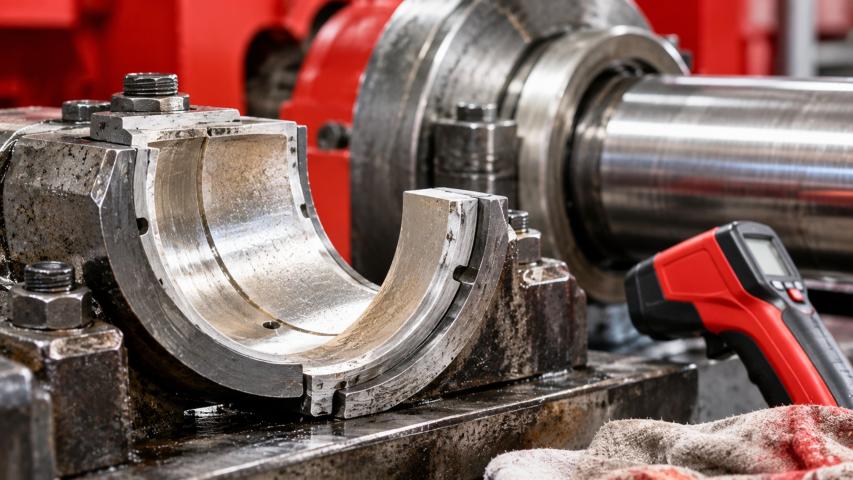
The honest answer is that there isn’t one. White metal bearings, are metal shells lined with a soft tin- or lead-based alloy, often called babbitt. They are used in turbines, compressors, large engines, pumps, gearboxes, and marine engines where they carry heavy loads on a thin film of oil. If you want a wider introduction to where they are used and why, our earlier piece on the evolution and impact of white metal bearings across sectors covers that ground.
This article focuses on which temperatures are acceptable for white metal bearings, which are not, and how to tell the difference.
Why temperature is the first thing to watch
A healthy white metal bearing runs on a film of oil that keeps the shaft and the soft lining apart. Almost every problem that threatens that film, whether too little oil, dirty oil, too much load, or poor cooling, ends up as extra heat. Often the temperature climbs well before you hear a noise or feel vibration.
Heat also makes things worse by itself. Oil thins as it warms; the film gets thinner, and the lining gets softer and weaker. A small rise can therefore turn into a damaging one if nobody acts.
Different Temperature Ranges
Normal, alarm, and damage are three different numbers. Much of the confusion comes from treating three separate ideas as one.
Normal operating temperature is what this particular machine reaches when it is healthy, at a given load and ambient temperature. A bearing that settles at 55 °C every day is normal at 55 °C, even if a generic table says 80 °C is acceptable.
Alarm and trip settings are the thresholds chosen to give you time to react. They sit above normal and well below the point of damage. For tin-based Babbitt, a commonly quoted rule of thumb for a sensor embedded in the bearing metal is a high-normal reading near 80 °C, an alarm near 90 °C, and a trip near 100 °C. A reliability study from EPRI mentions an alarm setpoint of about 85 °C (185 °F) for turbine applications. Treat any such figure as a starting point, not a specification, and confirm the right value, and where it is measured, against your equipment manual and the bearing supplier’s data.
Damage limits are where the lining itself suffers. Some references cite about 130°C (266°F) as a maximum operating temperature for Babbitt, though the real limit depends on the alloy and design. Melting happens at far higher temperatures: for a common tin-based grade (ASTM B23 Grade 2), at roughly 240 °C, with the alloy fully liquid near 350 °C, but the alloy loses strength long before that, and in practice oil breakdown and falling oil viscosity become the first concern.
Industry standards show how application-specific this is. For centrifugal compressors, API 617 allowed bearing and lube oil temperatures up to 212 °F (100 °C) until its 7th edition, and the 8th edition tightened this to 200 °F (about 93 °C) to match other API machinery standards. Engineers writing in Turbomachinery Magazine caution that a fixed number from a generic specification should not replace the manufacturer’s experience and the actual design.
Factors Affecting White Metal Bearing Operating Temperature
Two healthy bearings can run at very different temperatures. The main reasons:
- Alloy and bearing design. Tin-based and lead-based Babbitts behave differently under heat, and a tilting-pad bearing sheds heat differently from a plain sleeve. Also, copper-chrome carries heat away better than steel, so a bearing built on it runs cooler. Clearance, lining thickness, and how well the bearing seats in its housing matter too, because a poor fit slows the flow of heat out of the bearing.Load and speed. More load or more shaft speed means more friction heat. The same bearing runs cooler at part load than at full load.
- Lubrication and cooling. Oil is both the film and the coolant. Its grade, supply temperature, and flow rate decide how much heat it carries away. Oil also thins as it warms, which weakens the film. A hot summer afternoon, a blocked cooler, or a housing that cannot shed heat will push every reading up.
- Where the temperature is measured. The same bearing gives different numbers depending on whether the sensor sits in the bearing metal, in the oil or on the housing. A probe embedded in the Babbitt, close to the loaded zone, shows the hottest conditions. Oil outlet temperature is lower and slower to react. Oil leaving the bearing has passed through both hot and cool areas and mixes at the outlet, so its temperature is an average. A housing or casing reading is lower still.
Thus, a limit set for bearing metal would give a late warning if applied to a housing sensor, while a limit meant for the oil inlet would trigger false alarms if applied to the metal.
A bearing manufacturer can give you the details these readings depend on: alloy grade, lining thickness, running clearance, and recommended sensor position.
Common Causes of White Metal Bearing Overheating
When a bearing runs hotter than its own history, these are the usual suspects:
- Inadequate lubrication. A clogged filter, a blocked feed line, a weak pump, or a low oil level starves the film, while the wrong viscosity or air bubbles in the oil thin it. Contaminated or degraded oil. Dirt, water, or old oil weakens the film. Soft Babbitt can also trap hard particles, which then score the shaft and the lining.
- Excessive load. Running above the design rating, or a process change that adds thrust, pushes the film thinner.
- Misalignment. If the shaft sits at an angle, the load concentrates on one edge and creates a local hot spot even when the average reading looks fine.
- Restricted cooling. A fouled oil cooler, low cooling water flow, or poor ventilation raises oil temperature everywhere.
- Changed operating conditions. A new duty cycle, a different oil grade, or a hotter plant room can quietly shift the baseline. A pump moved to a tougher job without a review of its alarm settings is a typical case: readings creep up, the alarm is raised to stop nuisance trips, and the real safety margin quietly disappears.
The warning signs tend to arrive together: a steady upward trend, one bearing running hotter than its twin, falling oil pressure, rising vibration, discolored oil, or metal specks in the oil filter and fine metallic particles in the oil analysis report.
Practical Bearing Temperature Monitoring
Good bearing temperature monitoring is less about a clever sensor and more about habit.
- Record a baseline. Record readings once the machine has warmed up and settled, noting the load, speed, and oil inlet temperature, and repeat across different loads and seasons. Without that context, a number like 85 °C tells you very little.
- Watch the trend, not just the number. A reading that climbs steadily over days is more worrying than a stable reading that is simply higher than a neighbor’s. How fast the reading rises matters too, and on a multi-pad bearing, so does one sensor drifting away from the others.
- Compare readings. Check bearing metal against oil outlets and against similar machines.
- Set alarms from the machine. Use the equipment manufacturer’s limits as the ceiling, then place alerts above your own baseline so there is time to investigate, allowing for normal variation and for sensor lag during start-ups.
When a reading looks wrong, check the sensor and its wiring before assuming the bearing is failing, then look at oil flow, oil pressure, drain oil temperature, cooler performance, neighboring sensors, and recent load changes. If the cause is not obvious, reduce load or stop the machine following the manufacturer’s procedure instead of waiting to see what happens. Keep oil samples and filter debris, and avoid changing setpoints or oil flow on a hunch.
Preventive Steps that Keep Temperatures in Range
Most overheating is avoidable: keep oil clean and at the right level, clean coolers before they restrict flow, and check alignment and sensor calibration after maintenance.
Dimensional accuracy, a sound bond between the lining and its backing, and a suitable alloy for the load and temperature all affect how a bearing behaves in service. When you are specifying a replacement, a good bearing manufacturer will ask about your load, speed, oil system, and operating temperatures instead of quoting a universal limit.
Know Your White Metal Bearing Temperature Limit Before the Bearing Tells You.
There is no universal safe temperature for white metal bearings. Safe operation comes from knowing your machine’s normal range, setting alarms and trip points from the bearing manufacturing company documentation, being clear about where each temperature is measured, and acting on trends before they become failures.
Use generic figures as rough guides, and let the equipment manual and your own operating history make the final call.