Calculating the right amount of concrete is essential to saving money, avoiding waste, and ensuring a successful pour. Whether you're laying a driveway slab, building a footing for a wall, or pouring a concrete walkway, one of the most common questions asked by homeowners and contractors alike is: “How do I calculate yards of concrete accurately—without overordering?”
In this comprehensive guide, we'll break down the formulas, provide real-life examples, and share tips to help you calculate concrete yardage confidently for different types of projects, if you want to protect your privacy ,you can use Temp Mail.
🧮 Why Concrete Is Measured in Cubic Yards
Concrete is measured in cubic yards because it’s sold by volume, not by weight or surface area. A cubic yard is a cube that is 3 feet long, 3 feet wide, and 3 feet tall—or 27 cubic feet total.
So when you're ordering concrete, you’re essentially buying volume: the amount of space your slab, footing, or walkway will occupy once it's poured.
📐 Basic Concrete Volume Formula
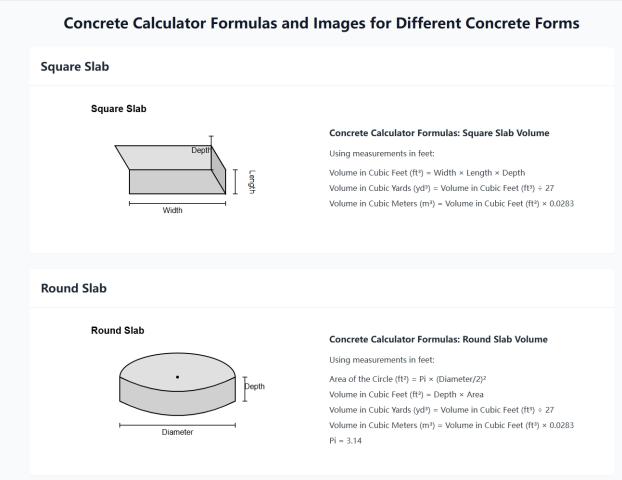
The universal formula to calculate volume in cubic feet is:
Length × Width × Depth = Cubic Feet
Then, to convert cubic feet into cubic yards:
Cubic Feet ÷ 27 = Cubic Yards
✅ Pro Tip: Always convert inches to feet before calculating. For example, 4 inches = 0.333 feet.
🧱 Calculating Concrete for a Slab
Let’s say you’re pouring a 10 ft × 12 ft driveway slab that is 4 inches thick.
Step-by-Step:
-
Convert thickness to feet:
4 inches ÷ 12 = 0.333 feet -
Calculate cubic feet:
10 × 12 × 0.333 = 39.96 cubic feet -
Convert to cubic yards:
39.96 ÷ 27 = 1.48 cubic yards
So you’ll need approximately 1.5 yards of concrete. Always round up slightly to accommodate waste, spillage, and minor miscalculations. In this case, ordering 1.75 cubic yards would be safe.
🧱 Calculating Concrete for Footings
Footings are narrower but often deeper than slabs. Assume you’re pouring a 20-foot-long footing that’s 1 foot wide and 2 feet deep.
-
Length × Width × Depth:
20 × 1 × 2 = 40 cubic feet -
Convert to cubic yards:
40 ÷ 27 = 1.48 cubic yards
Again, rounding up to 1.75 yards is smart, especially because footings often vary in depth due to uneven ground.
🏃♂️ Calculating Concrete for Walkways
Walkways are often long and relatively thin. Assume a 30-foot-long walkway that’s 3 feet wide and 4 inches (0.333 feet) thick:
-
30 × 3 × 0.333 = 29.97 cubic feet
-
29.97 ÷ 27 = 1.11 cubic yards
You’ll likely need 1.25–1.5 cubic yards depending on your site's specifics.
⚠️ Common Mistakes That Lead to Overordering
Even experienced builders can overorder if they’re not cautious. Here are common pitfalls:
-
Ignoring depth variations: Ground isn’t always level. Add 10% to your total if the area is uneven.
-
Not rounding up properly: Underordering is just as bad. But don’t add a full yard “just in case” unless needed.
-
Failing to account for waste: Spillage, overfill, and form leakage are real. Add 5-10% to your calculation for safety.
✅ Tips to Order the Right Amount Without Overordering
-
Use a Concrete Calculator
Tools like Concrete Calculator make the math simple and fast. You just input dimensions and get a reliable estimate instantly. -
Break Complex Shapes into Sections
For odd shapes, divide them into rectangles and triangles, calculate separately, then sum up the volumes. -
Always Round Up, But Strategically
Concrete is often sold in quarter-yard increments. If your calculation is 2.15 yards, round to 2.25 or 2.5—not 3. -
Consult Your Supplier
Concrete companies often help fine-tune your estimate. They may suggest less or more depending on truck capacity and delivery method. -
Be Precise With Your Forms
Well-leveled and tightly formed projects reduce the risk of needing more concrete than estimated.
🛠 Real-Life Example: Slab + Walkway Combo
You’re building a 12×12 patio slab (4" thick) and a 3×20 walkway (4" thick):
Patio:
-
12 × 12 × 0.333 = 47.95 ft³ → 1.78 yd³
Walkway:
-
3 × 20 × 0.333 = 19.98 ft³ → 0.74 yd³
Total:
-
1.78 + 0.74 = 2.52 cubic yards
-
Add 10% safety margin = 2.77 cubic yards
-
Recommended order: 3 cubic yards
🧾 Ordering and Delivery Tips
-
Minimum Delivery Quantities: Some companies have a 1-yard or 2-yard minimum.
-
Short Load Fees: If you order less than a full truck, you may pay extra.
-
Mix Type: Be sure to specify the right PSI strength and slump (consistency) for your project.
📌 Final Thoughts
Accurate concrete calculations are the foundation of a smooth project. Whether you’re laying a backyard slab or building structural footings, knowing how to calculate yards of concrete not only saves you money but also ensures your pour goes without a hitch.
By understanding the formulas, applying real-world tips, and using online tools like the Concrete Calculator, you can avoid overordering, reduce waste, and finish your concrete project with confidence.