In today’s competitive academic environment, understanding and tracking your Grade Point Average (GPA) is more than a formality—it’s a strategic necessity. Whether you're applying for college, seeking scholarships, or maintaining eligibility for academic honors, a reliable GPA calculator in 2025 can be your most valuable tool. Yet, many students still struggle with how to use it accurately. In this blog post, we’ll guide you through the process of calculating both weighted and unweighted GPAs using a GPA calculator, explore real-world case studies, and explain how these numbers can significantly impact your future academic and professional opportunities.
Problem: Students Are Confused About GPA Calculation
Despite its importance, the process of calculating GPA remains unclear to many. Should you include AP or honors classes? What’s the difference between weighted and unweighted GPA? How do semester credits affect your GPA? Misunderstanding these elements can lead to misjudging your academic standing, resulting in lost opportunities—from scholarships to early admissions. This confusion only deepens in 2025 as more schools adopt diverse grading scales, dual enrollment programs, and alternative assessment formats.
Case in Point: A high school junior, Emily, applied for a merit-based scholarship that required a minimum 3.75 GPA. She thought her GPA met the threshold, but when recalculated correctly using a weighted GPA calculator, it was only 3.68. The missed opportunity cost her a $10,000 scholarship.
Agitation: Why Incorrect GPA Estimates Can Cost You
A miscalculated GPA is not just a number—it’s a missed chance. When applying to competitive universities or scholarships in 2025, the difference between a 3.6 and 3.8 GPA could mean the difference between acceptance and rejection. Furthermore, many institutions now rely on automated tools to verify self-reported GPAs, and inconsistencies can raise red flags.
What’s at Stake?
-
College Admissions: Admissions officers may weigh GPA more heavily than standardized tests.
-
Scholarships and Grants: Many awards have strict GPA cutoffs.
-
Academic Honors: Valedictorian, Dean’s List, and other honors depend on GPA precision.
-
Internship Eligibility: Certain academic programs and internships filter candidates based on GPA requirements.
In short, relying on guesswork or outdated methods to estimate your GPA can seriously hinder your academic trajectory.
Solution: Using a GPA Calculator the Right Way in 2025
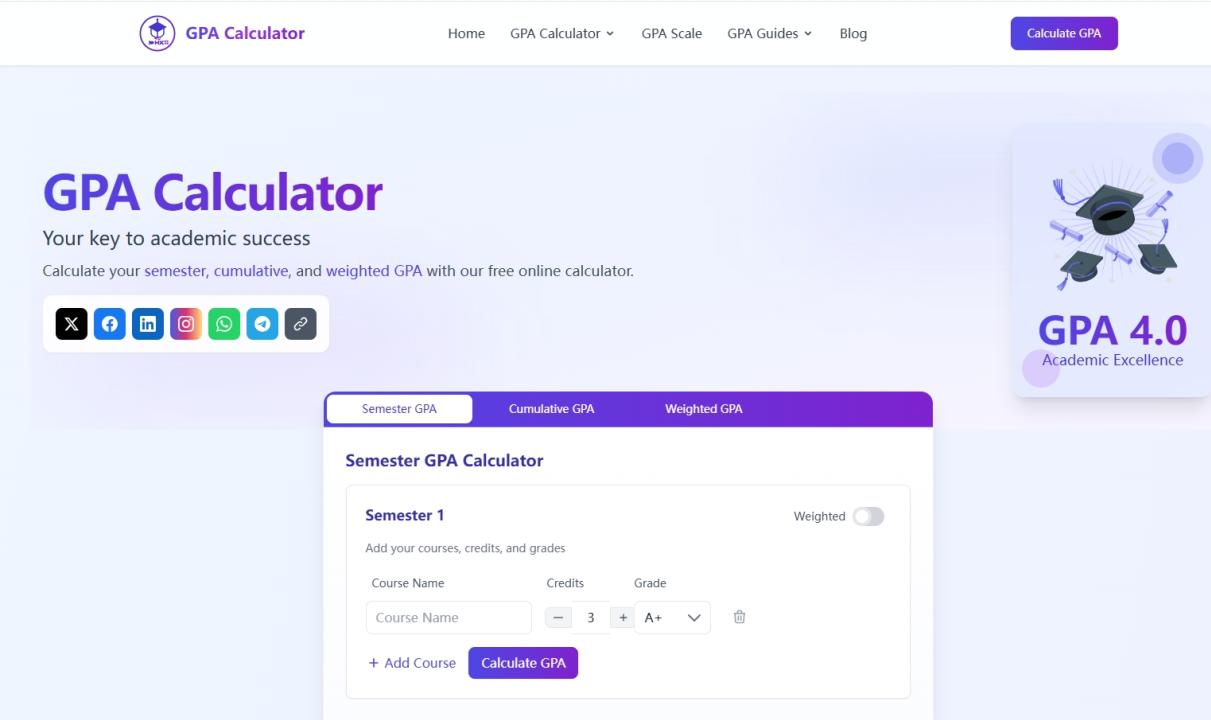
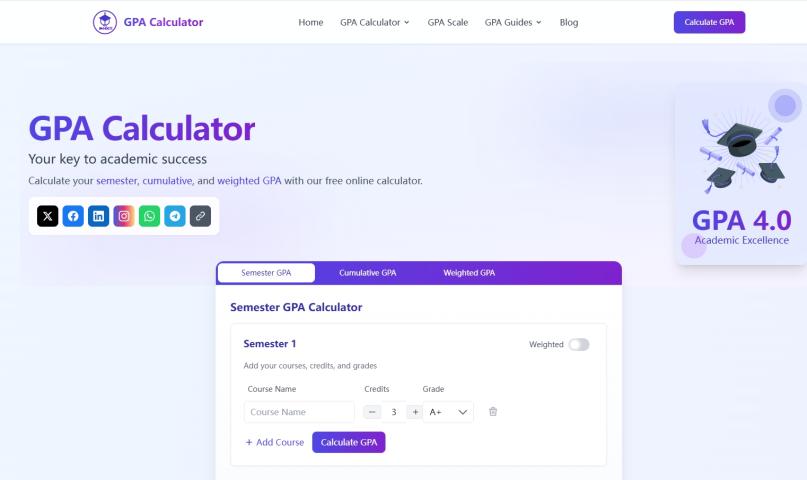
With modern GPA calculators in 2025, students can now accurately calculate their academic performance using dynamic, user-friendly platforms that accommodate various grading scales, weighted courses, and credit hours.
Step-by-Step: How to Use a GPA Calculator
-
Gather Your Grade Data:
Collect your report card or transcript with course names, grades, and credit hours (if applicable). -
Understand the Scale:
GPA scales vary. Most use a 4.0 scale, but honors/AP/IB classes can push this to 5.0 or even 6.0. -
Choose the Right Calculator:
-
Use an unweighted GPA calculator if your school uses the standard 4.0 scale.
-
Use a weighted GPA calculator if your school gives extra points for advanced courses.
-
For colleges, try a college GPA calculator that incorporates credit hours.
-
-
Enter the Data Correctly:
Input each class, grade (A, B+, etc.), and credit value. Many modern calculators automatically convert letter grades to grade points. -
Calculate and Verify:
Most calculators will show both semester and cumulative GPA. Verify the output with at least one manual calculation for accuracy.
Real-World Case Study: GPA Accuracy and Ivy League Admission
Name: Daniel Lee
High School: Magnet STEM School, California
Objective: Apply to MIT and Stanford (Fall 2025)
Challenge: Daniel took 8 AP courses across two years. His self-calculated GPA was 3.82 (unweighted), but using a weighted GPA calculator, it showed 4.27.
Outcome:
After correctly calculating his GPA and including weighted scores, Daniel qualified for multiple high-tier scholarship opportunities and was accepted into MIT. His accurate use of a GPA calculator gave him an edge in demonstrating academic rigor—something unweighted GPAs alone couldn’t reflect.
Understanding the Difference: Weighted vs. Unweighted GPA
| Type | Scale | Includes Honors/AP? | Impact |
|---|---|---|---|
| Unweighted GPA | Max 4.0 | No | Good for internal class rank |
| Weighted GPA | Max 5.0+ | Yes | Reflects course difficulty |
| Cumulative GPA | Varies | Yes/No | Total GPA across semesters |
In 2025, more high schools now report both weighted and unweighted GPAs to provide a full academic picture. Understanding which one matters for your goal—college, internship, honors—is essential.
GPA Calculators for College Students
College students often deal with more complex GPA structures involving course credit hours. A modern college GPA calculator in 2025 includes:
-
Credit Hour Weighting: A 4-credit class affects GPA more than a 2-credit one.
-
Major vs. Cumulative GPA: Some programs track both your overall and major-specific GPAs.
-
Grade Replacement Policies: Some universities allow grade replacement if you retake a class—GPA calculators often account for this.
Example:
Sarah, an undergraduate in biomedical engineering, used a GPA calculator to model how retaking one class could improve her GPA from 2.98 to 3.25—making her eligible for the Dean’s List in the final semester.
Choosing the Best GPA Calculator in 2025
Here are top features to look for:
-
✅ Custom grading scale (e.g., 4.0, 5.0, percentage)
-
✅ Mobile compatibility
-
✅ Support for pass/fail and AP classes
-
✅ Semester-by-semester GPA tracking
-
✅ Forecasting tools to simulate future grades
Recommended Tool:
➡️ GPA Calculator by Concrete GPA – Offers both high school and college options, including weighted GPA tools and credit-hour customization.
Frequently Asked Questions (FAQs)
Q: Can I use a GPA calculator for dual enrollment courses?
A: Yes. Ensure the calculator supports custom credit weighting and includes college-level grade conversion.
Q: Do colleges recalculate GPA differently?
A: Many colleges have internal formulas to standardize GPAs across various school systems, often emphasizing core courses and removing electives.
Q: Will a 3.5 GPA get me into a good college?
A: Possibly. A 3.5 GPA is considered strong, especially if accompanied by AP classes or high test scores. Always look at the full application profile.
Conclusion: Mastering GPA Calculation Is a 2025 Must-Have Skill
As academic standards continue to evolve, mastering how to calculate and interpret your GPA using a modern GPA calculator(https://gpa-calculator.app/) is more critical than ever. The right tool not only helps you assess your current standing but can also guide strategic course selection, retake decisions, and scholarship applications. In 2025, where GPA is often the first metric reviewed by decision-makers, getting it right is no longer optional—it’s essential.